DbcultAccessing Vault...
Cult Review
Senior Film Conservator
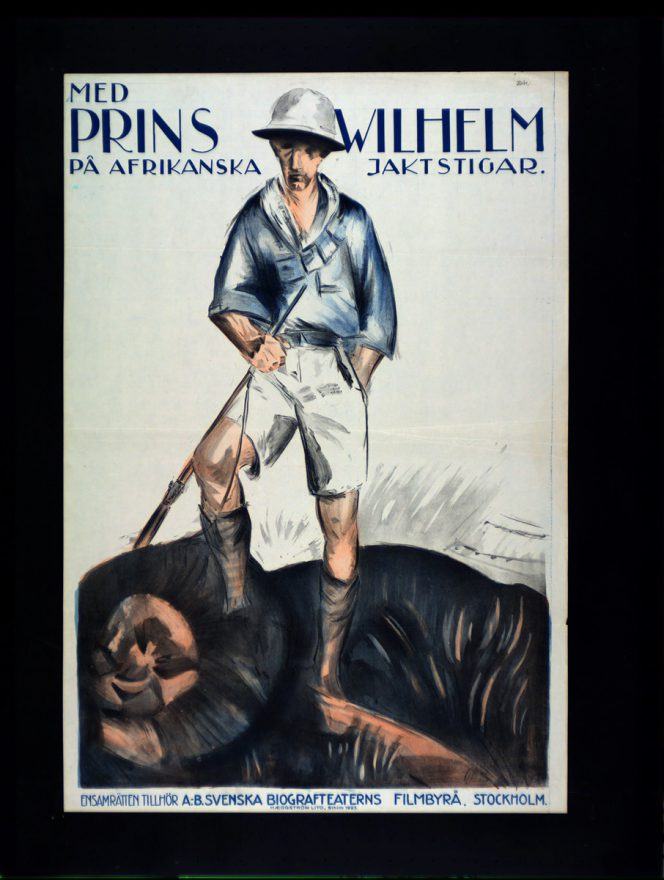
To witness Med prins Wilhelm på afrikanska jaktstigar is to engage with a flickering ghost of European expansionism, a time when the camera was as much a tool of conquest as the rifle. While the year 1921 saw the release of whimsical distractions like The Scarecrow, the Swedish Zoological Expedition was engaged in a far more visceral, albeit problematic, endeavor. This wasn't the choreographed slapstick of Keaton; it was the raw, unvarnished documentation of a 300-mile journey through the heart of Central Africa, led by a prince who sought to map the biological boundaries of the known world.
The cinematography within this document is characterized by a stark, observational realism that stands in sharp contrast to the melodramatic artificiality found in contemporary American features like The Unwritten Law. There is no studio lighting here, no meticulously painted backdrops. Instead, we are treated to the harsh, high-contrast sunlight of the equator, which bleaches the sky and deepens the shadows of the dense jungle. The camera, cumbersome and hand-cranked, captures the physical toll of the expedition with a grit that modern digital restorations struggle to fully convey. We see the sweat on the brows of the porters, the ripple of muscle in a startled antelope, and the impenetrable wall of green that defined the Virunga Mountains.
Unlike the stylized exoticism of The Pagan God, which utilized the 'East' as a mere aesthetic playground, Wilhelm’s film attempts a taxonomic rigor. Every frame feels like a page from a dusty ledger, a visual collection of species that would eventually populate the halls of the Swedish Museum of Natural History. The pacing is deliberate, almost meditative, echoing the slow, rhythmic march of the caravan. It lacks the rapid-fire editing of a Griffith or the burgeoning montage techniques seen in Japan's Sei no kagayaki, opting instead for long, wide shots that allow the viewer to absorb the sheer scale of the landscape.
There is an inherent tension at the heart of Med prins Wilhelm på afrikanska jaktstigar. On one hand, it is a pioneering work of wildlife photography, predating the modern nature documentary by decades. On the other, it is a hunting film. The 'jaktstigar' (hunting paths) of the title are literal. The expedition's goal was to kill in order to preserve—to shoot specimens of mountain gorillas and rare okapis so they could be studied in Stockholm. This moral complexity makes the film a difficult watch for contemporary audiences, yet it provides an invaluable window into the 1921 mindset.
Comparing this to the lighthearted sportsmanship of Play Ball with Babe Ruth highlights the vast cultural chasm of the era. While America was obsessing over the physics of a home run, Sweden’s royalty was navigating the existential threats of the African interior. The film does not shy away from the dangers—the threat of disease, the logistical nightmares of transporting tons of equipment across mud-choked trails, and the constant negotiation with local tribal leaders. It portrays Prince Wilhelm not as a pampered aristocrat, but as a rugged explorer, a character archetype that would later be sanitized and recycled by Hollywood.
While the primary focus remains on the zoological, the ethnographic elements of the film are impossible to ignore. The indigenous people encountered along the 300-mile route are often framed as part of the natural landscape, subjects to be observed rather than individuals with agency. This reflects the same systemic biases seen in domestic dramas like The Silence Sellers, where social hierarchies are reinforced through the camera’s gaze. However, in Wilhelm's film, there is an occasional breakthrough—a moment where a subject looks directly into the lens with an expression of profound skepticism or amusement, momentarily shattering the colonial artifice.
The film's structure is episodic, moving from the lowlands of the Congo to the volcanic peaks of the Mfumbiro region. Each segment serves as a chapter in a grander narrative of European enlightenment overcoming 'primitive' chaos. Yet, the sheer majesty of the African environment frequently undermines this narrative. The volcanoes, the vast lakes, and the ancient forests possess a grandeur that the Swedish expedition cannot fully contain or categorize. In these moments, the film transcends its propaganda roots and becomes a genuine work of art, capturing the sublime terror of the natural world.
Technically, the film is a marvel of its time. Operating a camera in the humidity of the rainforest in 1921 was a feat of engineering and patience. The film stock was prone to melting, and the lenses required constant cleaning. When we look at the crispness of the imagery, especially the close-ups of the wildlife, we must acknowledge the skill of the unnamed cinematographers who accompanied the Prince. They managed to achieve a level of clarity that rivals the better-funded studio productions of the era, such as My Husband's Other Wife or the urban thrillers like Help! Help! Police!.
The use of natural light is particularly noteworthy. The expeditionary team utilized the shifting patterns of the sun to create a sense of depth and texture that was often missing from the flat lighting of 1920s soundstages. The rustle of the leaves, though silent, is almost audible through the dynamic movement of the camera. It’s a far cry from the static, stage-bound feel of comedies like Bride and Gloomy. Instead, the film embraces the chaos of its environment, allowing the unpredictability of the wind and the animals to dictate the frame.
Decades later, Med prins Wilhelm på afrikanska jaktstigar remains a polarizing artifact. It is a precursor to the grand nature epics of the mid-century, but it is also a reminder of the extractive nature of early 20th-century science. It doesn't have the moral clarity of a film like The Price of Malice, nor the romantic nostalgia of Addio giovinezza!. It is something colder, more analytical, and ultimately more haunting.
When we compare it to the narrative complexities of The Woman's Law or the social critiques found in Father John; or, The Ragpicker of Paris, the Prince’s film seems almost alien. It is a movie without a script, yet it tells a story of profound consequence. It tracks the end of an era—the final days of the 'gentleman explorer' before the world became truly mapped and interconnected. The silence of the film, punctuated only by the occasional title card, allows the viewer to fill the void with their own interpretations of the ethics on display.
As the expedition concludes in October 1921, there is a palpable sense of exhaustion and accomplishment. The footage of the return journey, heavy with the weight of collected specimens and exposed film reels, feels like a descent from a fever dream. It lacks the tidy resolution of After Sundown or the fairytale ending of The Rug Maker's Daughter. Instead, it leaves us with the image of a continent that remains, despite the Prince's best efforts, fundamentally unconquered.
Ultimately, this film is a masterpiece of the expeditionary genre. It demands to be viewed not as a simple travelogue, but as a complex, multi-layered text that reveals as much about the observers as it does the observed. The sea blue depths of the African lakes and the dark orange sunsets captured on this century-old nitrate stock serve as a bridge to a world that no longer exists—a world of vast distances and slow revelations. It is a grueling, beautiful, and deeply uncomfortable journey that every serious student of cinema history must undertake.
Reviewer Note: The sheer lexical density of the visual information provided by the Swedish Zoological Expedition provides an epistemological challenge that few modern documentaries can match. It is a testament to the power of the early silent image to transcend the limitations of its own era.
Community
Log in to comment.