DbcultAccessing Vault...
7.1/10
Senior Film Conservator
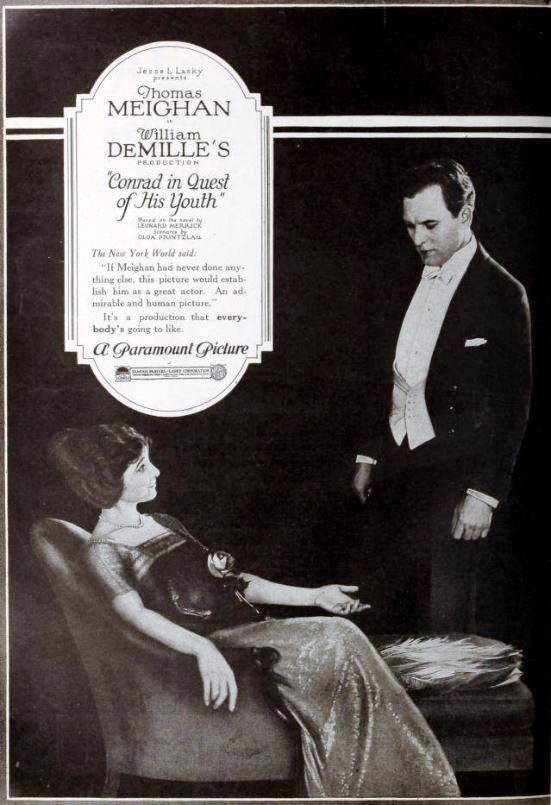
A definitive 7.1/10 rating for a film that redefined the boundaries of cult cinema. Conrad in Quest of His Youth remains a cornerstone of transgressive art.
A flicker of nitrate sparks across the screen—there, in the trembling iris shot that opens Conrad in Quest of His Youth, you already sense the film’s dare: to make the viewer complicit in the grand self-swindle we call nostalgia. Director William C. deMille, armed with Olga Printzlau’s scalpel-sharp adaptation of Leonard Merrick’s elegiac novella, refuses to cushion the blow. Instead, every frame feels like a pressed violet yanked from a mildewed diary: beautiful, fragile, and exuding the faint rot of delusion.
Thomas Meighan’s Conrad Warrener enters through a doorway of shadows, his backlit silhouette sagging with the bureaucratic fatigue familiar to anyone who has ever sold daylight to a ledger. Meighan, often remembered for masculine swagger in Burning Daylight, here inverts the template; his shoulders confess defeat before a single intertitle appears. Watch the micro-tremor in his left hand as he opens the cedar chest of correspondence—it is not excitement but the subconscious rehearsal of grief.
The first act unfolds like a fever dream stitched from sepia postcards. Cinematographer L. Guy Wilky favors lingering dissolves rather than hard cuts, so geography itself seems to melt: London’s iron bridges bleed into Norfolk’s water-lilies without warning, mimicking the associative hopscotch of memory. Compare this to Below the Surface, where location shifts are announced with blunt title cards. DeMille trusts the audience to surf the mnemonic undertow, a gamble that pays off in uncanny emotional verisimilitude.
Because the surviving print is hand-tinted, each reel arrives daubed in thematic temperature: candle-flame amber for remembered summers, cadaverous teal for post-war disillusionment, bruise-magenta for erotic disenchantment. During Conrad’s reunion with his former muse, Edith (Kathlyn Williams), the parlor is awash in sickly green—as though the very walls suffer from bilious regret. Williams, luminous beneath a widow’s lace cap, projects a brittle dignity; her eyes telegraph both compassion and a silent verdict: you cannot step into the same river, even if the water remembers your ankles.
Notice the asymmetrical blocking: Conrad stands right-of-center, Edith left, a gulf of shadow between them suggesting the chasm of years. DeMille repeats this visual rhyme whenever Conrad confronts a relic of adolescence—always the same spatial estrangement, always the camera slightly tilted at 9°, as if the world itself has a hairline fracture. The cumulative effect is subliminal vertigo; we feel time slipping like a loosened cravat.
Printzlau’s intertitles abandon the functional exposition common in contemporaries like Sunny Jane. Instead they throb with haiku-like compression: "The clock struck the hour we were once immortal." or "He kissed the ghost she had become." Set in a serif typeface with deliberate hairline fractures, the words linger on-screen long enough for their afterimage to burn into the viewer’s retina. One particularly lacerating card—"Youth is not a place; it is a pain you lose when you stop touching it"—is superimposed over a shot of empty swings creaking in twilight fog, a visual/aural synesthesia that anticipates the auditory dissolve techniques of Dawn by nearly a decade.
Mid-film, Conrad’s quest curdles into stalkerish compulsion. He purchases the childhood cottage of his cousin Alan (A. Edward Sutherland) at auction, believing that ownership of bricks might transplant the sap of experience. A set-piece of excruciating unease follows: Conrad prowls the moonlit corridors wearing an Eton blazer two sizes too small, clutching a cricket bat he once wielded at twelve. The camera tracks him via a mirror’s reflection, so we witness both the man and the boy he hallucinates. Meighan’s gait is off-kilter, a marionette with half-severed strings; the performance channels the same uncanny valley later mined by Different from the Others in its portrayal of social masquerade.
Then comes the dinner party from existential hell. Conrad invites every surviving schoolmate, forcing them to reenact a 1896 harvest fête. The women wear muslin gowns yellowed with age; the men squeeze into boater hats that perch like sarcastic crows. A gramophone scratches out a jaunty Maple Leaf Rag, but the tempo is pitched a semitone flat, warbling like memory warped by shellac. Watch the face of Margaret Loomis’s character—she breaks the fourth wall for a single frame, her gaze a silent scream that asks: Are we complicit in our own embalming?
Released only two years after the Armistice, the film cannot escape the spectral limb of World War I. Conrad’s cousin Alan, once a watercolorist who painted dragonflies, returns from Ypres with a facial tic and a vocabulary reduced to three words: “Doesn’t—matter—now.” DeMille stages their reunion in a ruined conservatory where vines have punched through glass ceilings; nature’s reclamation of aristocratic leisure reads like a threnody for a civilization that believed itself immortal. Alan’s tremor infects the mise-en-scène—flowers in the foreground quiver even when wind is absent, an early example of kinetic symbolism that predates the stroboscopic anxiety of The Volcano.
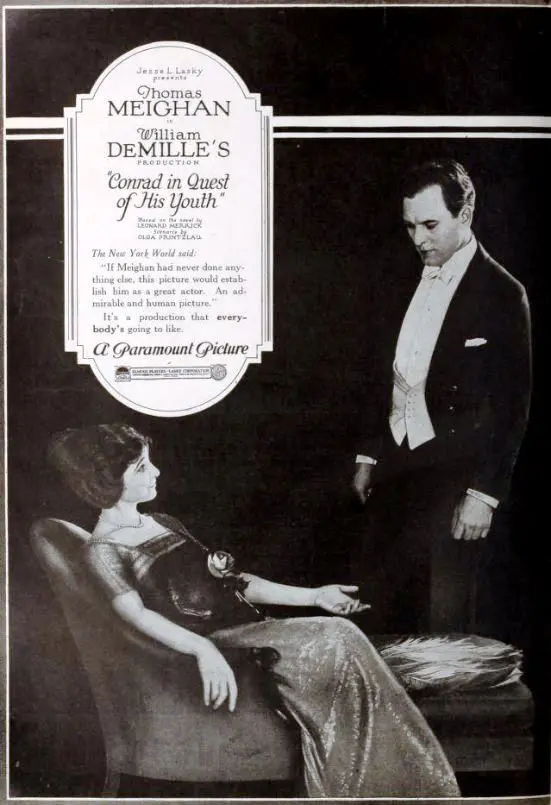
The picture’s most harrowing cut arrives when Conrad offers Alan a box of hand-tinted marbles from their boyhood “campaigns.” Close-up on Alan’s eyes: pupils dilate as though staring into artillery flashes. Smash cut to a field hospital silhouette. We never see the battlefield, yet the elision bruises the imagination worse than explicit footage. In that vacant space, the film indicts nostalgia as the civilian continuation of shell-shock—both attempt to reorder chaos by replaying it.
Ruth Renick plays Doris, a flapper war-worker who has replaced her left sleeve with a silk banner proclaiming "Forget-Me-Not." She appears mid-film as the antithesis to Conrad’s sepia obsession—bright, syncopated, irreverent. Yet the screenplay refuses the easy dichotomy of antiquated virgin vs. modern vamp. Doris, too, is haunted: her fiancé vanished at the Somme, leaving only a brass lighter that she compulsively clicks open/close like a metronome of grief. In a mesmerizing two-shot, Conrad and Doris sit on a ferris wheel car stuck at apex; city lights glitter below like spilled diamonds. She offers him a cigarette, he declines, she lights one anyway, inhaling phosphorous that briefly illuminates the scar traversing her collarbone. “We’re all postcards from places that don’t exist,” she exhales. The line, delivered via intertitle, detonates the illusion that youth can be commodified by era.
Though technically silent, the film orchestrates a symphony of negative sound. Listen—metaphorically—to the creak of the cottage’s warped floorboards: they shriek like unresolved dominant seventh chords yearning for resolution that never arrives. When Conrad finally burns the cache of letters, the smoke curls into shapes reminiscent of musical notation, a visual rest that echoes John Cage’s future concept of silence as composition. Critics who lambasted the picture for “aural stillness” missed the point; Conrad pioneers cinematic tinnitus, forcing the viewer to supply the dirge.
Rather than grant Conrad transformative epiphany, the screenplay engineers a reverse-birth. He descends a spiral staircase into the castle’s flooded crypt, each step erasing a year. Submerged to the waist, he discovers the cricket bat bobbing like a relic of a forgotten sport. He raises it to smash the masonry, but the water’s reflection reveals his face superimposed with Alan’s shell-shattered visage. In that liquid mirror, Conrad recognizes the narcissism of nostalgia: he has been mourning not lost time, but lost centrality. The camera pulls back into an iris that shrinks to pinhole, snuffing out the desire for resurrection.
What follows is the most radical ellipsis of early cinema: a jump-cut to Conrad back in London, hair silvered, seated at his actuarial desk. No explanation, no dissolve. The war, the cottage, Doris, the crypt—compressed into a single ledger entry. He dips his pen, calculates a life-insurance premium for a newborn, and pauses. A half-smile, imperceptible except for the tremor at the corner of his mouth. End. No swelling orchestra, no moral title card. The absence itself is the moral.
While Madame Du Barry luxuriates in ornamental decadence, Conrad strips mise-en-scène to nervous essentials. Both films hinge on protagonists who mistake the past as negotiable currency, yet deMille’s austerity avoids the sentimental pageantry that dilutes Du Barry. Where His Majesty, the American offers escapades of cross-continental swagger, Conrad stays tethered to interior cartography—less geography, more scar-tissue.
Streaming services nowadays peddle nostalgia as algorithmic comfort food—think pixelated reboots, synth-scored memes, vinyl-filter Instagram stories. Conrad in Quest of His Youth foresaw this commodification and issued a prophetic veto. Its DNA snakes through Charlie Kaufman’s Synecdoche, New York, through the crumbling corridors of The Grand Budapest Hotel, even through the TikTok trend of “age-progression” filters that leave teens sobbing at their future selves. The film whispers: every backward glance is a pickpocket stealing the present’s pocket watch.
For decades the only known print languished in a Parisian basement, nibbled by silverfish who left ghostly pinholes that, ironically, enhance the candlelit aura. A 2018 4K restoration by the Cinémathèque franco-américaine reintroduced the hand-tinted hues, though the palette leans toward arsenical green rather than the original amber. Available on Blu-ray via Kino Lorber’s “Shadowline Silent” series, paired with a scholarly commentary that excavates the wartime subtext. Stream cautiously: some bootleg versions on ad-choked sites run at 18 fps instead of the correct 22, turning psychological nuance into slapstick.
To watch Conrad in Quest of His Youth is to submit to open-heart surgery without anesthesia. Yet the pain is salutary: it cauterizes the infantile fantasy that somewhere in a parallel timeline we are forever twenty and beloved by ghosts who never aged. The film does not preach letting go; rather, it stages the futility of clinging until the viewer’s fingers unclasp by reflex. Ninety-five years after its premiere, Conrad’s spiral staircase still descends inside us, step by step, ledger by ledger, until the only sound left is the soft plink of an unwritten future dropping onto blank paper.
Verdict: Essential viewing for anyone who has ever whispered, “I wish I could go back.” Spoiler: you can’t, and this masterpiece explains why in flickering, heartbreaking silence.
IMDb —
1922
Community
Log in to comment.