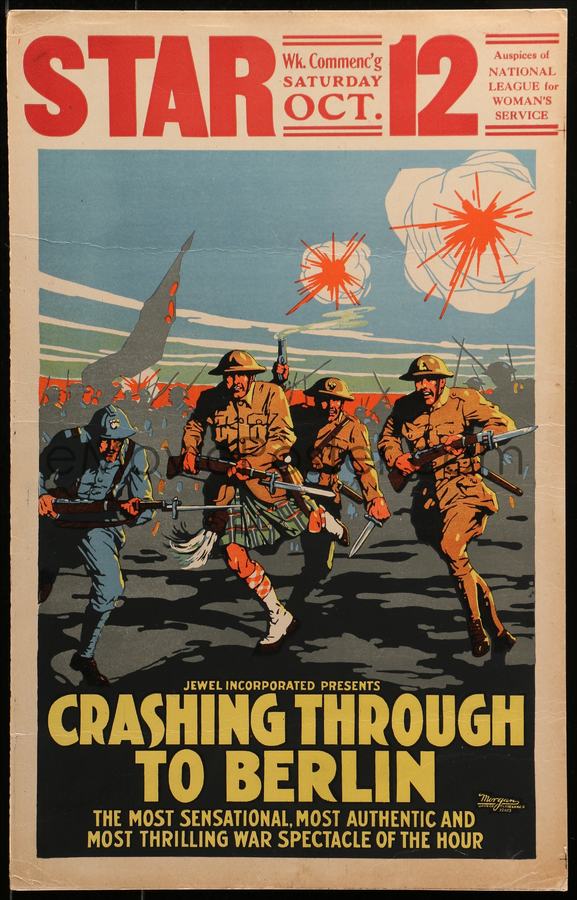
Watching Crashing Through to Berlin feels less like viewing a documentary than excavating shrapnel from history’s flesh. The anonymous compiler—likely some battlefield cinematographer whose name vanished into the Western Front’s mud—assembles fragments into a terrifying mosaic. Notice how the Sarajevo assassination sequence avoids the fatal shot itself. Instead, we witness Franz Ferdinand’s open-top carriage navigating streets thronged with subjects whose faces already flicker with premonitory dread. The edit implies causality through sheer adjacency: a cut from the Archduke’s gloved wave to a close-up of Die Faust des Riesen-style newspaper headlines screaming ultimatums, the text vibrating with typeset hysteria.
What distinguishes this from mere newsreel aggregation is its subterranean pulse of sensory overload. Artillery barrages aren’t depicted through wide shots but via seizure-inducing flashes that bleach the emulsion white, each detonation scratching the celluloid like claw marks. Trenches appear not as strategic diagrams but as claustrophobic wormholes where soldiers wade through viscous muck resembling primordial sludge. One astonishing sequence captures a mustard gas attack’s advance—a yellow-cloud (the chromatic choice feels both terrifying and symbolic) devouring the landscape like some biblical plague, men scrambling over sandbags with towels pressed to faces in a grotesque dance of suffocation.
The film’s middle section masterfully contrasts industrialized slaughter with eerie interludes of suspended humanity. A Belgian farmhouse cellar becomes an impromptu operating theater where surgeons work by candlelight, their scalpels glinting as they extract shards of metal from a boy-soldier’s thigh—a scene echoing the domestic-turned-macabre intimacy of Pique Dame’s psychological torment. Later, soldiers huddle around a gramophone in a dugout, their eyes closed as a Caruso recording momentarily conjures parlors and peace. The fragility of this moment devastates precisely because the subsequent reel shows that same trench flattened by mortars, the gramophone’s horn protruding from rubble like a fossilized flower.
Mobility defines the titular “crashing through” sequences. Unlike the static dread of trench warfare, the push toward Berlin unleashes startling vehicular chaos. Armored cars careen through shell-cratered villages, their mounted machine guns spitting fire at unseen enemies. A revolutionary tracking shot—possibly achieved via motorcycle sidecar—races alongside charging infantry, the camera bouncing violently enough to induce vertigo. This kineticism anticipates the proto-fascist mechanized fantasies in Protéa’s chase sequences, yet here the machines seem malevolent organisms consuming their riders. Most haunting are the phantom rides on supply trains: the locomotive’s POV hurtling past dismembered forests where splintered trunks stand like grave markers, their branches sheared off by shrapnel in arboreal amputations.
Human faces emerge from the maelstrom with startling immediacy. A German prisoner—barely sixteen—weeps silently into his tunic as medics bind his wounds, his vulnerability clashing with propaganda depictions of the enemy. Near Berlin’s outskirts, an elderly woman offers occupying troops wilted chrysanthemums, her eyes holding centuries of resigned sorrow. These moments achieve what Inspiration’s staged performances couldn’t: unmediated encounters with historical trauma. The soldiers’ exhaustion isn’t acted; it’s etched into the sag of shoulders, the thousand-yard stares, the trembling hands that struggle to light cigarettes. The film’s power resides in these physiological truths—war as biological breakdown.
Technologically, the footage reveals fascinating limitations transformed into virtues. Crank-speed inconsistencies make charging soldiers appear either comically sped-up or trapped in nightmare slow motion. Lens flares streak across frames like celestial interventions, while nitrate decomposition creates hallucinatory effects—explosions blooming into Rorschach blots, barbed wire disintegrating into cobwebs of light. The silence (beyond live musical accompaniment) becomes its own character. We read lips shaping unheard words, interpret screams through distended jaws, and imagine the basso profundo of howitzers through the trembling earth underfoot. This audiovisual void forces immersion in the image’s tactile reality—mud’s suction, wool uniforms chafing rain-slicked skin, the metallic taste of fear.
The Berlin finale subverts victory narratives. Rather than parades or captured landmarks, we see hollow-eyed survivors shuffling past bombed-out tenements. Children scavenge in rubble, their silhouettes dwarfed by skeletal architecture. A final shot pans across acres of crosses in a temporary cemetery, the camera drifting like a lost soul over anonymous graves. This anti-cathartic denouement connects unexpectedly to Perdida’s exploration of irrecoverable loss. Both films understand that some fractures never heal; they merely scar over into collective memory.
As artifact, the film inadvertently documents early cinema’s evolution. The static tripod shots of 1914 give way by 1918 to complex camera movements—dolly shots following tanks, aerial photography from reconnaissance planes, intimate handheld close-ups during field surgeries. This formal progression mirrors warfare’s own technological acceleration, creating a meta-commentary on perception’s militarization. The very act of filming becomes a reconnaissance mission, the camera both witness and weapon.
Crashing Through to Berlin transcends its propagandistic origins through sheer sensory assault. Its value lies not in strategic analysis but in preserving war’s textural horror—the way mud cakes on puttees, how snow settles on corpses mid-field, the vibration of rail transport beneath conscripts’ boots. While later works like Wolves of the Border would romanticize conflict, this remains unvarnished and essential: a ghostly battalion marching directly from the past onto our retinas, demanding we see the unfiltered cost of every inch gained toward Berlin.
Existentially, the film resonates because it captures modernity’s violent birth. The machine gun’s stutter, the tank’s crushing treads, the aircraft’s predatory dive—these weren’t mere weapons but harbingers of a desacralized world. In juxtaposing cavalry charges against armored divisions, the compiler reveals a paradigm shift: the romantic death of individual heroism beneath steel treads. That final pan across the cemetery acknowledges this loss implicitly. Each white cross marks not just a soldier but the extinguished possibility of a different 20th century.
Perhaps most remarkably, the film achieves emotional complexity without directorial manipulation. Pathos emerges from a medic’s trembling hands as he closes a dead comrade’s eyes, not contrived melodrama. Tension builds through actual artillery trajectories arcing overhead rather than edited suspense. Like the traumatic memory it embodies, the film refuses neat narrative resolution. Its power lies precisely in its fragmentation—a century-old scream frozen in nitrate, still capable of making audiences feel the vibrations beneath their seats.