DbcultAccessing Vault...
6.4/10
Senior Film Conservator

A definitive 6.4/10 rating for a film that redefined the boundaries of cult cinema. Curses of the Witch remains a cornerstone of transgressive art.
Does a century-old silent film from the Finnish wilderness still have the power to unsettle a modern audience? Short answer: Yes, but only if you allow its slow-burn atmospheric dread to get under your skin. This isn't a film for those seeking the frantic pacing of contemporary slashers; it is a film for the patient viewer who finds terror in the silence of a landscape that wants you dead.
This film is for the folk-horror completionist and those who appreciate the raw, expressive power of the silent era. It is not for viewers who struggle with the theatricality of 1920s performances or those who require explicit, high-definition gore to feel a sense of stakes.
1) This film works because: It treats the Finnish landscape as a sentient antagonist, utilizing the natural isolation of Lapland to create a claustrophobia that feels internal rather than just physical.
2) This film fails because: The middle act leans too heavily on repetitive domestic disputes that occasionally distract from the much more interesting supernatural elements of the curse.
3) You should watch it if: You want to see the primal roots of the 'cursed land' subgenre that influenced everything from The Witch to Midsommar.
Teuvo Puro, often cited as the father of Finnish cinema, understood something fundamental about horror: nature is indifferent, and that indifference is terrifying. In Curses of the Witch, the cinematography by Karl Fager doesn't just capture the scenery; it frames the mountains and forests as if they are watching the characters. There is a specific shot early in the film where the newlyweds look out over their new territory, and instead of a wide, hopeful vista, the camera remains tight, making the trees look like bars of a cage.
This visual language sets it apart from other films of the era like Frontier of the Stars, which often used wide spaces to denote opportunity. Here, the space is a vacuum. The film uses the 'Noitakirot' (the witch's curse) as a psychological anchor. It suggests that we are never truly alone in the wild; we are walking on the bones of those our ancestors wronged. This isn't just a spooky premise; it is a heavy, philosophical burden that the film carries through every frame.
The pacing is deliberate. It’s a crawl. But this crawl is intentional. It mimics the slow freezing of a lake. You don't notice the danger until you are already stuck. While some might find the lack of intertitles in certain sequences confusing, I find it liberating. The emotion is carried entirely by the physicality of Eero Kilpi and Heidi Blåfield.
Heidi Blåfield’s performance as Selma is a masterclass in escalating anxiety. In the silent era, actors often leaned into melodrama, but Blåfield finds a quieter, more vibrating frequency of fear. There is a scene where she sits alone in the cabin, convinced that the walls are closing in. Her eyes don't just bulge; they dart with a genuine sense of hunted desperation. It is a far cry from the more polished, urban anxieties seen in Nearly Married.
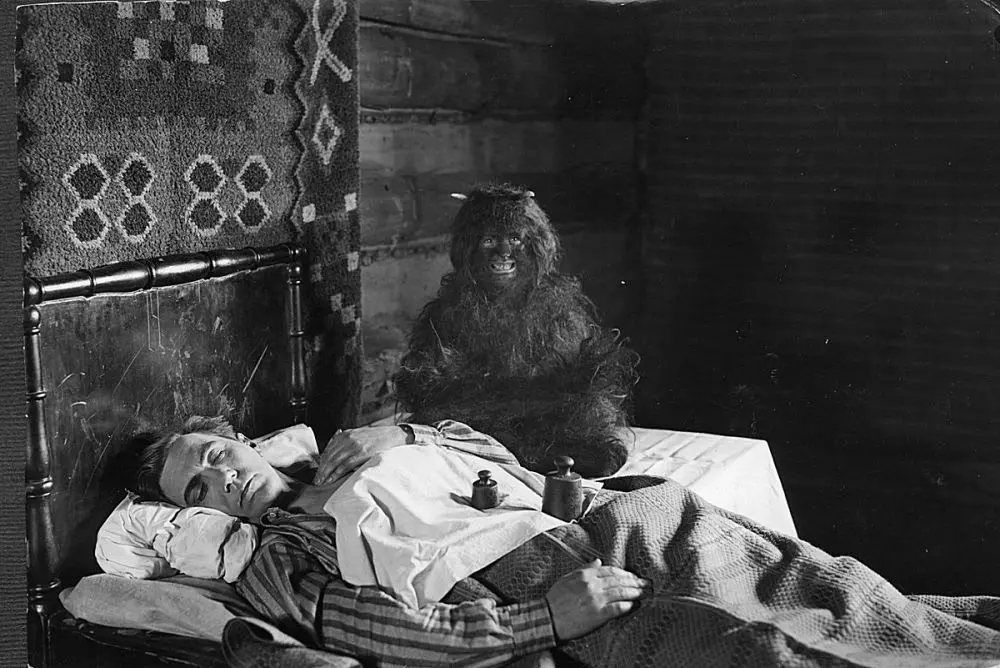
Eero Kilpi, playing Utu, provides the necessary counterpoint of stubborn masculinity. His refusal to acknowledge the curse is his undoing. It is a classic trope—the man who thinks he can conquer nature with an axe and sheer will. Watching his confidence erode as the supernatural elements become undeniable is one of the film's greatest strengths. His performance is grounded, unlike the more stylized turns found in The Mystic, making the eventual breakdown feel much more tragic.
The supporting cast, including the local villagers, acts as a Greek chorus of doom. Their faces are weathered, looking like the very rocks they live among. This casting choice adds a layer of authenticity that many Hollywood productions of the 1920s lacked. These people look like they belong to the dirt, which makes their fear of the spiritual world feel earned rather than performative.
Yes. Curses of the Witch is worth watching because it provides a raw, unvarnished look at how early cinema interpreted folklore and the supernatural. It lacks the polish of modern horror, but it possesses a primal energy that is often lost in digital filmmaking. It is a visual document of a culture’s relationship with its own dark myths.
For a modern viewer, the film serves as a reminder that fear is universal. The dread of being watched by the unknown, the guilt of occupying land with a dark history, and the fragility of human relationships under pressure are themes that haven't aged a day. It works. But it’s flawed by its own era’s limitations.
One surprising aspect of Curses of the Witch is how it handles the concept of the 'witch.' Unlike the caricatures found in later cinema, the witch here is an elemental force. She is a personification of the land's memory. This film argues that the environment is a hard drive, recording the traumas of the past and playing them back for the current inhabitants. It’s a sophisticated take on the haunting genre that predates the 'residual haunting' theories of modern paranormal fiction.
Compare this to the social tensions in Conflict. While that film deals with the friction between people, Curses of the Witch deals with the friction between humanity and time itself. The past is a physical weight. It’s a brutal, simple sentence: You cannot escape what happened before you arrived.
Teuvo Puro’s direction is surprisingly modern in its use of shadows. He doesn't rely on the high-contrast German Expressionism that was popular at the time. Instead, he uses naturalistic lighting that makes the shadows feel more 'real.' When a character walks into a dark corner, they don't disappear into a stylized black void; they disappear into a messy, dusty corner of a real house. This grounding in reality makes the supernatural intrusions feel much more invasive.
The editing, however, is where the film shows its age. Some transitions are jarring, and the subplots involving the extended family feel like they belong to a different movie—perhaps a domestic drama like The Mysterious Mr. Tiller. These diversions sap the tension that the main plot builds so effectively. When the film focuses on the couple and the curse, it is a tightening vice. When it wanders into village politics, the vice loosens.
Curses of the Witch is a jagged, beautiful, and deeply unsettling piece of film history. It manages to capture a specific type of 'Arctic dread' that few films have replicated since. While it occasionally stumbles over the conventions of its time, its core—a story of two people crushed by the weight of a land that remembers too much—remains incredibly potent. It is a foundational text for the horror genre, proving that silence is often the loudest way to tell a ghost story. If you can handle the slow burn, the payoff is a chilling realization that some curses never truly end; they just wait for new people to move in.
IMDb —
1935
Community
Log in to comment.