DbcultAccessing Vault...
Cult Review
Senior Film Conservator
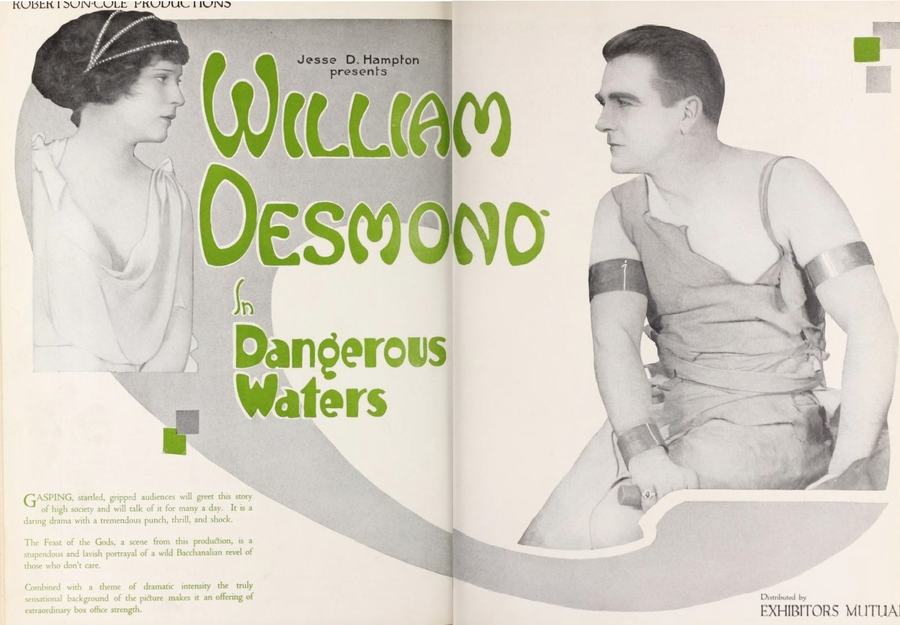
The 1919 silent feature Dangerous Waters stands as a fascinating, if occasionally harrowing, artifact of an era caught between the Victorian moral compass and the impending roar of the twenties. It is a film that breathes through its contrasts, pitting the topographical honesty of the frontier against the architectural and moral claustrophobia of New York’s upper crust. When Jimmie Moulton (portrayed with a stoic, physical gravitas by William Desmond) returns from his two-year stint on a western ranch, he is not merely a man returning home; he is an alien species entering a hothouse of corruption.
The narrative engine of Dangerous Waters is fueled by the dissolution of Cora Button, played with a fragile, wide-eyed desperation by Marguerite De La Motte. Her transformation from a faithful fiancée to a wavering socialite under the thumb of Victor DeLara (Arthur Edmund Carewe) provides the film's central tragedy. DeLara is not your typical silent film villain who twirls a mustache; he is a more insidious breed of predator, one who uses the 'Feast of the Gods'—a masquerade of immense visual ambition—to blur the lines between mythic grandeur and earthly debauchery. Much like the dark psychological undercurrents found in Doctor Nicholson and the Blue Diamond, the film explores how the elite use their wealth to construct alternate realities where consequences are merely aesthetic choices.
The 'Feast of the Gods' sequence is, without hyperbole, a triumph of early art direction. The screen is filled with figures draped in the iconography of Zeus, Hera, and Dionysus, yet the camera—guided by the discerning eye of the cinematographer—refuses to be enchanted. Instead, it lingers on the predatory glances and the hollow laughter of the revelers. It reminds one of the hellish visual metaphors in Through Dante's Flames, where the environment itself reflects the internal rot of the characters. The masquerade serves as a microcosm for the film's broader critique: that society, when left to its own devices, will always choose the mask over the face.
William Desmond’s performance is a study in restrained masculinity. Having spent two years in the West—a setting often romanticized in films like Beating Back—Jimmie Moulton embodies a rugged individualism that feels out of place in the manicured salons of New York. His physicality is direct, his gaze unblinking. In contrast, Arthur Edmund Carewe as DeLara is all fluid motion and serpentine grace. Their scenes together are a masterclass in silent tension, a precursor to the domestic power struggles seen in Her American Husband.
Marguerite De La Motte deserves significant praise for her nuanced portrayal of Cora. It would have been easy to play her as a simple victim, but De La Motte imbues her with a palpable sense of internal conflict. She is a woman caught between the memory of a stable love and the intoxicating, if poisonous, thrill of the new. This complexity elevates the film above standard melodrama, touching on the same themes of female agency and social pressure explored in The Price Mark.
Writer George Elwood Jenks weaves a script that is surprisingly cynical about the 'cream of society.' The film suggests that the higher one climbs in the social hierarchy, the more one loses touch with the fundamental truths of the human condition. This is a recurring motif in the era's cinema, often used to contrast the 'purity' of the rural or maritime life with the 'sin' of the city, a theme also prevalent in Neal of the Navy and the more adventurous The Adventures of Peg o' the Ring.
While Dangerous Waters shares some DNA with the 'society in peril' subgenre, it distinguishes itself through its pacing. The build-up to the masquerade is methodical, almost agonizing, as we watch Jimmie realize that the woman he loves is slipping into a world he cannot understand. The film doesn't rely on the slapstick or the hyper-accelerated action of Rip Roaring Rivals; instead, it opts for a psychological weight that feels modern. The stakes are not just physical safety, but the preservation of a soul.
The use of light and shadow in the New York sequences creates an almost noir-like atmosphere, years before the term was coined. The interiors are cluttered with the spoils of empire—statues, heavy drapes, ornate furniture—which seem to hem the characters in. This visual density contrasts sharply with the remembered scenes of the ranch, where the horizon is the only limit. This stylistic choice mirrors the thematic journey of the characters, similar to the atmospheric melancholy found in Triste crepúsculo.
The masquerade itself is a masterstroke of costume design. By having the characters dress as gods, Jenks and the director highlight their hubris. DeLara as a manipulative deity is a perfect visual metaphor. When the 'cream of society' behaves like the worst versions of the Olympians, the irony is not lost on the audience. It’s a critique of the idle rich that feels as biting today as it did in 1919. This level of social commentary is what separates a film like this from more straightforward fare like The Love Route or the purely entertaining The Misleading Lady.
When matters finally come to a head at the 'Feast of the Gods,' the film shifts from a slow-burn drama into a visceral confrontation. Jimmie’s arrival at the party—unmasked and dressed in his own skin—is a powerful moment of iconoclasm. He is the truth entering a room full of beautiful lies. The ensuing conflict is not just between two men for the heart of a woman, but between two diametrically opposed ways of life. It evokes the same sense of inevitable reckoning found in Vengeance or the somber realizations in The Chalice of Sorrow.
The resolution of Dangerous Waters avoids the easy, saccharine endings of many of its contemporaries. While there is a sense of salvation, it is tempered by the knowledge of what was nearly lost. The scars of the city remain. In this way, the film shares a spiritual kinship with The Dawn of Understanding, where clarity comes at a high price. It also touches upon the international anxieties of the time, echoing the urban dangers depicted in the Swedish production Storstadsfaror.
Ultimately, Dangerous Waters is a film that demands to be seen by anyone interested in the evolution of narrative cinema. It is more than just a story of a love triangle; it is a sophisticated critique of social stratification and the corrupting influence of unchecked hedonism. The performances are top-tier for the period, the direction is purposeful, and the thematic depth is genuinely surprising. It manages to be both a product of its time and a timeless warning about the masks we wear and the 'dangerous waters' we navigate when we lose our moral compass. As a blogger and critic, I find myself returning to this film not just for its historical value, but for its sheer emotional resonance. It is a stark reminder that even in the silent era, the loudest messages were often the ones delivered with the most subtle of glances.
Rating: 4.5 out of 5 Bacchanalian Masks.
IMDb —
1934
Community
Log in to comment.