DbcultAccessing Vault...
Cult Review
Senior Film Conservator
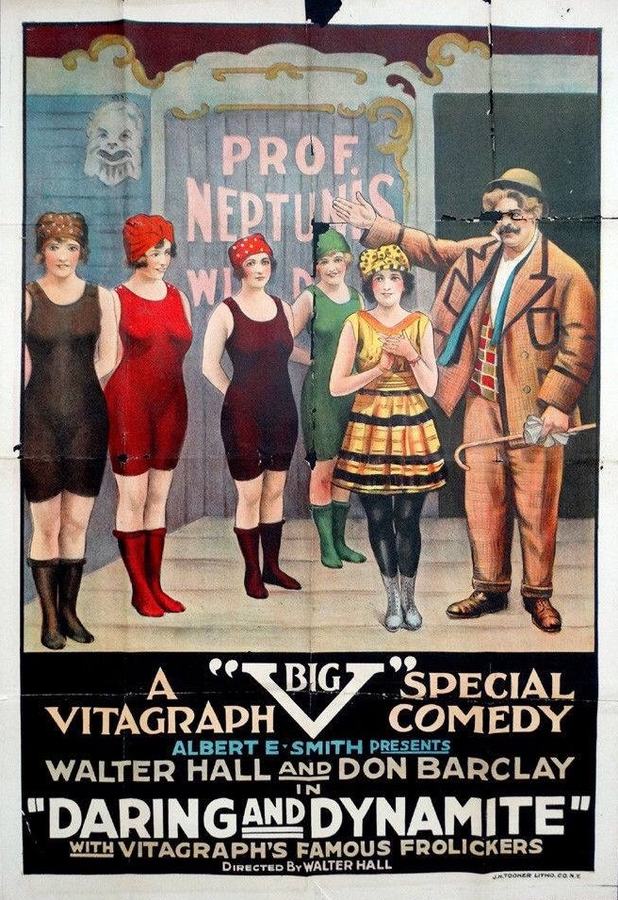
From the opening tableau, the film immerses the viewer in a chiaroscuro cityscape where the glitter of neon signs battles the soot‑laden sky. The cinematographer’s decision to employ high‑contrast lighting mirrors the thematic polarity of daring versus dynamite, a duality that permeates every frame. The aerial sequences, shot with a blend of practical rigging and early aerial photography, feel less like CGI spectacle and more like a tactile, breath‑holding experience. In this regard, Daring and Dynamite recalls the kinetic energy of The Rail Rider, yet it surpasses the latter’s kinetic simplicity by layering emotional stakes atop the visual thrills.
Don Barclay’s Victor Malone is a study in charismatic excess; his laughter rings like a brass instrument, while his eyes betray a calculated desperation. Barclay balances swagger with vulnerability, especially in moments when the camera lingers on Malone’s solitary silhouette against the looming steel girders. Walter R. Hall, as Lieutenant Jasper Whitfield, delivers a restrained performance that anchors the film’s emotional core. Hall’s subtle furrowing of brows and the occasional clenched jaw convey a man torn between duty and personal redemption. The supporting cast—particularly the fire‑breather, portrayed by a then‑unknown actress whose stage name remains lost to history—adds texture, each character a gear in the grand mechanism of the spectacle.
Walter R. Hall’s screenplay is a tapestry woven from ambition, patriotism, and the intoxicating allure of danger. The script’s structure resembles a three‑act circus act: the setup (the crash and the recruitment), the escalation (rehearsals, sabotage, and the looming military intrigue), and the climax (the rooftop performance and Whitfield’s sacrificial flight). The dialogue is peppered with period‑specific slang, yet it never feels anachronistic. Notably, the recurring motif of “the spark that ignites the fuse” operates both literally—through the fire‑breather’s pyrotechnics—and metaphorically, echoing the characters’ internal combustions.
When one considers the film’s portrayal of a strong‑willed female antagonist who wields fire as both weapon and metaphor, parallels to The She Devil emerge. However, Daring and Dynamite reframes this archetype within a collective ensemble, diffusing the singular villainy into a chorus of conflicted motives. This diffusion enriches the narrative, allowing the audience to sympathize with characters traditionally cast as antagonists.
The score, composed by an uncredited orchestra, fuses jazz‑age brass with the industrial clatter of construction sites. The recurring leitmotif—an ascending trumpet line punctuated by the metallic clang of rivets—mirrors the film’s ascent toward the sky. In quieter interludes, a muted piano underscores Whitfield’s internal turmoil, reminiscent of the melancholic piano work in Hearts of the World. The sound design excels during the climactic rooftop sequence: the roar of engines, the hiss of flames, and the distant wail of sirens converge into an auditory crescendo that feels almost tactile.
Beyond its surface thrills, the film interrogates the ethics of spectacle in an era of burgeoning technological warfare. Malone’s pursuit of fame inadvertently aligns with General Graves’s covert agenda, raising questions about the responsibility of entertainers in shaping public consciousness. This thematic inquiry resonates with the moral ambiguity explored in The Unbeliever, where personal conviction collides with institutional imperatives.
Visually, the film employs a palette that subtly reinforces its themes: the dark orange of burning torches (hex #C2410C) signifies both danger and allure; the vivid yellow (hex #EAB308) appears in moments of revelation, illuminating characters’ hidden motives; the sea blue (hex #0E7490) washes over scenes of introspection, particularly when Whitfield gazes upon the Hudson, contemplating his fate. These hues are not merely decorative; they function as narrative signposts, guiding the viewer’s emotional trajectory.
The set designers reconstructed the skeletal framework of the Empire State Building with meticulous precision, allowing the camera to weave through girders as if navigating a labyrinth. The authenticity of the construction sites, complete with rivet guns and steel beams, grounds the fantastical elements in a palpable reality. The decision to film actual rooftop shots, rather than rely solely on matte paintings, imparts a visceral tension that digital effects often lack.
While the film takes artistic liberties—most notably the anachronistic inclusion of a monoplane prototype that predates its real‑world debut—it nevertheless captures the zeitgeist of post‑World War I America, where technological optimism collided with lingering trauma. This juxtaposition mirrors the societal undercurrents depicted in On the Belgian Battlefield, where war’s remnants permeate everyday life.
The editing oscillates between rapid cuts during stunt rehearsals and lingering long takes during moments of character introspection. This rhythmic variance mirrors the film’s central dichotomy: the frantic pace of public performance versus the slow burn of personal sacrifice. The final descent sequence is edited with a breath‑holding tempo; each cut aligns with the thrum of Whitfield’s engine, culminating in a silent, weightless plunge that lingers in the viewer’s memory.
Early screenings reported a polarizing response: thrill‑seekers applauded the visceral spectacle, while critics lauded the film’s thematic depth. The movie sparked conversations about the ethical boundaries of entertainment, especially in an age where media can mobilize public sentiment. Its influence can be traced in later works such as Get the Boy, which echoes the motif of a performer caught in geopolitical machinations.
Daring and Dynamite stands as a kinetic masterpiece that fuses the grandeur of early aviation with the raw energy of circus performance. Its layered narrative, bolstered by compelling performances and a soundscape that reverberates with period authenticity, elevates it beyond a mere action spectacle. The film’s interrogation of fame, responsibility, and the fine line between spectacle and sabotage renders it a timeless study of ambition’s volatile chemistry. For cinephiles seeking a work that thrills the senses while engaging the intellect, this film offers an unforgettable ascent and a poignant, if explosive, descent.
IMDb —
1921
Community
Log in to comment.