DbcultAccessing Vault...
Cult Review
Senior Film Conservator
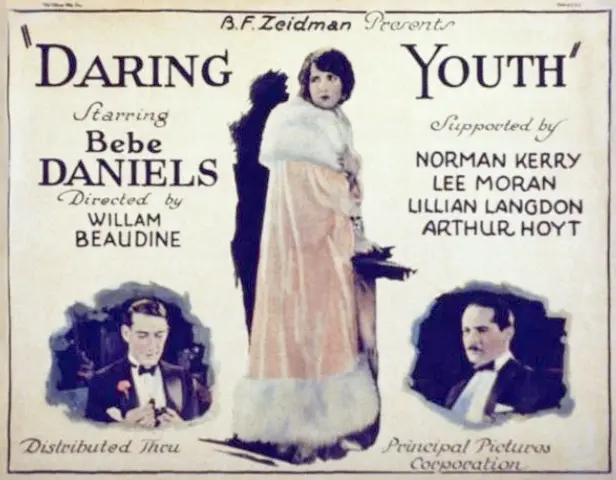
The cinematic landscape of 1924 was a crucible of shifting social paradigms, and Daring Youth emerges as a remarkably prescient artifact of that era's burgeoning skepticism toward institutionalized matrimony. While contemporaries like Nothing But Nerve leaned heavily into the slapstick kinetics of the period, this Dorothy Farnum-penned script navigates the treacherous waters of psychological warfare within the American parlor. The film does not merely present a story of youthful rebellion; it chronicles a systemic collapse of the Victorian ideal, replaced by a cold, transactional autonomy that feels startlingly modern.
Bebe Daniels, transitioning from her earlier roles into a more nuanced dramatic presence, portrays Alita Allen with a mercurial intensity. Her performance captures the exact moment when the flapper’s exuberance curdles into the existential dread of the 'modern woman.' When Alita’s mother—played with a weary, steel-spined resolve by Lillian Langdon—shatters twenty-five years of domestic silence, the ripple effect is not just personal, but paradigmatic. The demand for a 'breakfast-only' marriage is a masterstroke of narrative irony, a proto-feminist manifesto that seeks to preserve the self by surgically removing the companion. This isn't the gothic melodrama found in The Bells; it is a clinical dissection of the contract of love.
Curiously, the writing credits list William Shakespeare alongside Alexander Neal and Dorothy Farnum, suggesting a lineage rooted in the subversive gender dynamics of The Taming of the Shrew or perhaps the melancholic misunderstandings of Much Ado About Nothing. However, Daring Youth flips the script. Instead of the male protagonist 'taming' the woman into submission, Norman Kerry’s John Campbell tames Alita through a terrifyingly polite compliance. Kerry, an actor of considerable gravitas often seen in more rugged fare like God's Country and the Woman, utilizes a minimalist approach here. His willingness to grant Alita her 'freedom' becomes his most potent weapon. It is a psychological gambit that forces the protagonist to confront the void she so desperately fought to create.
The dialogue—delivered via intertitles that possess a biting, sophisticated wit—avoids the mawkish sentimentality that plagued many silent dramas of the mid-20s. There is a sharp, jagged edge to the exchanges between Alita and John. One cannot help but compare this to the visceral intensity of Menschen im Rausch, though where the latter explores intoxication and physical excess, Daring Youth explores the intoxication of ideology. Alita is drunk on the notion of independence, only to find the hangover of isolation waiting in the morning light.
Visually, the film employs a sophisticated use of space to mirror the emotional chasm between its characters. The Allen household is often framed with a claustrophobic density, reflecting the twenty-five years of suppressed resentment. As Alita moves into her own 'free' marriage, the frames become sparser, colder, and increasingly dominated by negative space. This visual vocabulary is reminiscent of the atmospheric tension in The Black Night, where the environment itself acts as a silent antagonist. The camera lingers on the breakfast table—the only site of mandated contact—transforming a mundane domestic furniture piece into a sacrificial altar where the intimacy of the characters is offered up to the gods of 'modernity.'
The supporting cast, including Lee Moran and Arthur Hoyt, provides a necessary counterpoint to the central tension. Their presence offers a glimpse into the broader social milieu, suggesting that Alita’s struggle is not an isolated incident but a symptom of a larger cultural fever. This is not the whimsical world of The Queen's Jewel; it is a world where the jewels of tradition are being bartered for the cold currency of individual liberty. The cinematography captures the shimmering surfaces of the 1920s—the silk gowns, the polished wood, the gleaming automobiles—but always with a lingering shadow that suggests the fragility of these material comforts.
When placed alongside the period's more traditional romances, such as Die weißen Rosen von Ravensberg, Daring Youth feels almost avant-garde in its cynicism. It lacks the pastoral romanticism of Gypsy Anne or the historical pageantry of My Lady's Slipper. Instead, it shares a DNA with the more experimental and socially conscious works like Kino-pravda no. 10, though contained within the shell of a Hollywood feature. It asks uncomfortable questions about the cost of progress. Is the 'freedom' Alita seeks a genuine liberation, or is it merely a different form of the alienation seen in Cora?
The film’s climax is not a traditional reconciliation but a sobering realization. The 'freedom' clause, once Alita’s pride, becomes her torment. John’s adherence to the rules she herself drafted serves as a mirror, reflecting her own insecurities and her latent desire for the very connection she sought to abolish. This psychological twist is handled with a deftness that rivals the dramatic weight of Doch Anny Kareninoy. It suggests that the true 'daring' of youth is not in the breaking of rules, but in the courage to admit when those rules have led to a desert of the soul.
In the final analysis, Daring Youth stands as a towering example of silent cinema’s ability to tackle complex, adult themes with sophistication and wit. It avoids the easy moralizing of For King and Country and the sheer adventurous escapism of Hurricane's Gal or Wild Waves and Women. It is a chamber piece of high intellectual caliber, driven by a powerhouse performance from Bebe Daniels and a script that remains as biting today as it was a century ago.
The film challenges the viewer to look beyond the surface of the 'Jazz Age' and see the profound anxiety that accompanied the era's social shifts. It is a masterpiece of domestic tension, a film that understands that the most significant battles are not fought on battlefields or in the streets, but across the breakfast table, between two people trying to navigate the impossible distance between independence and intimacy. For any serious student of cinema, Daring Youth is not just a historical curiosity; it is a vital, breathing document of the human condition, captured in the exquisite shadows of the silent screen.
Critic's Note:
While often overshadowed by the larger-than-life epics of the 1920s, this film's focus on the 'contractual' nature of marriage provides a unique lens through which to view the era's gender politics. It is a must-watch for those who appreciate the subtle interplay of power and desire in early 20th-century storytelling.
IMDb 6.4
1937
Community
Log in to comment.