DbcultAccessing Vault...
Cult Review
Senior Film Conservator
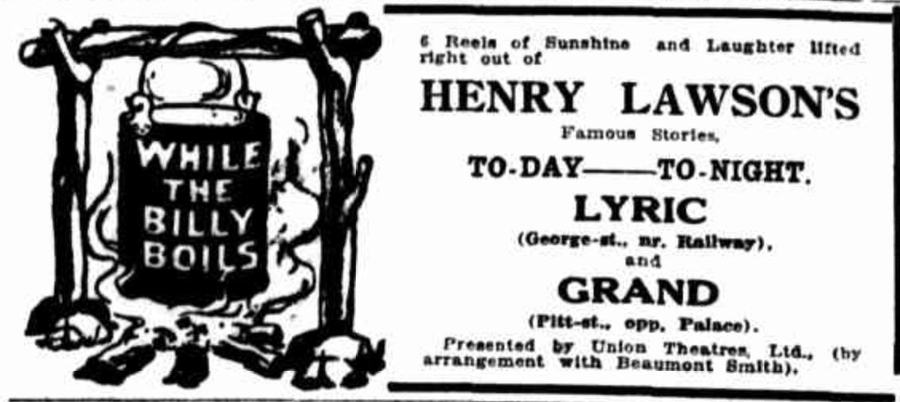
Australia’s silent era rarely tasted this salty.
Beaumont Smith’s While the Billy Boils arrives like a weathered stockman tipping his hat at the door of your subconscious: laconic, tobacco-scented, humming with yarns that refuse linearity. Instead of a plot spine, the film offers a constellation of Lawson sketches—‘The Drover’s Wife’, ‘The Union Buries Its Dead’, ‘A Bush Dance’—braided into a 78-minute trance. The effect is less narrative than meteorological: you inhale heat, flies, and eucalyptus, exhale a sigh that feels ancestral.
Charles Villiers’s camera drinks the horizon until drunkenness morphs into reverence. A selector’s hut is framed against a sky so wide the Milky Way looks like a cracked celestial dam. Inside, McCormick’s face glows from a single tallow candle; outside, moonlight renders iron roofing into pewter relics. The monochrome palate becomes paradoxically searing: every white shimmer on corrugated iron feels like heatstroke, every charcoal shadow a refuge from 110°F delirium.
Compare this to Invisible Ink where urban gaslight pools in cobalt blues, or The Magic Eye’s studio-bound expressionism. Smith rejects artifice; he wants you to taste sweat crystallising on upper lips. When a dust storm barrels toward the lens, the nitrate scratches resemble barbed wire—film history lacerated by the same land it seeks to immortalise.
Loma Lantaur shoulders the film’s moral weight with stoic minimalism. Watch her pupils in close-up: they tremble like waterholes disturbed by brumbies, yet never spill into melodrama. It is the inverse of Pamela Congreve’s histrionic grief; here, sorrow is a private religion practised under a veil of squint-eyed pragmatism.
May Renne’s barmaid, meanwhile, channels O. Henry’s calico philosophies: she pours beer with the tenderness of a battlefield nurse, then recites scripture to a drunk shearer as though each syllable were a chloroform swab. The moment she clips a patron over the ear with a tray, the gesture lands somewhere between vaudeville and sacrament.
Lawson’s prose, interleaved with Smith’s colloquial insert shots, becomes incantatory. When text card reads “And the bush hath friends to meet him, and her kindly voices greet him”, the next frame offers not pastoral idyll but a corpse slumped against a gum—flies stitching eulogies across his cheek. Such ironic counterpoint predates Soviet montage theory by a half-decade, proving antipodean cinema could weaponise juxtaposition without Marxist doctrine.
Women here are geological forces wrapped in calico. The drover’s wife (played by an ethereally cragged Elsie McCormick) waits for her husband as one might wait for tectonic shift—slow, inevitable, sculptural. She loads a rifle not for protection but to converse with the silence; the click of hammer against firing pin is the only dialect the outback understands. Compare that interior potency to A Wife on Trial where courtroom rhetoric emasculates the spouse; Lawson’s women need no judge—sky and thirst adjudicate daily.
The shearers’ strike vignette plays like a Greek chorus wearing moleskins. Faces half-lit by lantern glare intone solidarity, yet Smith undercuts heroism: the camera dollies back revealing empty tucker boxes, children sucking stale damper. Thus labour struggle is stripped of socialist mural grandeur; it becomes hunger arithmetic. If Die Schuld der Lavinia Morland philosophises debt through Weimar chiaroscuro, Lawson’s debt is counted in sheep tallies that never balance.
Modern viewers conditioned to talkie realism may scoff at silent cinema, yet absence of diegetic audio paradoxically amplifies sensoria. You hear gumleaves crack because the film insists you supply memory’s foley. Each creak of the dray conjures personal archives of hayrides, camping trips, or merely the sound of settling timber in an old house. Smith weaponises this participatory hallucination better than many 5.1 re-creations. Ironic, then, that Over There would later smother trench warfare in orchestral bombast, forfeiting such sensory synapse.
One cannot mythologise the bush without acknowledging whose land these feet traverse. Lawson’s stories, penned in imperial twilight, rarely reference First Nations presence; Smith’s adaptation maintains that erasure. The omission screams loudest in long shots of “empty” plains—country never empty, only emptied. Criticism levelled at The Pride of the Clan for Celtic romanticism applies doubly here; the film is a time-capsule of settler amnesia. Yet confronting that blindness offers pedagogic sting: each viewing becomes an archaeological dig into national myth-making.
Montage alternates between languid contemplation and jump-cut jolts. A ten-second shot of cicadas on bark segues into a two-frame flash of fists—viewers experience the bush’s languorous menace, then its sudden brutality. This cardiac pacing anticipates later Australasian experimenters like Peter Weir, revealing national cinema’s latent grammar forged here in 1921, not 1975.
Material culture fascinates Smith. Close-ups of pannikins, tallow candles, and billy cans fetishise utilitarian objects into holy relics. In that regard the film aligns with 3 Gold Coins’ obsession with specie, yet Lawson’s heroes measure wealth in the ability to boil water under stars. Capitalism’s abstraction dissolves; value reverts to fire, water, shelter—the Mesopotamian ledger rewritten for the scorched Antipodes.
Scripture is quoted, but divinity feels pantheistic. A thunderstorm erupts like Yahweh’s tantrum, yet dissipates into indifferent azure. No priest ever intrudes; salvation arrives via neighbour passing a waterbag. Thus the film occupies theological limbo akin to Every Mother’s Son—rituals stripped of dogma, reverence mapped onto horizon lines.
For decades While the Billy Boils survived only in archival cans smelling of vinegar syndrome. When the NFSA restored a 4K scan in 2019, indie musicians improvised live scores infusing didgeridoo, synth, and lap-steel. Suddenly the colonial text reverberated through post-colonial ears, a palimpsest of contrition. Festival crowds lay on hay bales under actual southern skies; celluloid stars merged with cosmic ones, producing vertiginous temporal slippage. Few silent films can survive such hybrid resuscitation—many buckle under ironic distance—but Lawson’s stoicism absorbs reinterpretation like gibber plains absorb rain: briefly, miraculously, blooming with wildflowers.
As of this month, the Criterion Channel hosts the 2019 restoration complete with optional commentary by bush-poetry scholars. Physical media hounds can hunt the Umbrella Entertainment Blu-ray whose booklet folds out into a replica 1897 Bulletin page. Serve alongside a mug of billy tea boiled over backyard fire; resist adding hipster oat milk—honour the tannic bite. If double-billing, program it with War and Peace for epic contrast, or Love’s Pay Day to witness how urban melodrama sanitises the very poverty Lawson renders raw.
Great cinema need not scale Everestian budgets nor flaunt technocratic bravado. Sometimes greatness is the courage to plant camera amid saltbush and listen—really listen—to soil exhaling stories older than speech. While the Billy Boils offers that rare communion; it turns the act of viewing into swagman’s trek across internal galaxies. When the kettle sings its climactic hiss, you may realise the boiling billy is your own chest: scalding, steaming, finally—achingly—human.
IMDb 7.4
1937
Community
Log in to comment.