DbcultAccessing Vault...
7/10
Senior Film Conservator
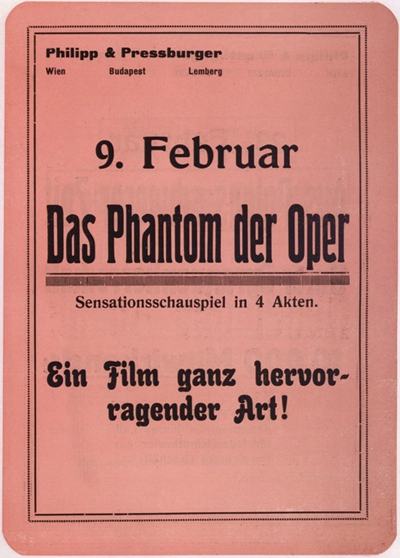
A definitive 7/10 rating for a film that redefined the boundaries of cult cinema. Das Phantom der Oper remains a cornerstone of transgressive art.
The first time the chandelier crashes in Das Phantom der Oper, you do not hear it—you feel it like a vertebra of light snapping inside the spine of cinema itself.
Released in the famine-year of 1916 while Europe’s trenches gulped whole generations, this German silent hallucination arrives as a velvet-lined scream hurled against the backdrop of carnage. Director Ernst Matray, cinematographer Nils Olaf Chrisander, and scenarist Greta Schröder conspire to transmute Gaston Leroux’s newspaper-serial shocker into a fever dream of flickering nitrate, a ghost story that already knows it is rotting from the inside out. The result is not merely an adaptation; it is a séance held inside a mausoleum that happens to sell tickets.
Forget the tourist-brochure boulevards; this fin-de-siècle Paris is a negative-space city where streetlamps gutter like failing hearts and the Seine resembles liquid pewter. Schröder’s intertitles read as if excerpted from a poison-pen confession: “He watched her through the eye of a rose.” The grammar of obsession is stitched into every iris-in, every double-exposure that superimposes Christine’s face over a cracked mirror, hinting that identity here is as fragile as the Phantom’s porcelain mask.
The Palais Garnier itself becomes a breathing organism: vaulted ceilings swell like whale ribs; fly-loft ropes dangle like nooses awaiting verdicts. Compare this claustrophobic grandeur to the open-air optimism of Scotland Forever or the pastoral romanticism of The Legend of Provence; Das Phantom der Oper insists that beauty and rot are conjoined twins sharing one oxygen mask.
Aud Egede-Nissen’s Christine is no swooning ingénue; her eyes carry the stunned calm of someone who has already pictured her own autopsy. When she steps onto the stage to sing Marguerite, the camera glides so close we can count the downy hairs at her temple trembling like antennae. The soprano’s voice—rendered through florid intertitles and a dizzying montage of gloved hands on organ keys—promises transcendence, yet the film whispers that every high C is merely a more ornate link in the manacle.
Aräschu’s Phantom (billed only by mononym, as if he were a primordial force) lurks beneath a mask that resembles a slice of moon chipped from obsidian. His gestures are balletic but palsied: fingers flutter like trapped moths when he reveals the underground lair festooned with papier-mâché gargoyles and candelabra whose flames never seem to consume their wicks. The film dares us to pity him; then it cuts to a shot of him locking the portcullis behind Christine with the casual click of a lover fastening a necklace. Desire, here, is a turnkey operation.
Where contemporaneous Gothic romances such as The Midnight Wedding trade in matrimonial misunderstandings, Das Phantom der Oper renders infatuation as civic infrastructure. The Phantom has mapped the opera house’s arteries—passages that smell of tallow and rat urine—more precisely than any municipal engineer. When he spirits Christine through a mirror that melts like heated celluloid, we enter a cathedral-sized dungeon where a colossal organ squats like a mechanical tarantula. Each pull of a stop lever corresponds to a creak in Christine’s psyche.
This underworld is lit with chiaroscuro so violent it borders on surgery: faces half-blanched, half-eclipsed, as though the cinematographer were carving guilt into flesh with a scalpel of photons. The palette alternates between the sulfurous yellow of backstage lanterns and the bruised aquamarine of moonlight filtering through grates, a chromatic tension echoed in the film’s moral spectrum: is the Phantom a wounded artist or a terrorist in greasepaint?
Chrisander, who both directs and embodies the masked anti-hero, understands that horror in 1916 is not about shock but hypnosis. His Phantom never rushes; he elongates time until the viewer feels sealed inside a jar of formaldehyde. Watch the sequence where he teaches Christine to sustain a note: the camera alternates between her quivering diaphragm and his gloved palm hovering millimeters from her skin, a visual metronome counting down to violation. The erotic charge is so acute it threatens to melt the film strip.
By contrast, Ernst Matray’s Raoul resembles a porcelain figurine too delicate for the third act. Yet this very fragility sharpens the stakes: the young viscount’s futile sword-swing against iron portcullises becomes a metaphor for an old world trying to hack its way into the twentieth century with antiquated codes of chivalry. The film savors that impotence, allowing torch-carrying stagehands to assume the heroic mantle, their soot-smeared faces more authentically revolutionary than any aristocrat’s oath.
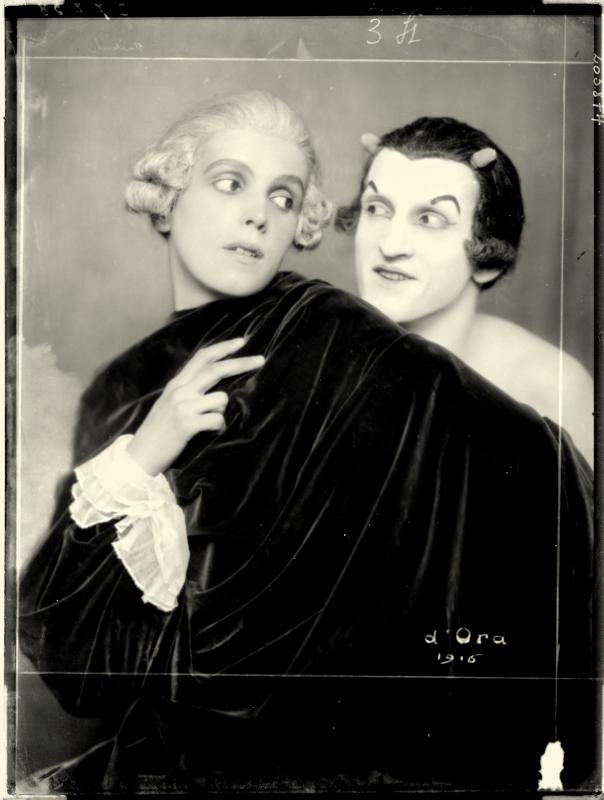
Schröder trims Leroux’s baroque subplots—no Persian, no retired magistrate’s memoir—yet she grafts in new arteries of dread. One intertitle reads: “The music of the night has teeth.” Another describes Christine awakening to find a wedding dress laid out, its train sewn from the silk of spider webs. The screenplay’s concision forces the visuals to shoulder narrative burdens, resulting in a cinematic shorthand where a single shot of a blood-red rose impaled upon a organ keyboard implies an entire cycle of hymenal dread.
Compare this narrative economy to the sprawl of The Road o' Strife, which needs reels to establish moral polarities. Das Phantom der Oper achieves the same mythic compression as Dolken, though where the latter externalizes guilt through doppelgängers, here guilt is a mask glued to flesh with the sap of unrequited genius.
Mid-film, the opera house hosts a bal masqué where nobles arrive as sphinxes, mermaids, and one blasphemous pope. The Phantom gate-crashes costumed as the Red Death, a cloak stitched from crimson velvet so deep it drinks kerosene light. Matray’s camera pirouettes through waltzing couples, then lands on that skull-mask visage emerging from a staircase of smoke. The moment lasts perhaps twenty seconds yet etches itself onto the viewer’s cortex with the permanence of acid. It is the first instance in cinema where terror gate-crashes opulence without warning, a template that will echo ninety years later in the art-house shock corridors of Sumerki zhenskoy dushi.
Because the film is silent, the audience becomes an unwilling accompanist. You hear your own pulse syncing with the flicker-rate of the shutter. When the Phantom pounds the organ, the intertitles grow jagged: “AND THE EARTH TREMBLED.” The absence of audible bass chords forces the viewer to hallucinate them, a synesthetic haunting more potent than any Vitaphone rumble. Contemporary critics complained that the film induced “delirious aurality” in deafening quiet—a phenomenon later exploited by Beulah, though that rural melodrama uses silence to evoke pastoral stillness, not subterranean damnation.
The final reel stages a pursuit that predates the expressionist fever of Caligari by three years. Stagehands, janitors, and street urchins converge into a hydra-headed posse wielding candelabras as cudgels. Their descent into the catacombs becomes a danse macabre shot in high-contrast orthochromatic stock that renders white eyes as lunar craters against coal-dust skin. The Phantom, cornered at an underground lake, raises his hand not in supplication but conductor’s authority: as if to command the rabble to sing. Instead, they throw stones that splash like verdicts. The camera tilts until his cloak fans out on the water’s surface, a black lily devoured by ripples. No resurrection, no sequels—just silence swallowing genius whole.
Modern viewers will flinch at the abduction narrative, yet the film complicates the damsel trope. Christine’s final glance at the submerged cloak is less relief than mourning for a part of herself that only the Phantom heard. Earlier, she tells Raoul, “He gave me music, you give me air,” a line that weaponizes the virgin/whore binary only to fracture it. She exits the story neither bride nor martyr but as a soprano whose range now extends into the grave register of loss. Compare this to the sacrificial femininity paraded in The Sons of Satan; Das Phantom der Oper allows its heroine the dignity of ambivalence.
For decades the film was presumed lost, a casualty of nitrate rot and war-time chaos. A 1998 retrieval from a Norwegian sanatorium attic yielded a 64-minute print riddled with fungal blooms. Digital restoration ironed out the bubbling emulsion, yet left intact the mosquito-speck blemishes that resemble celluloid measles—scars serving as material memory. Watching it today on 4K, you still see the splice marks where censors excised “excessively erotic” intertitles, creating stroboscopic jump-cuts that feel avant-garde a century later. Cinephiles who revere Escaped from Siberia for its frost-bitten authenticity will find a similar archaeological thrill here.
Every subsequent Phantom—Lon Chanley’s carnivalesque grotesque, Claude Rains’ velvet villain, even Andrew Lloyd Webber’s chandelier-pop maestro—owes its existence to this 1916 ur-text. Yet none replicate its existential chill, the sense that art and annihilation share a dressing room. The film whispers a question still unsettled: if genius requires captivity, does the cage become the artwork? In an era when algorithmic playlists quantify our tastes and streaming platforms rent our attention, the Phantom’s underground lair feels prophetic—a subscription service where the cost is eternal captivity.
Das Phantom der Oper is not a comfortable watch; it is a velvet-gloved slap that leaves fingerprints on your corneas. Its pleasures are perilous: the tremor of a gloved hand about to graze a throat, the sub-bass hallucination of organ chords you will swear you hear. It teaches that beauty can be a ransom note, that devotion can wear a mask and still be sincere. Most importantly, it reminds us that every opera house—every cinema—contains trapdoors. Step lightly, bring a torch, and never trust a melody that asks for your soul in lieu of applause.
The phantom never truly dies; he simply waits for the next reel to begin.
IMDb —
1924
Community
Log in to comment.