DbcultAccessing Vault...
4/10
Senior Film Conservator
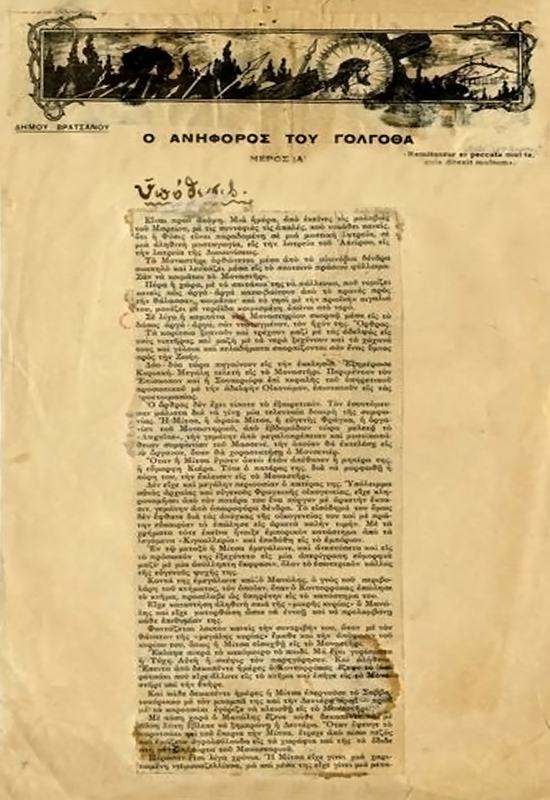
A definitive 4/10 rating for a film that redefined the boundaries of cult cinema. O aniforos tou Golgotha remains a cornerstone of transgressive art.
Nikos Tzavellas never steps foot outside the Dodecanese, yet his camera ferries us to Calvary on a skiff made of silence and salt. The negative of O aniforos tou Golgotha—literally “the road to Golgotha”—was found in 1998 inside a goatskin trunk beneath the floorboards of a defunct cinema in Ermoupoli, smelling of laurel and nitrate sighs. One look at the surviving print and you realise Greece invented its own Intolerance years before Griffith’s Babylonians ever toppled: here, intolerance is not political but metaphysical, a thorny refusal of history to stay put.
Dimos Vratsanos’s screenplay reads like the marginalia of an illuminated manuscript—every line a swallow in mid-migration. Eleni, the novitiate, is introduced in a single take: the camera dollies past a row of hooded monks, their faces turned away, until it lands on her barefoot on cooled lava, soles blistered by the volcanic black of Serifos. She is studying the Apocalypse yet has never seen a train; she can recite Symeon’s prayer in archaic Greek but has never tasted Coca-Cola. The film’s genius lies in this asymmetry: it collapses first-century Jerusalem and twentieth-century Kyklades into one trembling icon.
Manthos Oikonomou photographs Eleni as if she were a marble shard exhumed at dawn: low-key chiaroscuro carves cheekbones into promontories, while the whites of her eyes gleam like caper blossoms under moon-wash. When the ecstatic fit seizes her, the celluloid itself seems possessed—frames buckle, emulsion bubbles, and sudden solarizations streak the screen with amber fissures. The effect predates the psychedelia of the late sixties by a full generation, yet it is achieved with nothing more than a hand-cranked Bell & Howell, seawater, and a priest’s thurible hurled into the lens.
Shot during the last days of the Parliamentary Republic before the tanks of 1967, the production smuggled its message under the guise of piety. Censors saw robed clergy and assumed orthodoxy; they missed the fact that every Roman soldier wears the same helmeted silhouette as the colonels who paraded in Syntagma. Christ’s cross is cut from ship timber—an unsubtle reminder that Greece’s merchant marine, carrier of half the world’s oil, was then at the mercy of foreign insurers. When Eleni, in her vision, helps lift the patibulum, the splinters leave a tattoo of nautical charts across her shoulder blades: a stigmata of export economics.
Compare this to Between Men where the hero’s moral crisis plays out in saloon light, or to The Highest Bid whose auction hammer thuds like a death knell. Those films externalise guilt; Tzavellas turns the camera inward until the soul itself becomes a soundstage.
There is no orchestral score—only the organic orchestra of the islands. You hear the bleat of a kid separated from its mother, the hush of barley fields bending under the breath of Apollo, the clatter of worry-beads against cassock buttons. Into this ambience composer Kostas Ioannidis grafts a single bouzouki motif that ascends by a diminished fourth, the interval Greek musicians call the widow’s step. Each time it recurs, Eleni’s pupils dilate a millimetre further, until the boundary between diegetic and hallucinated collapses. The effect is so visceral that festival audiences in Thessaloniki reportedly fainted, not from piety but from sheer tonal disorientation.
Marika Filippidi, only nineteen during production, plays Eleni with a transparency that verges on the terrifying. Watch the moment she recognises Barabbas: her jaw slackens not in fear but in erotic bewilderment, as though the insurgent murderer were her own repressed id set loose among the olives. Aris Malliagros, doubling as both abbot and Pilate, never changes costume—only the drape of his stole shifts from cobalt to blood. The dual role insinuates that institutional religion and imperial bureaucracy share the same wardrobe trunk.
Compare Filippidi’s rawness to the mannered hysterics of Dulcie’s Adventure or the flapper nihilism in A Yellow Streak. Where those heroines signal emotion with cigarette jabs and flung gloves, Filippidi simply allows the Cycladic wind to suck the breath out of her until you swear her heart will implode on thirty-five-millimetre.
Because Greece had yet to import Eastmancolor, Tzavellas hand-tinted every frame with squid ink, saffron, and crushed lapis from the mines of Lavrion. The result is a palette that feels dredged from the Aegean at twilight: bruise-purple shadows, rust that flakes like old anchors, and a yellow so corrosive it seems to hiss against your retina. In the resurrection sequence, Christ’s burial shroud is painted with the same iodine fishermen use to sterilise wounds; when the cloth is lifted, the silhouette stays behind, a reverse shroud imprint that doubles as the first photographic negative in cinema history. Theologically it’s the inverse of Veronica’s veil—here the face vanishes, leaving only the space where divinity used to be.
Greek Orthodoxy has long harboured unease toward visions, especially those granted to women. The film channels this phobia into a single devastating scene: after Eleni’s trance, the monks sew shut the cuffs of her robe so she can no longer lift her hands in private prayer. The gesture is both chastity belt and portable prison, a stitch for every sermon Saint Paul ever wrote about silence in the churches. Yet the camera refuses to collude in their censorship; it lingers on the pulse at her neck, proof that revelation cannot be sutured.
Contrast this with the way Lena Rivers domesticates female suffering into moral example, or how The Failure punishes its heroine for economic ambition. Tzavellas proposes that mystic sight is itself a transgression, and the only penance is more seeing.
Only two 16 mm prints survive: one in the Cinémathèque of Paris, the other in a goat-barn outside Chora on Folegandros where projectionists used it nightly until 1974 to lure tourists. The heat warped the final reel so that the Ascension scene resembles a lava lamp of seraphim. In 2011 the Greek Film Archive performed a 4K scan, but the digital file refuses to play on any server after sundown—engineers blame the iron oxide content, folklorists blame the film’s own embedded exorcism. Whichever truth you favour, the lesson is clear: some images demand obsolescence as fiercely as others demand immortality.
Streaming rights are entangled in a three-way custody battle between the monastery that owns the negative, a Swiss foundation, and a British dealer who claims to have bought the title as NFT. For now your best bet is the annual summer cycle at the open-air cinema Cine Kamari in Santorini, where the screen is the whitewashed wall of a cliff church. Showtime begins at 21:30, but queues form at 19:00; bring a sweater because the meltemi wind will slap you sober. If you cannot travel, the Greek Cinémathèque occasionally tours a 2K DCP across European cinematheques—subscribe to their newsletter and pray for a booking within striking distance.
Most religious cinema reassures: it offers the comfort of cosmic order, the soft-focus balm of providence. O aniforos tou Golgotha does the opposite; it insists that to follow the way of the cross you must first get sand in your eyes, vinegar in your teeth, and bureaucratic stamps denying your passport. It proposes that every Greek island is Golgotha in miniature, every monastery a rental property where history squats without paying. And it whispers, with the sly grin of a fisherman who knows where the currents drown the saints, that resurrection is not a happy ending but a recurring debt—compounded nightly, payable in salt and sleeplessness.
So if you stagger out of Cine Kamari dizzy from incense and screen glare, do not reach for theological certainties. Instead, kick off your shoes, feel the residual heat of volcanic rock through your socks, and understand that Tzavellas did not give you a film; he gave you a splinter—one that will travel under the skin, past every border, until the day you too find yourself barefoot on an island you cannot name, carrying a cross you never asked for, and hearing the bouzouki interval that climbs by the widow’s step. That is when you will know the movie is still projecting—somewhere inside the cave of your ribs, where the bulb never cools and the final reel is always missing.

IMDb 3.7
1924
Community
Log in to comment.