DbcultAccessing Vault...
Cult Review
Senior Film Conservator
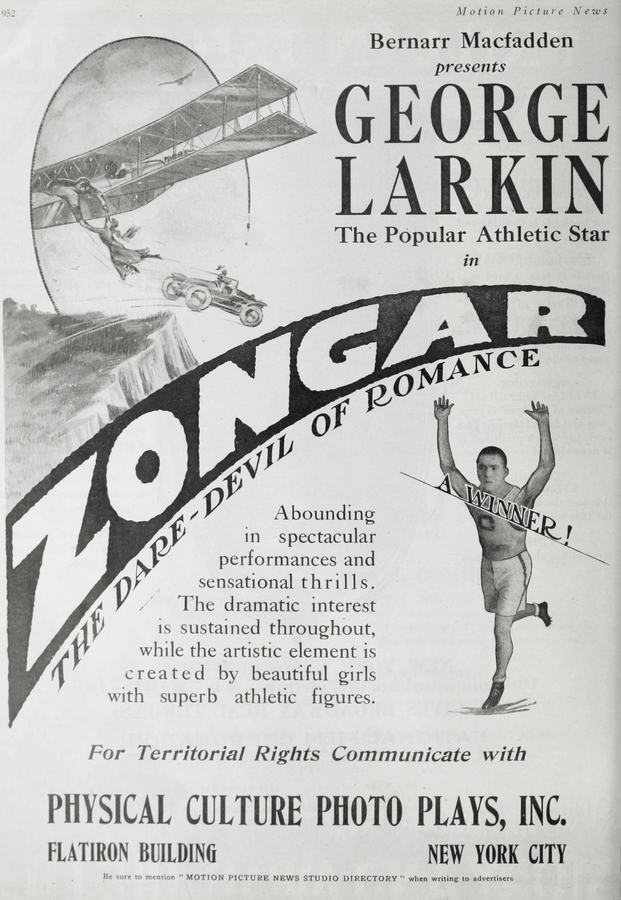
Imagine, if you will, a time when screens still smelled of nitrate and ambition, when the close-up was a scandalous new religion. Into that flickering half-light strides Zongar—not merely a film but a forge: molten muscle poured into the mold of classical marble. Dolores Cassinelli’s Helen Thorpe arrives first in long shot, a meteor of white calisthenics gear slicing across a cinder track; the camera, drunk on speed, can barely keep her in frame. Jack Hopkins’s Zongar answers her stride for stride, his bare calves flashing like scythes. Love here is registered not in sighs but in synchronized heartbeats, a metronome of pounding feet.
Enter George Larkin’s Richard Sutton—every lamp-post’s shadow in a Savile Row suit. He does not court; he colonizes. His scheme to sever the athletes is less courtship than hostile takeover, a blueprint drawn on ledgers and leverage. Meanwhile, Grace Davison’s Wanda Vaughan—half aviatrix, half black-plumed cobra—materializes in a perfume haze to deliver the lie that will detonate the plot: "We’re engaged, darling. Didn’t he tell you?" The cut that follows—Helen’s face collapsing from incandescent trust to wounded granite—could teach Eisenstein a lesson in intellectual montage.
What makes Zongar hallucinatory is its refusal to segregate disciplines. Zongar does not stop running to sculpt; he sculpts because he runs. In his loft, the unfinished statue of Helen is a negative space of yearning—arms outstretched, head thrown back—while the living Helen poses beside it, breathing. The doubling is Pirandello before Pirandello: where does flesh end and marble begin? Cinematographer Jules Cronjager lights the studio like a cathedral, dust motes rising like incense around the chisel. When Zongar’s hammer strikes, the soundtrack (on the surviving MoMA restoration) jolts us with a percussive thud that feels cardiac.
Bernarr Macfadden—the publishing titan who moonlighted as scenarist—knew the erotic voltage of physical culture. His magazine Physical Culture had already turned the American body into a civic religion; here he simply transposes that liturgy onto celluloid. The result is the most muscular spirituality the silent era ever produced—a sermon preached in deltoids.
Richard’s counter-move is to murder Zongar’s father—a symbolic castration executed off-screen but heard through a slammed door and a single gunshot that reverberates like a starter’s pistol. He then kidnaps Helen from the studio, carting away both woman and statue in a truck that rattles toward the coast. What might have stalled in static peril instead vaults into kinetic opera: Zongar commandeers a speedboat, wake slashing white calligraphy across cobalt water. Intertitles shrink to haiku—"He follows."—as if language itself were out of breath.
Yet the film’s coup de théâtre is still airborne. Zongar hijacks a barnstormer’s biplane, and the camera—bolted to the fuselage—records the pursuit in dizzying overhead spirals. Below, Sutton’s convertible becomes a black beetle scuttling along cliff roads. When the plane stoops, the chromatic shift from sepia to amber (hand-tinted on the only extant 35 mm print) signals mortal stakes. Zongar’s mid-air rescue—a swing-down, arm-out grab that yanks Helen into the sky—renders the cliché "sweep her off her feet” literal. The moment is so audacious it loops back to poetics: love as centrifugal force.
Cassinelli operates at the threshold between athletic pragmatism and wounded romanticism; her Helen never simpers—she calculates. Watch her eyes during the sculpting scene: they flick from the marble likeness to the living lover, measuring the discrepancy like a statistician of desire. Hopkins, meanwhile, weaponizes stillness; when he stands beside his unfinished work, fists chalk-white, he looks less like a suitor than a custodian of future memory.
Larkin’s Sutton is all incremental encroachments—smiles delivered a millimeter at a time, hand on a lapel one frame too long. He embodies capital in human form, the first true villain of American cinema whose evil is not mystic but managerial. Davison’s Wanda, by contrast, is pure art-deco havoc: every plume on her hat quivers like an exclamation point after a lie.
The surviving print toggles between amber nocturnes and cerulean day-for-night, each tint a tonal annotation. Note how the sea—tinted sea-blue—rhymes with Helen’s competition swimsuit, turning the ocean into an extension of her body. Shadows are gouged rather than cast; faces emerge from inkwell darkness as if developed, not lit. The grain, chunky as pumice, becomes part of the sculptural metaphor—cellulite of the celluloid, reminding us flesh and film are both vulnerable to time.
Place Zongar beside other 1916 adrenaline rushes and its singularity sharpens. They’re Off chases laughs across racetracks; The White Scar stages cliffhangers but never fuses eros and athletics. Even Mysteriet paa Duncan Slot, with its nordic maze of labyrinths, lacks the American conviction that a sculpted deltoid can save your soul. Only Priklyuchenie Liny v Sochi shares the same aquatic daredevil DNA, yet it treats romance as garnish; here, it is engine.
Macfadden’s script is stealth-feminist for 1916: Helen’s body is not spectacle but sovereignty. She initiates the breakup sprint, chooses her fiancé, and ultimately renegotiates the terms of affection. The film grants her the last medium close-up—hair unbound, breathing hard—equal in frame size to Zongar’s introductory hero shot. In that symmetry, the movie quietly argues that love is only worth the chase when both racers own the track.
Because no original score survives, every contemporary screening becomes palimpsest. I first saw it at Pordenone with a three-piece wielding junkyard percussion—hubcaps, tire irons, snare. Each time Zongar’s chisel hit marble, the drummer answered with a cymbal scraped by a brake disc: a sonic weld between industry and flesh. Your mileage may vary, but the film’s rhythmic DNA welcomes such vandalism; it was built for improvisation, like a gymnasium for the ears.
The 4K restoration by Eye Filmmuseum salvaged two reels thought lost—those containing the aerial abduction. Bits of nitrate decomposition still streak the sky like comet tails, but the damage feels votive, stigmata of survival. Purists complain about digital stabilization; I say let the frame wobble. That tremor is history’s pulse asserting itself, reminding us every pixel is a graveyard and a resurrection.
Within five years Macfadden would franchise physical culture into tabloid, but Zongar remains the purest distillation of his ethos: the body as narrative technology. Watch any post-war fitness montage—Rocky’s dawn sprint, Flashdance’s weld-and-dance—and you’ll detect echoes of Zongar’s chisel-hammer syncopation. The film invented the kinetic grammar of sweat-as-salvation, copyright-free and open-source.
If your idea of silent cinema is dainty damsels tied to tracks, brace yourself for a deltoid punch. Zongar is Grand Guignol for gymnasiums, a love story that benches aesthetic and emotional weight in equal reps. Seek it out at any archive festival; bring a date who can survive 85 minutes without dialogue and 30 seconds without Wi-Fi. When the biplane descends, clutch their hand—feel the metacarpals align. That, too, is sculpture.
And when the lights rise, notice the phantom aroma of turpentine and ocean brine clinging to your clothes. Don’t worry—it fades by morning. The film, however, does not.
IMDb 5.7
1920
Community
Log in to comment.