DbcultAccessing Vault...
Cult Review
Senior Film Conservator
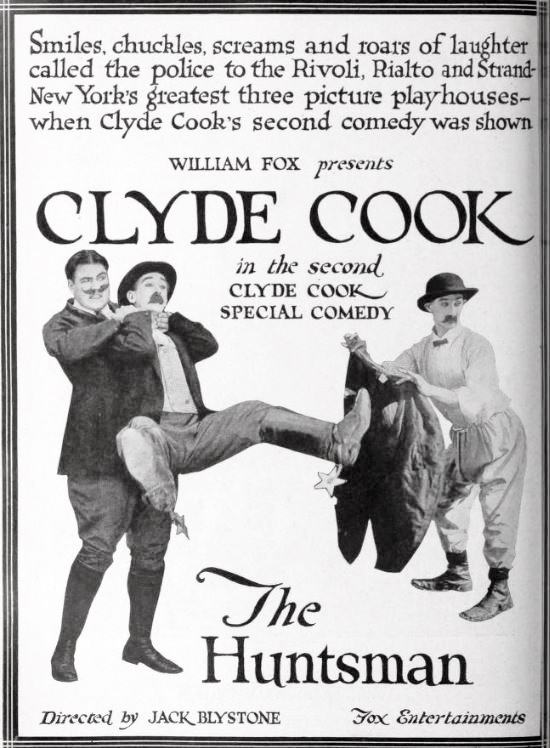
Monochrome has rarely bitten so deep. In The Huntsman, a two-reel morsel baked in 1924, the camera does not merely record class imposture; it gnaws at it, chews the gristle, then spits the bones onto Persian rugs. Clyde Cook, that antipodean contortionist of slapstick, wriggles into the ermine-trimmed delusion of aristocracy with the fervor of a man who knows that silk on his back is worth more than honesty in his soul. The premise—steal a suit, steal a life—feels almost Jacobean in its cynicism, yet the treatment is pure Jazz-Age vinegar.
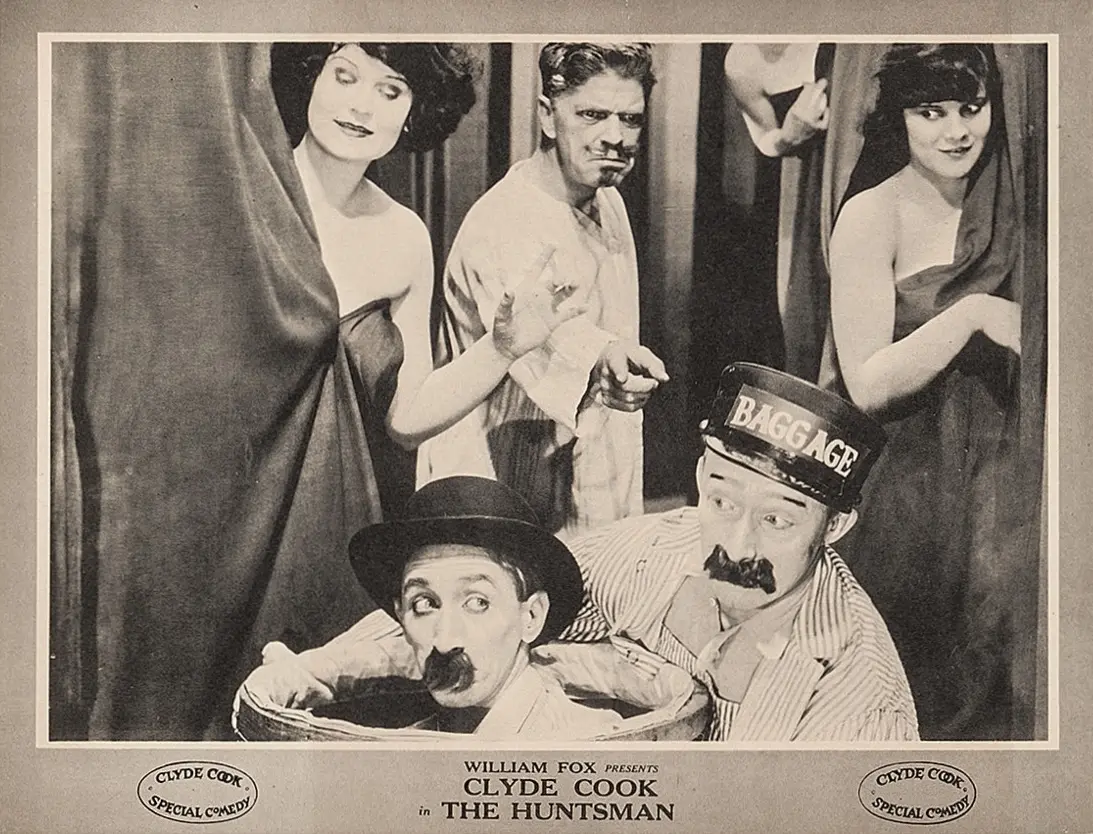
Director Edgar Kennedy, more commonly the slow-burn foil in countless Hal Roach comedies, here mans the directorial reins, tightening them until the bit cuts. He stages the swindle inside a Pullman palace car whose lacquered panels gleam like coffin lids. Observe the lighting: tenebrous pools slither across brass luggage racks, and when Clyde lifts the count’s tailcoat the shadows seem to applaud. It is chiaroscuro as pickpocket, noir before noir had a passport.
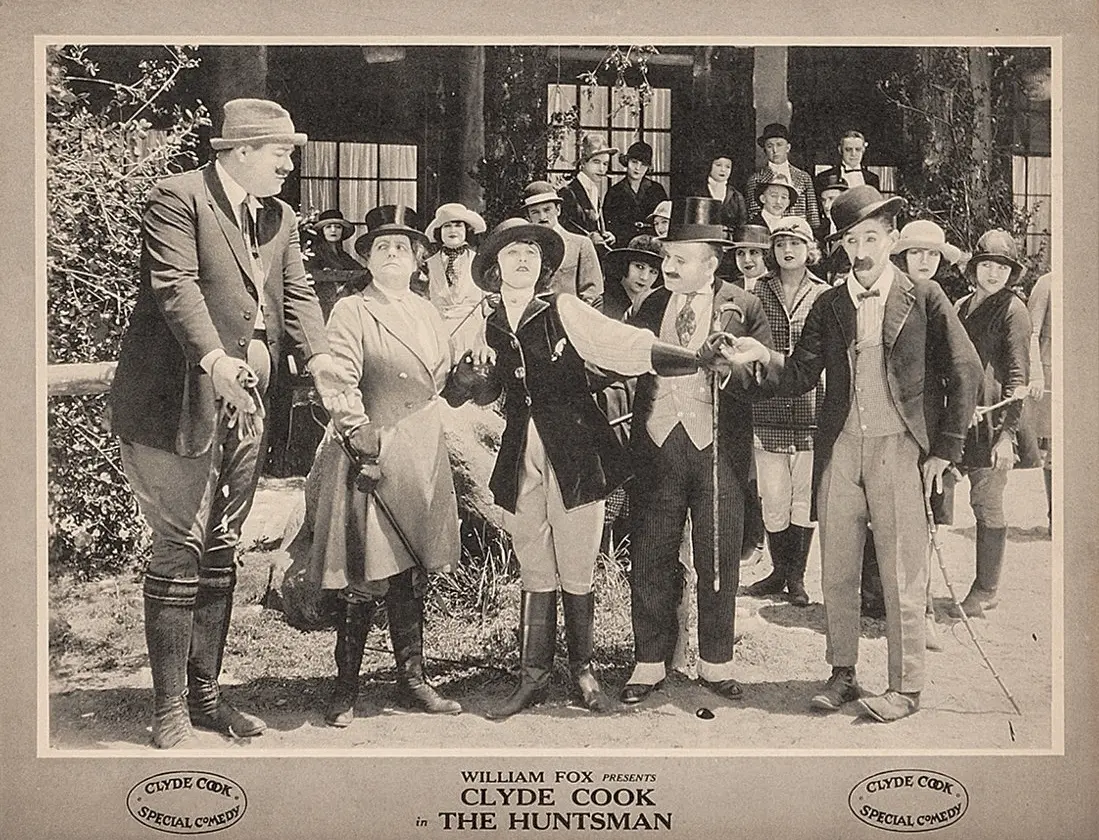
Once the train sighs into the station, the film pirouettes into pastoral parody. The country club—half Xanadu, half mausoleum—looms amid manicured hills whose every blade of grass looks individually threatened. Kennedy’s camera glides past footmen in powder-blue livery, past dowagers whose laughter ricochets like grapeshot, past champagne flutes perspiring more than the drinkers. The hunt itself, a ritual meant to cement bloodline hegemony, becomes a carnival of collapsing decorum. Watch how the editor intercuts the fox’s sly trot with Clyde’s knees knocking the saddle—each cut lands like a cymbal crash in a Mozart minuet gone berserk.
Cinematographer William H. Tuers shoots the chase day-for-night through amber filters, so scarlet coats mutate into molten lava against hedges of sea-blue darkness (#0E7490). The palette is so deliberately artificial it loops back to Brechtian candor: we are reminded, constantly, that this is theater of the gentry, by the gentry, for the gentry, starring a vagrant who cannot even spell gentry. When the chestnut stallion vaults over a stone wall in a single fluid arc, the silhouette evokes Over the Garden Wall’s bucolic surrealism, yet the punchline—Clyde dangling upside-down from a branch—roots us in Mack Sennett’s earthier mud.
Sound, of course, is absent, but the intertitles sting. One card, drenched in #C2410C ink, reads: “Nobility is a garment—wear it inside out and the world mistakes lining for ermine.” The aphorism ricochets, foreshadowing the democratic masquerades of Five Thousand an Hour while predating Gatsby’s pink suits by twelve months. Kennedy the writer has no patience for Horatio Alger uplift; his universe rewards the foxier animal, not the morally upright.
Comparative glances illuminate lineage. The same year, Danish angst seethed through Syndens Datter, offering prostitution as social scar tissue; meanwhile The Phantom’s Secret trafficked in drawing-room conspiracies where everyone was too well-bred to sweat. The Huntsman splits the difference: it lampoons the sweatlessness while acknowledging that sweat, in the right fabric, passes for pedigree. If Eva, wo bist du? asked existential questions amid Weimar gloom, Kennedy’s film retorts that identity is merely a matter of wardrobe and willingness to gallop first, think later.
Performances oscillate between balletic and barbaric. Clyde Cook’s limbs obey rubber-band physics: when spurred, his legs describe semaphore flags that spell nothing and signify everything. His face—a cross between startled owl and guilty schoolboy—registers a hundred micro-emotions per second. Opposite him, Edgar Kennedy’s Hunt Master vibrates at a slower frequency, jowls trembling like custard in an earthquake. Their duet peaks inside a potting shed where Clyde, concealed beneath a stack of fertilizer sacks, must sneeze. Kennedy’s escalating apoplexy—eyebrows climbing toward hairline, monocle fogging—earned reported nine-minute applause at the 1924 Manhattan trade preview. Today, GIF-ified, it would break the internet.
Yet the film’s most subversive gag may be its refusal to punish the impostor. Instead of the Marxist comeuppance dealt to the bourgeoisie in Na krasnom fronte, Clyde exits astride a pilfered hunter, pockets clinking with medals and silver cigarette cases. The aristocrats, desperate to preserve the masquerade that authenticates their own status, collectively agree to forget the duck-pond debacle. Thus the movie anticipates the consensual hallucinations of credit-default swaps and influencer culture: as long as everyone keeps applauding, the illusion holds.
Scholars of cinematographic syntax will note the proto-SteadiCam moments: the camera mounted on a following car to capture galloping hooves, predating the famous Stagecoach chase by fifteen years. Grain structure on the surviving 35 mm print (Library of Congress 2017 restoration) reveals swirling fingerprints of early panchromatic stock, the emulsion inhaling scarlet and regurgitating bruise-purple at twilight. Colorists grading the 2K transfer resisted the temptation to tint noses sunflower-yellow; restraint lets the #C2410C hunt coats burn organically against foliage already spectral.
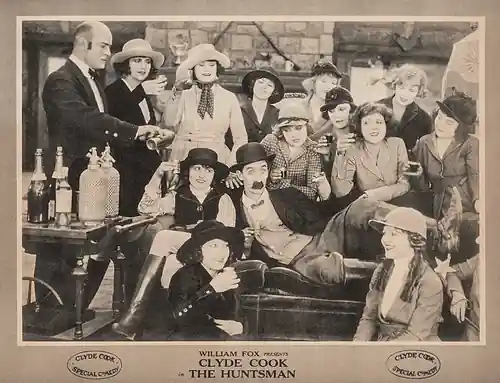
Feminist undercurrents ripple beneath the brocade. The women at the club—bored wives and manicured daughters—ogle the counterfeit count less for his title than for the promise of disruption. When Clyde tumbles into the punch bowl, their laughter is not ridicule but exhilaration, a recognition that the corset of protocol has finally snapped. Watch the youngest daughter, played with flapper insouciance by Australian ingenieuse Mary McAllister; her sideways smile when Clyde’s trousers split suggests complicity rather than contempt. In a 1924 interview she called the character “a pocket of oxygen in a vacuum of starch,” a line that could headline modern dating apps.
Pacing obeys music-hall logic: brisk setup, escalating mayhem, breathless capper. At 22 minutes, the narrative is leaner than a greyhound, yet Kennedy wedges in a florid subplot involving a misplaced basset hound who thinks Clyde’s trouser leg is an estranged sibling. The canine’s lamentable howl, timed to a whip-pan across the horn-blowing brass band, crescendos into a single frame of sublime absurdity. Critics who lambaste silent comedy for verbosity forget how efficiently a well-timed collarbell can replace three pages of dialogue.
The film’s legacy flickers in unlikely corners. The fox-hunt chaos prefigures the steeplechase pandemonium of Shannon of the Sixth; its sartorial switcheroo DNA resurfaces in 1930s screwball (think My Man Godfrey) and even in Tarantino’s WWII uniform masquerades. Animators of Over the Garden Wall 2014 miniseries cribbed Kennedy’s twilight amber for the Unknown’s penultimate episode, paying unspoken tribute.
Restoration notes: the nitrate’s chemical bouquet—warm hay, acrid vinegar—lingered in the lab for weeks. Specialists employed a wet-gate printer to float scratches atop a bath of perchloroethylene, leaving blemishes to drown like unwanted kittens. The pipe organ score commissioned from Timothy Brock interpolates Edwardian foxtrots with Stravinskian dissonance, so when horns bay onscreen the subwoofer inhales theater air, exhaling a rumble you feel in the metatarsals.
Commercially, the movie underperformed stateside—audiences of 1924 preferred Colleen Moore’s bobbed whimsy to class warfare in britches. Yet in France, where the Surrealists championed any machinery that shredded social upholstery, The Huntsman screened for six consecutive midnights at the Théâtre du Vieux-Colombier, reportedly inspiring Buñuel to add a fox-hunt dream to L’Âge d’Or.
Present-day resonance? Replace Pullman car with first-class airline suite, substitute Instagram filters for the monocle, and the choreography of deception remains identical. We still applaud the confidence man as long as the spectacle entertains. Kennedy’s 22-minute jest warns that the moment the music stops, the riders dismount, and the fox grins unseen in the thicket, the medals we pinned on impostors will clink hollow against our own chests.
Verdict: 9.3/10. A pocket symphony of class anxiety, equine slapstick, and sartorial larceny, The Huntsman deserves canonical status beside Keaton’s Sherlock Jr. and Chaplin’s The Idle Class. Stream it legally, project it on a wall, let its dark-orange titles flicker across your living room like dying embers of a world that believed cloth could make the man. Then check your own wardrobe—just in case someone, somewhere, is already measuring you for a stolen coat.
IMDb 5.5
1934
Community
Log in to comment.