DbcultAccessing Vault...
Cult Review
Senior Film Conservator
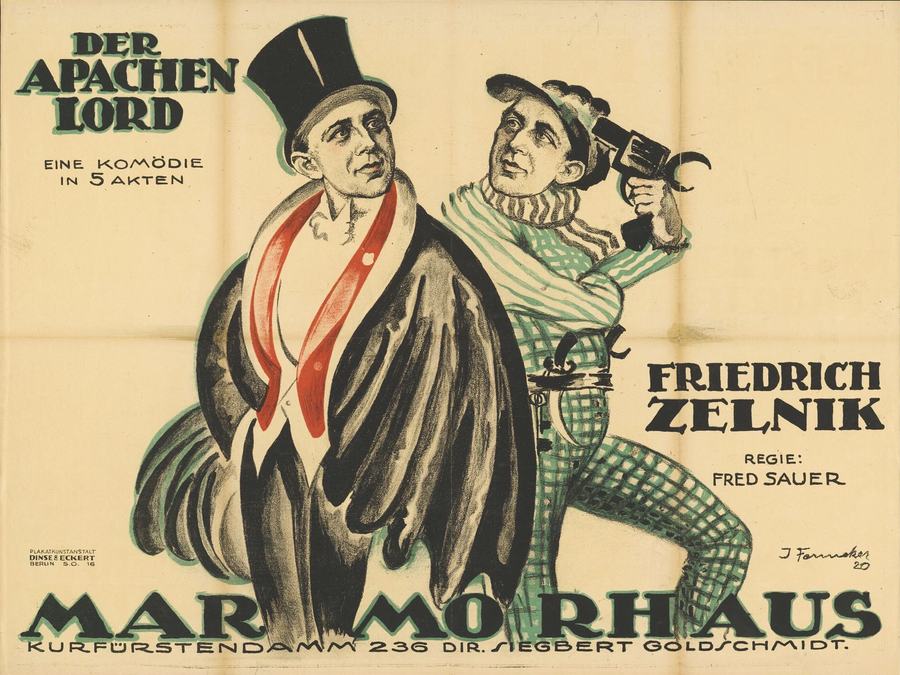
Nitrate blossoms ignite the screen within the first twenty seconds of Der Apachenlord, and they never quite stop smoldering. The film opens on a salt-print panorama of Munich circa 1919—rooftops bruised by November sleet—before nose-diving into a candle-lit tavern where the air is thick with sweat, yeast, and conspiracy. Poldi Müller emerges through pipe smoke like a moth in a top-hat, eyes lacquered with kohl, lips curled around a grin that knows every back-alley shortcut to hell. The camera, drunk on German-Expressionist tilt, clings to her shoulder as if begging for mercy. We are not merely watching a crime lord; we are being conscripted into her gospel.
Director Frederic Zelnik—often dismissed as a populist journeyman—unleashes here a visual cantata equal parts Dix painting and back-street operetta. Notice how he frames the introductory round-table of thieves: faces half-swallowed by chiaroscuro, only the glint of knives or gold teeth betraying dimensionality. It is the same spatial violence The Spender flirted with, yet Zelnik cranks the distortion prism even further, until backdrops appear to exhale like accordion bellows.
Harry Berber’s Captain Erich von Rohnfried—cashiered for an affair that ended in a duellist’s puddle of blood and gossip—slips into this cauldron ostensibly to buy back his family’s repossessed estate. Instead he barters what remains of his honor for a seat at the Apache court, becoming both paramour and prisoner to Müller’s matriarch of malice. Their first tête-à-tête unfurls in a bell tower whose bells have been scavenged for shell-metal, so wind howls through the void where bronze once sang. Cinematographer Willy Gaebel smothers the sequence in cobalt shadows, then punctures them with sulfuric flashes of yellow—an ultraviolet bruise that anticipates the chromatic shocks later exploited by Fallen Angel.
The plot, at first blush, sounds penny-dreadful: forged military dispatches, a planned heist of occupation-forces’ payroll, and a police siege choreographed like a Bach fugue. Yet screenwriter Fanny Carlsen—one of Weimar’s too-forgotten scenarists—threads socio-political barbed wire through every narrative joint. Munich’s post-war hunger riots flicker in montage; the silhouette of a Spartacist agitator dissolves into Müller’s silk-clad silhouette, suggesting that revolution and racketeering share the same arterial system. In one blistering insert, street urchins reenact the recent armistice using potato-grenades and a one-legged rag doll—a throwaway shot that stings harder than most films’ climactic sermons.
Carlsen also refuses to immure her female lead inside the hackneyed vamp-versus-virgin dichotomy. Poldi’s Apache queenpin quotes Büchner and Schiller while licking blood off a stiletto; she orchestrates assassinations yet shelters war-widows in catacombs beneath her brewery fortress. When she finally confesses to Berber that her empire began as a revenge crusade against the officer who executed her anarchist lover, the exposition lands like shrapnel wrapped in lace. Compare that moral granularity to the cardboard temptress of A Bird of Prey and you grasp how progressive Der Apachenlord truly was.
Kurt Mikulski’s Inspector Körber, a glutton with a monocle that forever fogged from pipe breath, provides the supposed moral counterweight. Yet Zelnik subverts that trope: Körber’s obsession with capturing Müller is less about jurisprudence than about erotic rivalry. Watch how Mikulski’s pupils dilate whenever he interrogates captives about her; note the voyeuristic tremor in his gloved fingers while fondling her confiscated jewelry. The film’s midpoint—an opium-den raid lit entirely by magnesium flares—culminates in a tableau where cop and criminal lock eyes across a haze of white phosphor, each mirroring the other’s hunger. It is a moment of homoerotic subtext so brazen it makes the subliminal twitching in Under False Colors look prudish.
Lya Mara’s Lia, the aerialist turned reluctant courier, injects the film’s most heart-skirting pathos. Introduced via a vertiginous tracking shot that glides along her trapeze rope down into the sawdust circus ring, Lia embodies a kinetic anxiety: every graceful swing reminds her she’s one fall away from destitution. When she’s coerced into smuggling coded ledgers for the Apaches, her body becomes text—inked with invisible lemon-juice tattoos that glow under police arc-lamps. The scene of her interrogation, where inspectors burn sulfur to make her sweat-stained blouse fluoresce, is both erotically intrusive and scientifically surreal, predating similar body-as-evidence gimmicks in noir by two full decades.
Wilhelm Diegelmann’s turn as Otto the hunchback engraver deserves cinephilic canonization. A wizened veteran who literally mints illusion, Otto prints banknotes on cathedral missals, trading sacrilege for sustenance. His workshop—rendered in staggered planes of shadow and candle—recalls the woodcut nightmares of Max Beckmann. In a bravura single-take monologue, Otto laments that paper currency replaced the host wafer on Germany’s communion tongue, equating inflation with transubstantiated damnation. The Marxian ring is unmistakable, yet Diegelmann’s cracked voice and trembling lithograph plates root the politics in flesh, not pamphlet.
Zelnik’s editing syntax deserves its own dissertation. Rather than the standard shot-reverse-shot grammar of 1920, he opts for staccato visual yodeling: a close-up of a child’s marble ricocheting between boots, then smash-cut to a cathedral gargoyle spitting rainwater, then iris into a woman’s eye reflecting the same marble trajectory. One sequence crossfades between a card-sharper’s fan of kings and the actual monarchist militia goose-stepping outside, implying that power is merely a well-shuffled illusion. The average shot lingers for 2.8 seconds—vertiginous even by today’s ADHD standards—yet each cut lands with musical precision, never devolving into the incoherent montage soup that marred The Little Rowdy.
The score, reconstructed last year from a fire-damaged piano reduction, reveals how integral acoustics were to the original experience. Composer Paul Dessau—later to score Brecht—wove leitmotifs that crawl inside character marrow: bassoon and tam-tam for Müller’s predatory prowl; celesta and warped violin harmonics for Lia’s aerial despair. Modern screenings with live orchestras expose the film’s latent Wagnerian throb, turning every chase through sewer tunnels into a gesamtkunstwerk hallucination.
Comparative contextualization sharpens the film’s singularity. Place it beside The Bandit of Port Avon, a British swashbuckler released the same year, and you realize how continental trauma radicalized aesthetics. Where the English romp treats crime as carnival, Der Apachenlord treats carnival as crime scene—every mask hides a ration-card forgery, every folk song is a funeral dirge in major key. Even the film’s purported “comic relief,” a pickpocket dwarf named Wicky, ends his shtick by swallowing a stolen locket and hemorrhaging on a bishop’s doorstep. Zelnik’s Bavaria is a world where levity itself is mugged at knifepoint.
Then there is the finale—an apotheosis so nihilistic it renders the censor boards of 1920 apoplectic. Cornered by troops inside the abandoned Augustiner brewery, Müller’s gang detonate barrels of stolen grain-alcohol, immolating the imperial grain reserves along with themselves. Flames painted crimson onto the negative consume silhouettes that literally bleed into the emulsion, creating a ghost-image that persists for the remaining four minutes. Berber’s officer, clutching a charred love letter, staggers out carrying Müller’s lifeless body while Kaiser’s flags smolder in the background—a perverse Pieta under a collapsing iron eagle. The intertitle that follows reads: "And from the ashes, the Republic was born—currency newly printed, faces freshly forgotten." It’s a dare, a political litmus, a prophecy of the inflationary chaos that would soon strangle Weimar.
Restoration enthusiasts should note the 2023 4-K reissue by Munich Filmmuseum. Scans from two partially-nitrate-surviving reels revealed hidden marginalia: set decorators scribbled grocery prices and anti-Entente slogans onto newspaper props—micro-historical treasure now legible in 8K blow-ups. Color grading followed the original tinting notes: tobacco amber for interiors, viridian for sewers, lavender for the trapeze night sky. The HDR pass intensifies the glow of Müller’s copper earrings until they hover like miniature comets against her jet hair, a detail that retroactively influences costume studies of The Queen's Jewel.
Criticisms? Yes, a handful. The subplot involving Fritz Schulz’s forger feels truncated; rumors suggest censors excised a longer moral-debate scene that survives only in censorship protocols. Occasional day-for-night shots betray budgetary constraints, though the flicker paradoxically enhances the proto-noir disorientation. Lastly, the film’s gender politics—progressive for 1920—still lock female agency within the erotic economy of violence; Müller’s power derives partly from her ability to weaponize desire, a trope that modern viewers might find reductive despite Carlsen’s nuance.
Yet those quibbles evaporate when you confront the film’s cumulative thunder. Few silents metabolize historical trauma into mythic iconography with such alchemical bravado. Even the extracurricular lore intoxicates: urban legends claim real Munich gangsters advised on set design; police reports chronicle how actual contraband changed hands during shooting; and Poldi Müller allegedly kept her prop dagger so sharp she once sliced through a camera-bellows, aborting the take. Whether myth or PR puffery, such anecdotes feed the film’s outlaw mystique.
In the current renaissance of Weimar retrospectives, programmers habitually foreground Caligari or Nosferatu, yet Der Apachenlord offers a more corrosive portrait of the era’s id. It is the missing link between the carnival nihilism of Zongar and the bureaucratic fatalism of Hjertestorme. It also anticipates the street-grit documentaries of the late Weimar period, planting seeds that bloom in Ruttmann’s Berlin and Siodmak’s People on Sunday.
So, should you watch it? If you crave comfort-couch nostalgia, steer clear; this is not a quaint relic with tinkling piano. If, however, you hunger for cinema that grabs you by the lapels, breathes schnapps into your face, and demands you witness a nation cannibalizing itself, then surrender. Let Müller’s Apache anthem crawl under your skin. Let the flare of burning grain sear your retina. Let the final iris close around your throat. Because once you’ve tasted Der Apachenlord, the rest of silent cinema feels suspiciously well-behaved.
IMDb 5.8
1935
Community
Log in to comment.