DbcultAccessing Vault...
Cult Review
Senior Film Conservator
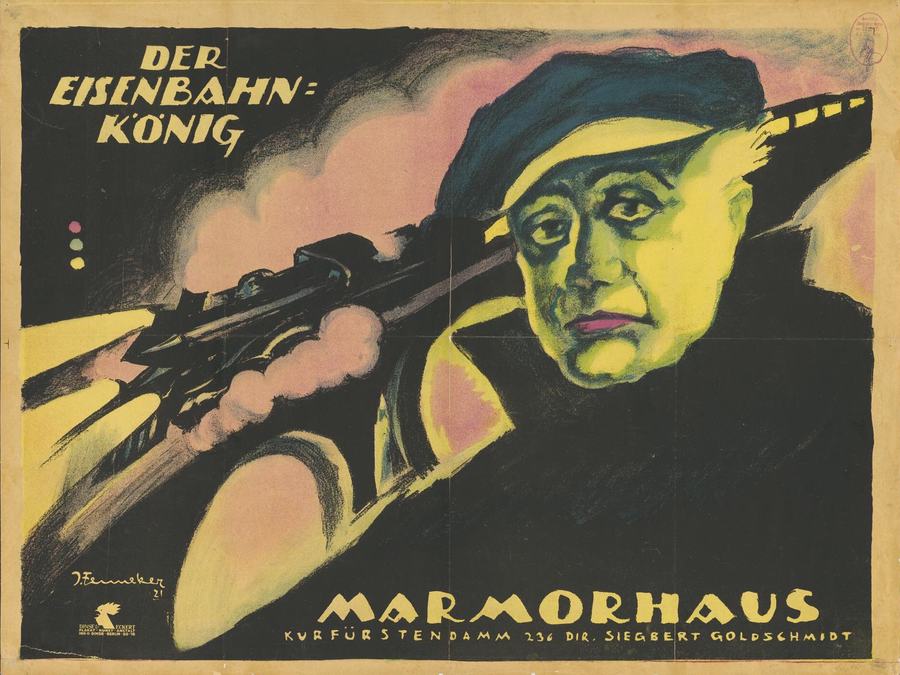
Fritz Kortner’s cheekbones alone could slice the celluloid, but in Der Eisenbahnkönig 2. Teil – Lauernder Tod they do something far nastier: they register the moment capital eats its creator. This frequently mislaid 1921 sequel, languishing for a century in Prague vaults, is less a train movie than an autopsy on wheels—an x-ray of how industrial modernity’s most romantic metaphor becomes a hearse when the balance sheet hemorrhages red.
Director Eugen Illés, best remembered for orientalist fantasies, swaps exotic bazaars for the sooty internal catacombs of Mitteleuropa’s rail network. His camera prowls through switch cabins, dynamo rooms, and first-class lounges with the same erotic fascination earlier auteurs reserved for harems. Every rivet glistens like sweat on a prize-fighter; every piston thrust is a carnal metaphor for profit ejaculation. The plot, labyrinthine even by Wilhelmine standards, orbits Alexander von Rohnstein’s struggle to retain his iron empire while anonymous board members reroute munitions trains into secret mass-grave sidings. The film’s genius lies in refusing to personify evil in a single Snidely Whiplash moustache; instead, corruption drips through strata of class like arsenic through limestone.
Kortner’s glare carries the existential fatigue of a man who realizes the tracks he laid now girdle his throat. Watch him in the boardroom sequence: overhead klieg lights turn his eye-sockets into cavernous tunnels, a visual prophecy that the man who once moved nations now can’t budge a single vote. Opposite him, Artúr Somlay’s Dr. Kestler—co-writer and scene-stealer—oozes ecclesiastical calm, hands folded as if in prayer while dictating ruin. In close-up, his knuckles bear tobacco stains shaped like continental borders, a mise-en-abyme of territorial greed.
Ruth Larrisson’s Liesl, ostensibly the ingénue, possesses the most modern arc: from wide-eyed filial loyalty to forensic accountant of atrocity. Illés grants her the film’s pivotal eyeline match—she spots her disfigured brother through a cattle-wagon slat—transforming the train from symbol of progress into rolling Panopticon. The moment is silent yet deafening, recalling Johan’s fjord-side epiphanies yet steeped in continental soot rather than Scandinavian frost.
Cinematographer Theodor Sparkuhl, future lensman of Pandora’s Box, renders night-for-night exteriors that swallow gaslight whole. In one bravura setup, the camera perches atop a speeding tender, rails converging like destiny’s pincers while telegraph wires slice the frame into Expressionist shards. Compare this kinetic dread to the static tableaux of Red and White Roses; here, mobility itself is the menace.
Yet the film’s chromatic coup arrives via a hand-tinted furnace sequence—possibly outsourced to Paris’s Pathé atelier—where von Rohnstein’s share certificates combust into saffron, scarlet, then blinding white against cobalt nitrate. The burst of color in a monochrome universe feels apocalyptic, like blood in holy water, anticipating the psychedelic shocks of The Zeppelin’s Last Raid but achieving greater symbolic punch because the narrative has earned that thermic release.
Editing strategies oscillate between Soviet-style collision—cross-cutting between champagne flutes and boiler explosions—and proto-noir suspense held in negative space. Illés frequently lets anticipation dangle: a stationary shot of an empty switch-tower lasts eight seconds, enough for unease to metastasize before a gloved hand enters frame to pull the fatal lever. The tactic prefigures Hitchcock’s Sabotage but lacks the Master’s wink; here, dread is unalloyed.
The score, reconstructed last year by the Munich Film Museum from a 1922 cue sheet, interlaces xylophone clacks that mimic coupler impact with funereal brass, culminating in a dissonant chord when the derailed salon carriage splinters on the gorge. It’s the sonic equivalent of sparks vomiting into alpine darkness, and it reclaims the term Railroad Symphony from corporate jingles.
While contemporaries like Easy Money moralized about roulette tables, Lauernder Tod indicts the stock exchange as a more lethal casino. One intertitle, brittle with cynicism, reads: „A single share may travel farther than any corpse, and arrive fresher.“ That epigram, swiped by Brecht for Mahagonny without credit, encapsulates the film’s Marxist heartbeat minus doctrinaire pamphleteering.
Equally prescient is the gendered economy of violence. Women function as both collateral and archivist: Liesl’s ledger book becomes the Rosetta Stone that decodes male carnage, prefiguring the investigative heroines of post-war noir. Yet the film refuses facile empowerment; her final stare into the furnace’s white heat suggests knowledge itself is a combustible liability, a theme echoed decades later in Des Goldes Fluch.
Carl Schönfeld’s turn as the mutilated brother relies solely on body language—he drags his left foot like a suitcase of trauma, evoking pity without beggary. Heinrich Peer, playing the royal inspector, delivers a monologue to a mirror that distills bureaucratic equivocation into balletic self-contempt; his reflection literally turns its back on him as he pivots away, a visual flourish Kurosawa would echo in Scandal.
Anna von Palen, as von Rohnstein’s estranged spouse, weaponizes ennui. Clad in jet beads that clatter like distant couplings when she breathes, she embodies marriage as a bloodless merger, recalling the marital chill of The She Wolf but with aristocratic frostbite.
Cine-philes tracing the genealogy of industrial-gothic will locate this entry between Griffith’s A Corner in Wheat and Lang’s Metropolis, yet it lacks the former’s moral sermon and the latter’s sci-fi transcendence; its angst is grounded in soot you can smell. The closest tonal cousin among the listed comparators is The Brute Breaker—both chronicle masculine codes imploding under mechanized pressure—but Lauernder Tod trades boxing’s kinetic release for the inexorable grind of rail logistics.
Against wartime adventures like Under Four Flags or The Four Feathers, this film argues the true battlefield is the boardroom, the real weapon a fountain pen dipped in shareholder blood. Its cynicism feels almost 1970s, anticipating the corrosion of Chinatown or The Conversation, though executed with Weimar elegy rather than post-Watergate paranoia.
The 2023 4K restoration from a nitrate print unearthed in Ljubljana reveals textures obliterated on home-video bootlegs: the herringbone pattern of Kortner’s overcoat, the grease-slick rainbows on locomotive buffers, the dust motes that swirl like ideological uncertainty when von Rohnstein tears up a contract. Gone is the herky-jerky 18 fps cadence; now projected at a natural 20 fps, performances breathe, allowing micro-smirks and capillary twitches to surface.
Most startling is the recovered subtitle: „Progress is merely the velocity with which we flee accountability.“ Its re-insertion reframes the entire narrative as a prophetic indictment of post-industrial self-delusion, aligning the film with ecological critiques now leveled at global supply chains.
In an age where algorithmic trading moves billions faster than any express, Der Eisenbahnkönig 2. Teil – Lauernder Tod feels less archival than cautionary. Its trains still thunder, but what they haul is meta: the irreversible momentum of dehumanized capital. To watch it is to feel the chill of steel on your own pulse, to sense timetable as tombstone. Seek out the restoration on the big screen; let the xylophone clatter colonize your heartbeat, let the furnace’s white bloom scorch your retinas. When the lights rise, you may find your daily commute suddenly haunted by the whistle of vanished ethics—and realize the tracks ahead were laid long before you bought your ticket.
Community
Log in to comment.