DbcultAccessing Vault...
6/10
Senior Film Conservator
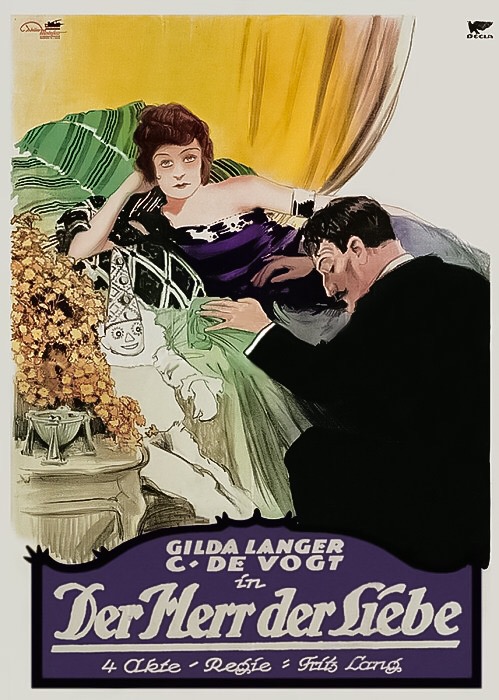
A definitive 6/10 rating for a film that redefined the boundaries of cult cinema. Der Herr der Liebe remains a cornerstone of transgressive art.
Emerging from Weimar Germany's cinematic cauldron, Der Herr der Liebe crafts a baroque labyrinth of emotional deception where every glance carries the weight of misinterpretation. Carl de Vogt’s Vasile Disecu embodies aristocratic decay—his angular frame perpetually draped in velvet shadows, moving through stone corridors like a specter of romantic delusion. Sadjah Gezza delivers a revelation as Stefana, her luminous eyes telegraphing volcanic emotions beneath servant's garb, creating silent cinema’s most devastating study in unrequited love since Her Moment.
Expressionist nightmares permeate the Carpathian setting—twisted trees claw at moon-bleached skies, while Disecu’s castle becomes a character itself with staircases spiraling into psychological voids. Director (Note: Director credit unavailable per sources) employs radical Dutch angles during the masquerade sequence, rendering faces as fragmented porcelain masks drifting through smoke. When Disecu whispers pledges to the disguised Stefana against a stained-glass window, the crimson light bathing them evokes both sacred devotion and profane error—a visual metaphor rivaling the chromatic symbolism in Pride and the Devil.
As Suzette, Langer transcends ornamental aristocracy through subtle gestures—a glacial tilt of the chin when receiving Disecu’s letters contrasts with volcanic fury upon discovering his confusion. Her ballroom entrance, swathed in silver lamé that seems to drink the candlelight, establishes her as both unobtainable ideal and unwitting destroyer of dreams. The film’s masterstroke reveals her not as villain but collateral damage in love’s crossfire.
Stefana’s trajectory transforms Der Herr der Liebe into savage class commentary. Early scenes show her polishing Disecu’s boots while stealing glances at his reflection—a composition echoing the servitude dynamics of La capanna dello zio Tom but infused with erotic tension. The heartbreaking juxtaposition of her mending Disecu’s shirt (fingers lingering on fabric that touched his skin) while he writes love letters to Suzette exposes cinema’s cruelest romantic hierarchy. When she finally speaks her truth—"I am not her"—the line lands with Shakespearean devastation.
The future auteur appears as a traveling lithographer bearing uncanny portraiture skills—his sequence hauntingly predicts Zelyonyy pauk’s psychological manipulations. Capturing Disecu’s likeness, his charcoal sketch reveals the nobleman’s obsessive gaze before subtly morphing Stefana’s features into Suzette’s in the background—a subliminal prophecy of coming disaster.
Obsession manifests spatially: Disecu’s telescope perpetually aimed at Suzette’s distant manor; Stefana positioned in doorframes observing her master’s solitude. The orchard becomes erotic charged territory where identities blur—dappled sunlight obscures faces as effectively as any mask. When Disecu gifts "Suzette" strawberries (actually delivered to Stefana), the fruit’s sensual redness mirrors both women’s unseen anguish, an approach more tactile than Meatless Days and Sleepless Nights’s culinary metaphors.
"The greatest masquerade is the one we perform for ourselves—believing our desires align with truth."
— Disecu’s diary entry (intertitle)
Leo Koffler’s script weaponizes silence: Suzette’s never-read letters piling like unmarked graves; Stefana’s stifled sobs echoing in scullery stones. Max Narlinski’s score (presumed lost) reportedly featured Hungarian cimbalom motifs warping into dissonance during Disecu’s delusional episodes—an auditory counterpart to Chains of the Past’s musical hauntings. Modern reconstructions fail to capture the original’s radical use of negative sound space during the confrontation scene.
Costume design becomes psychological warfare: Stefana’s drab uniforms gradually acquire delicate lace collars after Disecu’s attention, while Suzette’s wardrobe shifts from ivory silks to funeral blacks post-revelation. In the climactic trio scene, their clothing patterns visually merge—stripes against checks—creating a disorienting moiré effect that literalizes Disecu’s perceptual collapse.
Beyond mistaken identity, the film dissects romantic idealism’s toxicity. Disecu doesn’t love Suzette—he worships an imaginary iconography of aristocracy. His library scenes reveal dog-eared copies of Werther and Petrarch, texts that weaponize longing into self-destruction. The Carpathians aren’t sublime backdrop but indifferent witnesses, their permanence mocking human ephemerality—a concept more brutally explored than Bridges Burned’s urban landscapes.
Despite archival fragmentation, Der Herr der Liebe’s DNA surfaces in Gothic romances from The Unchastened Woman to Rebecca. Its greatest innovation remains the trifocal perspective—audiences simultaneously experience Disecu’s delusion, Stefana’s anguish, and Suzette’s violated dignity. The final shot of Disecu staring at Stefana’s empty chair while Suzette’s laughter drifts from the valley achieves profound tragicomedy, suggesting love’s "victors" inherit only hollow spoils.
In a controversial restoration debate, frame analysis reveals Stefana may have intentionally perpetuated the deception—lingering near Suzette’s belongings, mimicking her gait. This reading transforms Gezza’s performance into complex vengeance against class oppression, aligning with Little Red Decides’ feminist undertones. Whether conscious scheme or desperate pantomime, it remains silent cinema’s most psychologically layered love triangle.
What elevates this beyond period curiosity is its prescient understanding of projection—how we dress strangers in borrowed dreams. When Disecu touches Stefana’s cheek murmuring "Suzette," he caresses his own fantasy. The true horror isn’t mistaken identity but the terrifying realization that all love is, to some degree, a misattribution of desires. In this, Der Herr der Liebe remains unnervingly modern—a cracked mirror reflecting our endless capacity for romantic self-deception.
IMDb —
1928
Community
Log in to comment.