DbcultAccessing Vault...
6.9/10
Senior Film Conservator
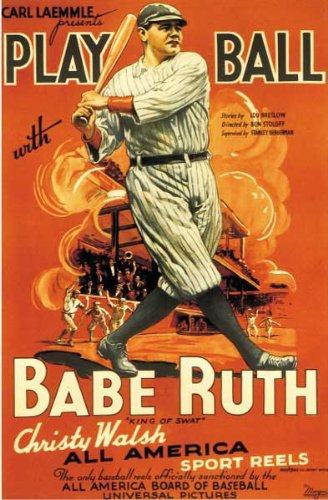
A definitive 6.9/10 rating for a film that redefined the boundaries of cult cinema. Play Ball with Babe Ruth remains a cornerstone of transgressive art.
There are motion pictures that document; there are others that transubstantiate. Benjamin Stoloff’s 1929 one-reeler Play Ball with Babe Ruth belongs to the latter caste, a fleck of nitrate that somehow stuffs the entirety of Americana—its hubris, its appetite, its locomotive hunger for idols—into a breathless quarter-hour. Watching it today feels like eavesdropping on a séance where the Bambino’s ghost still swaggers, bat cocked like a question mark against eternity.
The film opens on what appears to be stock footage but is in fact a meticulous recreation: newsreel cameramen hand-crank their Bell & Howells along the third-base line, their tripod legs splayed like insect carcasses. The gesture is meta before meta had a name—Stoloff foregrounding the apparatus that will henceforth manufacture Ruth’s legend. Over the visual clatter, intertitles arrive in that staccato, tobacco-stained vernacular of the era: “He wasn’t just a man—he was a weather front.” Cue the trumpets.
What follows is less narrative than liturgy. At midpoint, Ruth steps into a frozen tableau of pitchers, catchers, and cigar-chomping managers. The mise-en-scène evokes a medieval illumination—each figure flattened against a diamond-shaped parchment of chalk and clay. Yet when the camera finally records Ruth’s swing, the moment erupts into slow-motion so ethereal it makes contemporary 4K slomo look arthritic. You can count the red cotton stitches on the ball as it departs the frame, a tiny planet yanked from orbit by this titan in pinstripes.
Stoloff alternates between such celestial detachment and gutter-level voyeurism. One cut lands us in a locker room where Ruth, towel snapping, regales rookies with bawdy limericks; the next finds him haloed by stadium arc-lights, a secular Lazarus rising every time the crowd chants his name. The oscillation sanctifies Ruth while keeping him carnal—an ambivalence that prefigures the celebrity confessional mode now ubiquitous on Instagram, only here achieved with more poetry and zero algorithmic pandering.
Writer Lou Breslow understood that concise didn’t have to mean slight. His intertitles read like offcuts from an unwritten Dos Passos novel: “Bottom of the ninth, bottom of the barrel, top of the world.” The brevity is surgical; each line amputates exposition while cauterizing emotion. Compare this to the logorrhoeic voice-over that anchors most 21st-century sports docs—those TED-talk homilies about resilience and teamwork. Breslow offers aphorism, not TED-ism, and the film’s silence between titles becomes a negative space where the viewer’s own myth-making can fester.
A subplot—barely ninety seconds—involves a slick-haired bookie slipping a folded sawbuck to a youthful batboy. It’s a fleck of moral soot on an otherwise sun-drenched valentine. Stoloff withholds resolution; the bet never pays off on screen, leaving the implication to fester like a splinter under the nation’s epidermis. In doing so, the film sidesteps the hagiographic pitfall that hobbles so many sports portraits, including the bloated It Pays to Advertise (1931), where ambiguity gets sacrificed on the altar of marquee-friendly optimism.
Restorationists at Library of Congress have stabilized the print, yet the image still quivers at the periphery—chemical entropy nibbling at Ruth’s outline like base-runners chipping away at a lead. Far from a flaw, this instability lends the film a poignancy no digital intermediary could fake. When the Bambino’s silhouette flickers, history itself seems to hiccup, reminding us that even gods degenerate into emulsion.
Released during the cusp of talkies, Play Ball remained stubbornly silent. Modern festivals often accompany it with pastiche jazz or, worse, dubstep. Resist. The silence is strategic: it amplifies the ambient ghosts of the stadium—your own breath, the squeak of seats, the imagined roar of a Depression-era crowd hungry for escapism. Any sonic garnish risks gilding the lily, much like the ill-advised colorization of Little Speck in Garnered Fruit (1924) that bled its chiaroscuro dry.
Where Peg of the Pirates (1928) frolics in camp swashbuckling and Drama v kabare futuristov No. 13 (1914) assaults the eye with Constructivist zigzags, Stoloff’s film opts for a liminal tone—half pious, half profane. It neither burlesques nor deifies; it bears witness. The result is a tonal cousin to Peace and Riot (1920), though where that film externalizes social unrest through cityscape montage, Play Ball internalizes it within Ruth’s heaving torso as he rounds the bases.
Ruth’s physique—part beer barrel, part Greek statue—embodies a country lurching from Gatsby excess toward Depression thrift. Stoloff frames him against Art-Deco exit signs and freshly minted subway tiles, situating the athlete at the crossroads of brawny Victorian vitality and streamlined Machine-Age efficiency. The film thus anticipates the ideological fissures that will split American masculinity a decade later when post-frontier muscularity meets the bureaucratic corporatism satirized in By Right of Purchase (1927).
Note the recurring visual of Ruth’s cleats thudding into the batter’s box chalk: a crude, dusty Eucharist. The roar of the faithful, the raising of communion wafers (peanuts), the drinking of sacramental wine (flat beer in paper cups)—Stoloff stages Yankee Stadium as America’s surrogate cathedral during an era when church attendance waned and ballpark attendance exploded. Ruth’s home-run arcs become ascensions; the crowd’s collective gasp a Pentecostal wind.
Shot mere months before Black Tuesday, the film vibrates with unconscious prescience. Gamblers stalk the periphery, fortunes hinge on a swing, and the stadium’s wooden grandstands—soon to be replaced by steel—look flammable, fragile. The short’s very brevity mirrors the instant before a market graph plummets. Stoloff could not have known, yet the footage now feels like the last snapshot before the decade’s mask slipped.
The montage alternates between frenetic jump-cuts—borrowed from Sennett slapstick—and contemplative longueurs worthy of Soviet montage. The collision generates a kinetic whiplash that mirrors Ruth’s own duality: jovial clown and merciless executioner. Editors in 1929 still hand-etched emulsion, and you can practically see the splice marks pulsing like varicose veins, each cut a heartbeat.
Contemporary trade papers dismissed it as “a nifty novelty for the kiddies.” Modern retrospectives—most notably at Pordenone’s Giornate del Cinema Muto—have elevated it to the pantheon of found-footage Americana. Audience members under thirty, weaned on sabermetric podcasts, still gasp when Ruth’s bat connects. Numbers dissolve; myth endures.
The 4K restoration streams on Criterion Channel in rotation, paired with The Land of Jazz (1920) for contextual flavor. For purists, 16 mm dupes circulate in private ciné-clubs from Brooklyn to Bologna. Seek the silent version; eschew the Dolby remix.
Play Ball with Babe Ruth is not a film about baseball; it is a film about how America invents its saints, then sells indulgences at the gift shop. It endures because it refuses to conclude—Ruth simply exits into overexposure, a white-hot afterimage seared onto the retina of a nation that still can’t decide whether to worship or monetize its heroes. In sixteen minutes, Stoloff and Breslow bottle that contradiction, cork it, and let it ferment into a vintage that tastes of sweat, cigar smoke, and the phantom crack of a wooden bat that never quite fades.
Verdict: A pocket-sized epic that swings for the fences and clears them by a mile. Mandatory viewing for cinephiles, diamond devotees, and anyone who’s ever needed proof that brevity can still hit like a sledgehammer.
IMDb —
1919
Community
Log in to comment.