DbcultAccessing Vault...
4.8/10
Senior Film Conservator
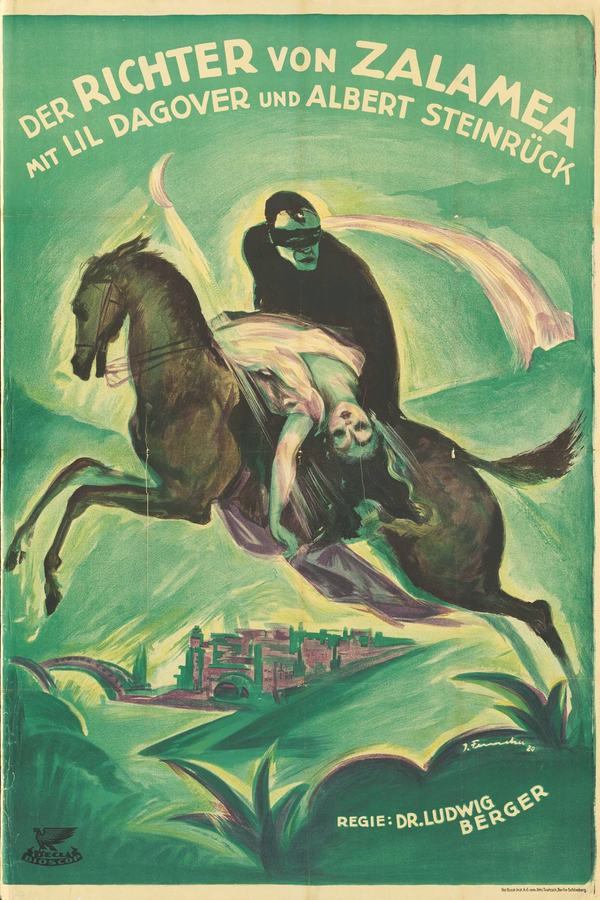
A definitive 4.8/10 rating for a film that redefined the boundaries of cult cinema. Der Richter von Zalamea remains a cornerstone of transgressive art.
The Weimar camera that opens Der Richter von Zalamea seems to inhale the very pollen of Castile: dust motes swirl like flecks of gilt in a sunbeam, and for a breath we might believe this 1920 artefact will treat us to folkloric postcard Spain. Then Ludwig Berger’s iris contracts, carving the frame into a scalpel-circle around the marching feet of Philip II’s tercios, and any illusion of tourism collapses. These soldiers move with the automaton rigidity of a medieval fresco—an echo that will soon grow monstrous once Max Schreck’s bug-eyed presence looms among them. The film, long buried in archives under the German intertitles, has resurfaced on a tinted restoration whose amber blues and bruised oranges feel less like tinting than cauterisation.
Berger—who would later helm the effervescent Ein Walzertraum—here opts for a chiaroscuro so tactile you could strike sparks off it. The village of Zalamea is rendered in slabs of umber and chalk-white, its houses stacked like broken teeth against the sierras. Shadow pools so deep they swallow belt-buckles whole contrast with noon glare that turns armour into mirrors of unbearable light. In this oscillation between blind blaze and ink-black recess, the film anticipates the morality play at its core: every character must choose whether to reflect the king’s authority or disappear into ethical darkness.
Silent cinema rarely enjoys location swagger, yet Berger sent his unit to sun-scorched Aragonese villages, inter-cutting those plates with studio sets whose plaster walls bear intentional cracks—fissures that echo the social fractures about to split open. Compare this textured realism with the cardboard Iberia of The Belle of New York or the sound-stage Andalusia of María de la O; Zalamea’s grit under fingernails feels almost neo-realist decades before Visconti.
As Pedro Crespo, Hermann Vallentin delivers a master-class in controlled seismic shift. Early reels show him weighing sacks of grain with merchant pride, shoulders squared in self-made confidence. After the violation of his daughter, watch the way the same shoulders fold inward, not in defeat but in recalibration: his body becomes a siege engine slowly reversing aim toward the citadel of rank itself. Vallentin’s eyes—magnified by the flicker of candle stubs—toggle between paternal tenderness and juridical flint. It is a performance calibrated for silence: every clench of jaw, every deliberate blink speaks louder than the florid intertitles adapted from Calderón.
Two years before The Menace of the Mute showcased Schreck’s cadaverous mime, he appears here as a nameless corporal whose cheekbones could slice ham. He lingers at the story’s periphery—sharpening stakes, tightening ropes—yet magnetises the lens. Observe the sequence where soldiers draw lots for billets: Schreck’s hand emerges from lottery helmet clutching the fatal “Casa Crespo” tile, and his grin is a hinge opening onto the void. It’s a cameo that metastasises through the rest of the picture; long after his character vanishes, you sense those eyes still roaming the frame.
Isabel could have been a mere symbol of besmirched virtue. Instead, Lil Dagover—whose Expressionist creds include Destiny and Paganini—plays her like a cathedral statue suddenly gifted pulse and temper. When Don Álvaro corners her in the olive press, Dagover tilts her chin at a 90-degree defiance that seems to scrape the sky. The assault itself is staged in negative space: we see only her hand clawing across a mill-stone, knuckles whitening until the sound of ripped linen is suggested by a jagged cutaway to a dove bursting from the rafters. It’s a fragment of pure visual poetry whose restraint makes the aftermath—her catatonic glide through the marketplace—feel apocalyptic.
Steinrück, best remembered for conniving counts in Fridericus Rex, here sculpts a villain who embodies entitlement as gravitational force. His Don Álvaro never blusters; instead he insinuates, occupies, consumes. Notice how he fingers the lace at Isabel’s throat as though measuring property boundaries. The duel he fights—not with swords but with silence—ends with him hoisted on a makeshift gallows built from the very beams of the house he violated. Berger stages the execution in a single take: camera dollies back as the noose tightens, revealing the entire village watching, faces unreadable. It is one of silent cinema’s most unnerving examples of collective justice, a scene that reverberates through Buñuel’s Viridiana and Haneke’s The White Ribbon.
The source text—El alcalde de Zalamea—is baroque, laced with verse and metaphysical quips about honour as divine currency. Berger and scribe Hans Kyser prune the poetry to visual stumps: a cracked portrait of Philip II, a blood-stained land deed, a gavel fashioned from a ploughshare. In doing so they excise Catholic mysticism yet amplify class critique. The Restoration’s restored intertitle cards reveal a subtle shift: Calderón’s Crespo sought royal ratification; Berger’s Crespo pockets the king’s parchment, then tears off the wax seal, letting it drop like a spent shell. It’s a gesture that anticipates the Weimar street riots soon to erupt outside cinemas.
Editor Milena Gauerhoff (uncredited in most prints) alternates languid, heat-drunk long shots with stroboscopic cuts that feel almost Soviet. When troops storm the village, we get eight-frame flashes of boots, horse teeth, and musket muzzles—an Eisensteinian crescendo that slams into a tableau worthy of Goya. Contemporary screenings with live percussion often underscore these assaults with martial snare, but the recent restoration favours a minimalist strings-and-psaltery approach, allowing ambient clatter—projector purr, seat-creak, your own pulse—to serve as Foley. The silence is so acute you can almost hear dust scrape across emulsion.
Place Zalamea beside The Rough Lover and you see two divergent strategies for staging masculine crisis: the latter leans on brawny close-ups and fisticuffs, whereas Berger orchestrates honour as civic architecture—houses, gallows, throne. Conversely, stack it against Glory and you find a shared fascination with how institutional power inscribes itself onto private bodies—Glory via Civil War uniforms, Zalamea via royal insignia that ultimately fails to outrank a farmer’s noose.
Modern viewers will rightly bristle at the age-old trope of woman-as-territory. Yet Berger complicates the paradigm by granting Isabel the coda’s final close-up. After her father pronounces sentence, the camera lingers on her face: not triumph, not relief, but a mineral stillness that refuses the viewer catharsis. It is an expression that indicts not only the rapist but the communal gaze that demanded retribution as spectacle. In 1920, such refusal of emotional payoff was almost radical; today it still feels queasily potent.
For decades the only known element sat in Moscow’s Gosfilmofond, a 35 mm nitrate positive seized as war booty. In 2018 a near-complete negative surfaced in a decommissioned Jesuit school outside Valencia, mis-catalogued as La dama de Zaragoza. The F.W. Murnau Foundation combined both sources, restoring tints referenced in Ufa’s 1921 distribution notes. The resulting 4K scan premiered at Bologna’s Il Cinema Ritrovato, earning a stunned ovation for its nickelodeon-meets-Expressionist palette. Streaming platforms now host the 2K DCP, but cinephiles owe it to themselves to chase down a 35 mm print; the photochemical grain shimmers like heat-haze over Iberian slate.
Because every era needs its parable on the moment when citizen defiance calcifies into law. Because Berger’s images prove that silent cinema could be both stately and savage, that a flicker of celluloid can indict monarchy, patriarchy and voyeurism without uttering a syllable. Because Max Schreck’s cheekbones deserve their own cult. And because, in an age of algorithmic justice and digital mobs, the sight of a farmer wielding a gavel of rough-hewn cedar feels like both warning and promise. Watch Der Richter von Zalamea not as dusty homework but as live current—its voltage undimmed by a century’s roar of history.
IMDb —
1924
Community
Log in to comment.