DbcultAccessing Vault...
Cult Review
Senior Film Conservator
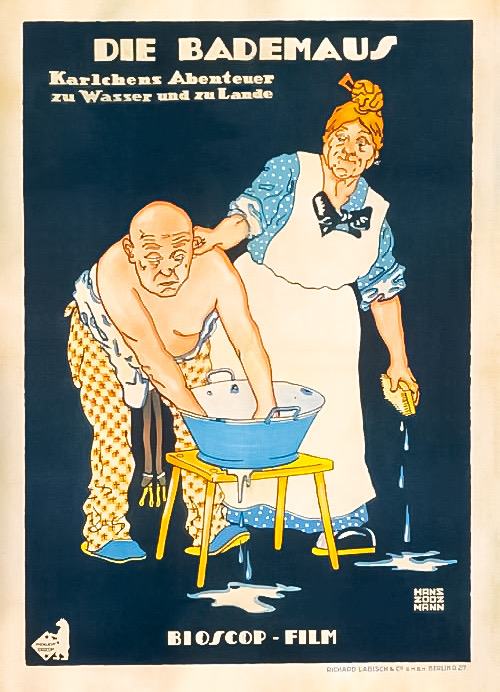
Ah, the silent film era! A period often romanticized, sometimes misunderstood, but consistently brimming with ingenuity and a unique narrative cadence that speaks volumes without uttering a single word. And then there is Die Bademaus, a delightful confection from the annals of early German cinema that, upon re-examination, reveals itself to be far more than just a frivolous comedy. It is a meticulous study in societal absurdities, a poignant exploration of identity, and a testament to the power of human connection forged amidst the most improbable circumstances. This film, though perhaps not as widely canonized as some of its contemporaries, possesses an undeniable charm and a narrative sophistication that belies its seemingly simple premise.
At its core, Die Bademaus masterfully employs the classic trope of mistaken identity, elevating it from mere farce to a vehicle for insightful social commentary. Karl Victor Plagge, in a performance that can only be described as a triumph of understated physical comedy, embodies Herr Anton Schmidt, a man so utterly unremarkable that he practically blends into the wallpaper of his own life. Plagge’s portrayal of Anton’s initial timidity is exquisite, a symphony of nervous gestures and downcast gazes that immediately endears him to the audience. His transformation, or rather, his accidental metamorphosis into the infamous 'Bademaus,' is driven by a series of escalating comedic misfortunes that are both ludicrous and entirely believable within the film's heightened reality. The sheer genius lies in how Plagge, without dialogue, conveys Anton’s internal struggle—the terror of being misidentified, the bewilderment at his newfound notoriety, and the slow, reluctant awakening of a self he never knew existed.
The film's narrative architecture, credited to Peter Josef, is a marvel of intricate plotting. The decision to hinge the entire comedic engine on a simple swimwear swap at a public bathhouse is inspired, instantly establishing a foundation of everyday relatability before spiraling into a glorious vortex of high-society hijinks. The bathhouse, a symbol of public vulnerability and private ritual, becomes the unwitting crucible for Anton’s accidental reinvention. It's a setting that subtly critiques the superficiality of Berlin's upper crust, where appearances are everything, and a misplaced monogram can fundamentally alter one's perceived status. This kind of nuanced social satire is a hallmark of the era, seen in films like Upstairs and Down, which also cleverly played with class distinctions and mistaken roles, albeit with a different comedic tone.
Ilse Wilke, as the intrepid journalist Fräulein Lotte Meier, provides a vibrant counterpoint to Plagge’s understated performance. Lotte is a force of nature, a woman ahead of her time, embodying the burgeoning spirit of female independence. Her initial pursuit of Anton, fueled by professional ambition and a healthy dose of cynicism, gradually gives way to a more nuanced understanding. Wilke imbues Lotte with a captivating blend of intelligence, wit, and a subtle vulnerability that makes her character deeply human. The chemistry between Plagge and Wilke is palpable, evolving from suspicion and exasperation into a genuine, heartwarming romance. Their interactions, conveyed through expressive glances and finely tuned gestures, form the emotional anchor of the film, preventing it from devolving into mere slapstick.
Kurt Wolfram Kiesslich, as the true Baron von Kitzel, is wonderfully cast as the flamboyant rival, a man whose superficial charm masks a deeper, albeit harmless, self-interest. His presence complicates Anton’s predicament, adding layers of irony as the real 'Bademaus' continues to operate in the background, a deliciously subtle subplot that keeps the audience guessing. And then there's Kurt Doerry's Inspector Gruber, a delightful caricature of bureaucratic incompetence. Doerry’s bumbling yet persistent pursuit of Anton provides many of the film's broader comedic moments, his physical comedy a perfect foil to Plagge’s more internal performance. Gruber’s unwavering conviction in Anton’s guilt, despite all evidence to the contrary, serves as a humorous critique of institutional tunnel vision, a theme that resonates even today. The dynamic between these characters creates a rich tapestry of human foibles and virtues, reminiscent of the ensemble casts in films like Men, Women, and Money, which similarly explored the intricate dance of social classes and personal motivations.
The direction of Die Bademaus (presumably by Peter Josef, given the writing credit and common practice of the era) is remarkably assured. The pacing is brisk, a crucial element for a silent comedy aiming to maintain audience engagement without the benefit of spoken dialogue. The use of intertitles is judicious, providing necessary exposition without interrupting the visual flow. The cinematography, though perhaps not groundbreaking for its time, is effective in establishing mood and conveying character emotion. Close-ups are employed strategically to highlight Plagge’s nuanced expressions of panic and burgeoning confidence, and Wilke’s determined gaze. Wide shots are used for comedic effect, emphasizing the chaos Anton finds himself in, or to capture the grandeur of the Berlin settings—the bustling streets, the opulent hotel lobbies, and of course, the elegant bathhouse that sets everything in motion.
What truly elevates Die Bademaus is its profound understanding of visual storytelling. Every gesture, every prop, every shift in a character's posture contributes to the narrative. The repeated motif of Anton’s oversized, stolen bathing suit, for instance, becomes a visual metaphor for his uncomfortable fit within the identity thrust upon him. It’s a silent scream of discomfort and an ironic symbol of his accidental notoriety. The film manages to convey complex emotional states—embarrassment, yearning, triumph—through purely visual means, a testament to the actors' skill and the director's vision. This mastery of non-verbal communication is a defining characteristic of the silent era's finest works, often achieving a universal resonance that transcends language barriers. One could draw parallels to the expressive power found in narratives like The Last Dance, where emotional depth is conveyed through movement and unspoken tension, albeit in a dramatic context.
The film's climax, involving a masquerade ball and the eventual unmasking of the *true* 'Bademaus,' is a masterclass in comedic tension and resolution. The masquerade setting, with its inherent themes of disguise and hidden identities, serves as the perfect backdrop for Anton’s final confrontation with his accidental persona. The revelation of the real prankster is handled with a light touch, ensuring that the focus remains on Anton’s journey rather than solely on the mystery. It’s a moment that not only provides a satisfying conclusion to the central mystery but also reinforces the film’s broader message about the arbitrary nature of reputation and the importance of looking beyond superficial judgments. This clever unraveling of a mystery, interwoven with romantic progression, finds echoes in the intricate plots of films like The Golden Rosary, where secrets and revelations drive the narrative forward.
Beyond the laughter, Die Bademaus offers a surprisingly profound commentary on self-discovery. Anton Schmidt, initially a man defined by his anonymity, is forced by circumstance to confront and ultimately shed his timid shell. His journey is one from diffidence to quiet confidence, not by becoming someone he isn't, but by finding the courage to be himself, even when others mistake him for someone else entirely. This arc resonates deeply, touching upon universal themes of identity, social pressure, and the courage to embrace one's true self. The film subtly suggests that sometimes, it takes an external catalyst, however absurd, to ignite an internal transformation. This exploration of personal growth through adversity is a timeless narrative, much like the struggles depicted in Scars of Love, though in a dramatically different genre.
The film's enduring appeal also lies in its delightful blend of romance and comedy. The evolving relationship between Anton and Lotte is a joy to behold, a testament to the power of opposites attracting and finding common ground amidst chaos. Their romance is built on mutual respect and a shared journey of discovery, making it far more compelling than a mere superficial attraction. This kind of charming, character-driven romance is a consistent draw, echoing the romantic entanglements and social dynamics seen in When Paris Loves, where relationships navigate a complex social landscape.
In conclusion, Die Bademaus stands as a charming, intelligent, and surprisingly insightful example of early German silent cinema. It transcends its comedic premise to offer a nuanced look at identity, social expectations, and the transformative power of unexpected events. The performances, particularly Plagge’s understated brilliance and Wilke’s vibrant portrayal of journalistic zeal, elevate the material beyond simple farce. The film’s crisp pacing, clever plotting, and masterful use of visual storytelling ensure its place as a delightful and thought-provoking watch. It reminds us that even in the absence of spoken words, cinema possesses an unparalleled ability to convey complex emotions, spark laughter, and leave a lasting impression. For anyone seeking a journey back to a time when storytelling was an art of gesture and expression, Die Bademaus is an absolute must-see, a hidden gem that continues to sparkle with wit and warmth. Its legacy is not just in its laughter, but in its subtle assertion that true character often reveals itself when one is least expecting it, and that sometimes, a little accidental anarchy is precisely what one needs to find their true self and, perhaps, true love.
A cinematic swim worth taking.
IMDb 4.9
1936
Community
Log in to comment.