DbcultAccessing Vault...
Cult Review
Senior Film Conservator
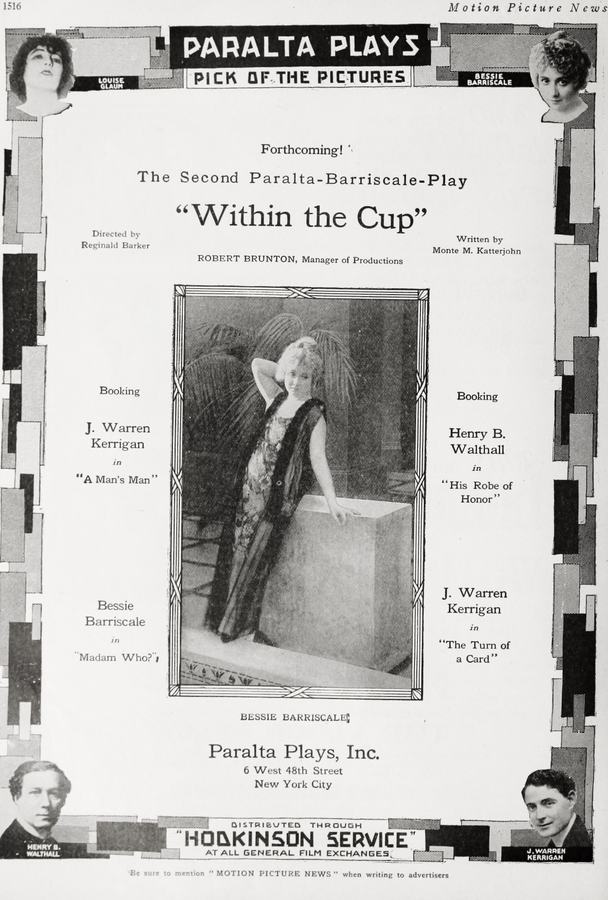
In the annals of early 20th-century cinema, certain narratives emerge not merely as stories, but as potent cultural artifacts, reflecting and refracting the societal anxieties and burgeoning freedoms of their era. 'Within the Cup' (1917) stands as one such compelling testament, a silent film that, despite its age, resonates with a startling prescience. It is a cinematic journey that delves into the tumultuous life of a woman daring to defy the rigid strictures of her time, navigating the treacherous waters of love, betrayal, and self-discovery. This film, a product of its nascent industry, masterfully weaves a tale of personal liberation forged in the crucible of profound disillusionment, presenting a protagonist whose arc of transformation feels both deeply personal and broadly emblematic of a nascent feminism.
At the heart of 'Within the Cup' is Thisbe Lorraine, portrayed with remarkable nuance by Bessie Barriscale, whose expressive eyes and gestures carry the weight of an entire epoch's expectations and rebellions. We first encounter Thisbe as an idealistic American artist, her soul brimming with the romantic promise of Paris. She is a woman on the cusp, poised to embrace the bohemian allure and creative ferment of the European art scene. This early depiction establishes her as a dreamer, vulnerable yet ambitious, seeking not just love, but a life rich with artistic meaning. Her initial entanglement with Ernst Faber, a German aristocrat, is painted with the brushstrokes of youthful infatuation, a whirlwind romance that promises a grand future. However, this seemingly idyllic chapter is abruptly shattered by Faber's callous abandonment, a betrayal that rips through Thisbe's innocence and leaves an indelible scar on her psyche. This pivotal event is more than a mere plot device; it's the catalyst for her profound metamorphosis, an awakening to the harsh realities of a world often unforgiving to women who dare to love without caution. Much like the societal condemnation faced by characters in films such as Sapho or Anna Karenina, Thisbe's initial fall from grace is framed by the era's unforgiving moral compass, yet her response is strikingly different.
Disillusionment, for Thisbe, becomes a forge rather than a cage. Rather than succumbing to despair or seeking conventional solace, she makes a conscious, defiant choice. She returns to New York, not as a broken woman, but as one reborn with a radical new philosophy: to live by her own rules, unbound by patriarchal expectations or the fear of societal censure. This transformation is vividly rendered through her subsequent career as an author of "sex novels." This choice is audacious for its time, a direct challenge to the prevailing prudery and the notion of female artistic expression being confined to "acceptable" subjects. Her literary success is not just a personal triumph; it's a symbolic reclamation of agency, a woman monetizing her experiences, even the painful ones, and turning them into a source of power and wealth. It mirrors, in a way, the fierce independence seen in characters from films like The Sin of a Woman, though Thisbe's path is uniquely defined by her intellectual and creative output.
Amidst her burgeoning fame and financial independence, a curious interlude unfolds in Greenwich Village: an encounter with "Tea Cup Ann," a fortuneteller whose cryptic prediction casts a long, unsettling shadow. Ann foretells that Thisbe's "sinful ways" will bring her only sorrow. This element injects a layer of fatalism and moralistic commentary into the narrative, a common trope in early cinema that often served to temper the perceived excesses of female independence. Is Thisbe truly "sinful," or is her lifestyle merely unconventional? The film subtly invites us to ponder this, suggesting that society’s judgment, not an inherent moral failing, is the true source of potential sorrow. This prophetic warning functions as a dramatic irony, foreshadowing the subsequent challenges Thisbe faces, but also highlighting the external pressures constantly exerted upon her chosen path.
The narrative takes another poignant turn with Thisbe's encounter with Le Saint Hammond, an artist who represents a potential balm for her bruised heart. Their connection is immediate and profound, blossoming into a love that feels both passionate and artistically inspiring. Le Saint asks Thisbe to pose for his statue of Psyche, a choice rich with symbolic resonance. Psyche, in Greek mythology, embodies the human soul, often depicted as a beautiful maiden who undergoes trials and tribulations before achieving immortality and union with Love (Eros). Thisbe, as Psyche, becomes a living embodiment of this journey – her own soul, bruised and tested, now seeking artistic and romantic fulfillment. The juxtaposition of her "sinful" past with the spiritual purity of Psyche is a powerful thematic device, challenging the audience to reconcile these seemingly disparate aspects of her being.
However, this nascent idyll is brutally interrupted when Le Saint learns of Thisbe's past, of her "sex novels" and the life she built outside conventional bounds. His reaction is swift and devastating: he rejects her, his idealized vision of his muse shattered by societal prejudice. This moment is particularly heartbreaking, as it underscores the pervasive double standards of the era. Le Saint, an artist presumably attuned to the complexities of the human spirit, proves himself ultimately beholden to conventional morality. His subsequent descent into excessive drinking is a testament to his own inner conflict and the destructive power of judgment, not just for the judged, but for the one who judges. His sorrow mirrors Thisbe's own initial despair, creating a tragic symmetry. This parallels the self-destructive tendencies seen in characters burdened by societal expectations, not unlike the protagonist in The Painted World, grappling with internal and external pressures.
The thematic tapestry of 'Within the Cup' is richly woven, offering layers of interpretation that remain relevant even today. At its core, the film is a searing critique of **societal hypocrisy and double standards**. Thisbe's initial abandonment by Faber is lamentable, but her subsequent career choice, born from defiance, garners far greater censure. The film asks us to question why a woman's agency and financial independence, particularly when achieved through unconventional means, are often met with such moralistic condemnation, while a man's casual betrayal might be more readily overlooked or excused. This dynamic is a recurring motif in cinematic history, echoing through narratives where women dare to challenge the status quo.
Another salient theme is **artistic expression and freedom**. Both Thisbe's novels and Le Saint's sculpture represent different facets of artistic endeavor. Thisbe's work, though controversial, is a powerful form of self-expression and a tool for financial liberation. Le Saint's sculpture of Psyche, intended to capture the essence of the soul, ironically becomes a site of conflict when the real-world complexities of his muse's 'soul' clash with his preconceived notions. The film subtly explores the tension between idealized art and the messy, often inconvenient, truths of human experience that inspire it. How much truth can art bear, and how much can an artist's personal prejudices compromise their vision?
**Redemption and forgiveness** form the narrative's ultimate trajectory. Le Saint's return to Thisbe, after his period of self-destruction, is presented as a moment of profound reconciliation. It suggests that true love, or perhaps a more mature understanding of love, can transcend superficial judgments and past transgressions. This isn't a simplistic 'happily ever after' as much as it is an acknowledgement of growth, both individual and relational. It hints that forgiveness, particularly self-forgiveness and the ability to see beyond societal labels, is crucial for genuine connection. The journey to this redemption is arduous, illustrating that breaking free from prejudice is a struggle not just for the one judged, but for the one doing the judging as well.
Finally, the film interrogates **the price of independence**. Thisbe achieves fame and wealth, but at what personal cost? The sorrow predicted by Tea Cup Ann, though perhaps not a direct divine retribution, manifests through the pain of being misunderstood and rejected by those she loves. Yet, Thisbe's resilience and unwavering commitment to her authentic self ultimately suggest that the rewards of autonomy, even with their attendant challenges, outweigh the comforts of conformity. Her journey serves as an early cinematic exploration of a woman's right to define her own life and values, a theme that continues to echo in contemporary narratives.
In the era of silent film, the onus on actors to convey complex emotional states through gesture, facial expression, and physicality was immense. Bessie Barriscale, as Thisbe, delivers a performance that is both powerful and nuanced. She navigates Thisbe's transformation from wide-eyed ingenue to defiant author to heartbroken lover with compelling conviction. Her ability to project inner turmoil and resolute strength without dialogue is a testament to her skill and the expressive potential of silent cinema. The supporting cast, including Edward Coxen as Le Saint Hammond, effectively contributes to the dramatic tension, with Coxen portraying Le Saint's internal struggle and eventual remorse with believable pathos.
The screenwriting by Monte M. Katterjohn and Roy S. Sanford is remarkably sophisticated for its time, crafting a narrative that moves beyond simple melodrama to explore complex psychological and sociological themes. The pacing, the use of symbolic imagery (Psyche, the tea cup prophecy), and the development of Thisbe's character arc demonstrate a keen understanding of storytelling. While specific directorial flourishes by a named director are often hard to ascertain without more archival detail for such early films, the overall aesthetic and narrative thrust indicate a cohesive vision that effectively translates the script's ambition to the screen. The film's ability to tackle such progressive themes within the constraints of early cinematic language speaks volumes about its creative team's foresight and daring.
'Within the Cup' is more than just a historical curiosity; it is a film that continues to speak to contemporary audiences about the timeless struggles of identity, societal acceptance, and the pursuit of authentic love. Its portrayal of a woman who defies conventional expectations, faces public condemnation, and ultimately finds a path to personal fulfillment resonates powerfully in an age still grappling with gender equality and individual freedom. The film's exploration of judgment, forgiveness, and the courage to live authentically ensures its place as a significant work, not just within the silent era, but in the broader canon of cinema that champions the human spirit's capacity for resilience and transformation. It reminds us that the "sinful ways" are often merely the ways that challenge the comfortable prejudices of the powerful, and that true sorrow often stems not from living authentically, but from the fear and intolerance of others. This enduring message makes 'Within the Cup' a valuable watch, a window into the past that illuminates the present and perhaps even guides our future conversations about love, art, and the intricate dance of human relationships. Its themes, in fact, are as robust and pertinent as those found in narratives like The Toilers, which similarly grappled with societal constraints and personal integrity, albeit through a different lens.
IMDb —
1927
Community
Log in to comment.