DbcultAccessing Vault...
Cult Review
Senior Film Conservator
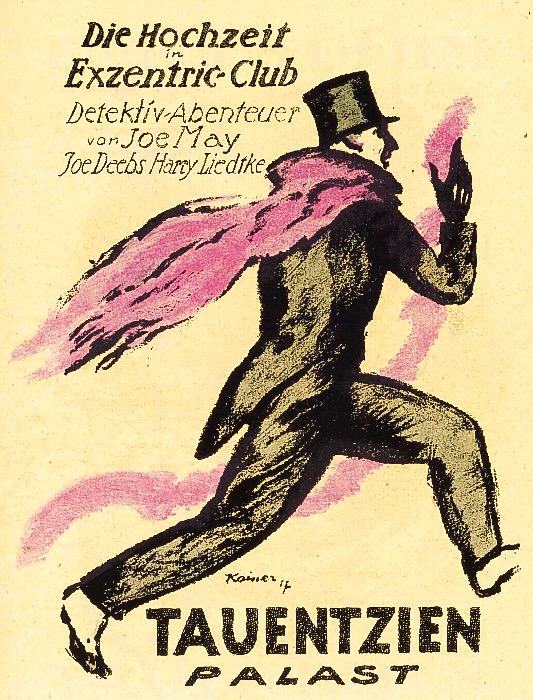
In the annals of German silent cinema, few collaborations spark as much intellectual curiosity as the intersection of Joe May's populist directorial flair and Fritz Lang's nascent, architecturally-driven narrative sensibilities. "Die Hochzeit im Excentricclub" stands as a testament to a time when the medium was shedding its theatrical chrysalis to become something altogether more psychological and spatially aware.
The film operates within the framework of the "Joe Deebs" series, a precursor to the modern franchise that turned the detective into a figure of cosmopolitan elegance rather than just a forensic scientist. Here, the "Excentricclub" serves as a microcosm of a decadent Europe. The sets, even within the limitations of 1917, suggest a world that is slightly off-kilter—a stylistic choice that prefigures the Expressionist movement that would soon dominate the German screen. Unlike the grounded realism found in The Poor Little Rich Girl, which dealt with the isolation of wealth through a child's eyes, May’s work here uses wealth as a catalyst for surrealist challenges.
The writing, credited to May and Lang, showcases an obsession with the mechanics of fate. The plot, driven by a bet and a deadline, forces the characters into a peripatetic race against time. This isn't merely a chase; it is a choreographed dance through the drawing rooms and secret chambers of the elite. The lexical diversity of the visual storytelling—the way a tilted camera angle or a lingering shot on a clock face conveys more than any intertitle could—marks this as a pivotal work in Lang’s development. One can see the seeds of "Dr. Mabuse" or "Metropolis" in the way the club members manipulate the world around them like puppet masters.
Harry Liedtke, portraying Joe Deebs, anchors the film with a performance that is remarkably modern. In an era where histrionics were the norm, Liedtke brings a restrained, almost nonchalant charisma to the role. He doesn't just inhabit the space; he dominates it with a dandyish precision that reminds one of the energetic leads in The Americano or the scrappy protagonists of Reggie Mixes In. However, where Douglas Fairbanks relied on athleticism, Liedtke relies on a sharp, Teutonic wit.
The female cast, including Esther Carena and Käthe Haack, provides more than just decorative support. There is a palpable sense of agency in their interactions, even within the confines of a story centered on a marriage wager. Haack, in particular, displays a nuanced screen presence that would eventually make her a staple of the industry for decades. The chemistry between the ensemble is what prevents the film from devolving into a mere series of stunts. It feels lived-in, despite the fantastical premise of the "Eccentric Club" itself.
We must also acknowledge Bruno Kastner and Magda Madeleine, whose roles add layers of intrigue to the social hierarchy presented. The film’s ability to balance such a large cast without losing the thread of Deebs' personal quest is a credit to May’s directorial control. It shares a certain dramatic density with The Lion's Bride, though it swaps that film's tragic weight for a more cynical, albeit playful, sophistication.
Technically, "Die Hochzeit im Excentricclub" is a marvel of its time. The cinematography utilizes depth of field in a way that creates a sense of voyeurism—we are not just watching a story; we are peering into the private games of a class that believes itself above the law. The lighting, while not yet the full-blown chiaroscuro of the 1920s, experiments with shadows to heighten the mystery of the club’s rituals. It’s a far cry from the static, stagey presentations of Madame Butterfly or the more conventional framing of Officer 666.
Even in this early stage, Fritz Lang’s fascination with the 'underworld'—whether literal or metaphorical—is evident. The Excentricclub is a precursor to the secret societies that would populate his later masterpieces. There is a preoccupation with the "rulebook" and the consequences of deviating from it. This thematic thread creates a tension that elevates the film above the standard detective fare of 1917, such as Blind Man's Luck or the more melodramatic La comtesse de Somerive.
The pacing is relentless. May understands the necessity of the "sensation"—the visual hook that keeps the audience in their seats. Whether it is a daring escape or a meticulously staged social gathering, the film never stagnates. It shares the narrative drive of The Marriage Market, yet it imbues its central conflict with a higher degree of intellectual stakes. The marriage here isn't just a romantic resolution; it's a victory over a system designed to make the protagonist fail.
One cannot ignore the subtext of the film, released during the height of the Great War. While it appears to be escapist entertainment, there is a biting irony in watching wealthy men invent artificial problems to solve while the world outside is in a state of genuine collapse. This cynicism is perhaps what makes the film feel so contemporary. It doesn't possess the moralizing tone of The Dollar and the Law or the heavy-handed social commentary of The Walls of Jericho. Instead, it presents a world that is fundamentally broken and suggests that the only way to win is to play the game better than the people who wrote the rules.
In many ways, the film is a precursor to the "heist" genre. The wedding itself is the ultimate heist—a theft of status and fortune from the clutches of the elite. The way Joe Deebs navigates this world, moving between the shadows and the spotlight, prefigures the dual nature of many of Lang’s future heroes and villains. It lacks the overt supernatural elements of The Witch or the folkloric tragedy of Coral, but it replaces them with a very human, very urban kind of magic: the magic of the con.
The film’s conclusion, while satisfying the genre requirements of the time, leaves a lingering sense of unease. We have seen the inner workings of the Excentricclub, and we know that while Deebs has won this round, the club—and the systems it represents—remain intact. This existential dread is a hallmark of the best German cinema and is far more sophisticated than the resolutions found in contemporary works like Fedora or The Master Passion.
Ultimately, "Die Hochzeit im Excentricclub" is a vital piece of cinematic history that deserves more than a mere footnote. It is the sound of two masters finding their voices. Joe May provides the spectacle, the rhythm, and the commercial viability, while Fritz Lang provides the soul, the geometry, and the darkness. It is a wedding of styles that resulted in one of the most intriguing and visually stimulating films of the late 1910s. For anyone interested in the evolution of the thriller or the origins of the Weimar aesthetic, this film is an essential, intoxicating watch.
IMDb —
1918
Community
Log in to comment.