DbcultAccessing Vault...
Cult Review
Senior Film Conservator
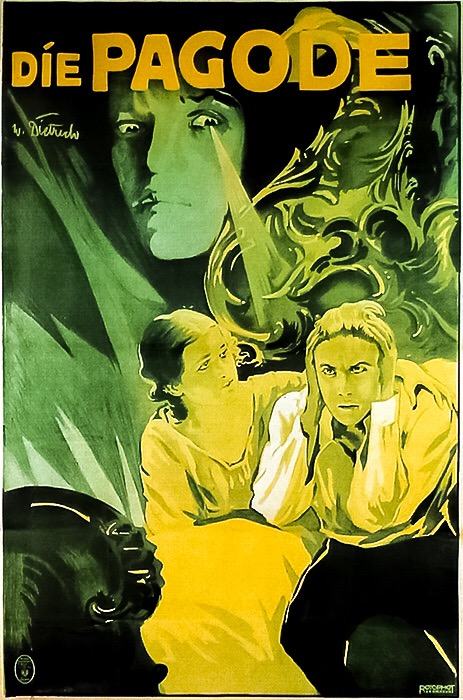
The Stygian Aesthetics of the Weimar Soul
To watch Die Pagode (1923) is to succumb to a visual delirium that only the German silent era could conjure with such frightening precision. While the American film industry was busy perfecting the populist charm of The Professor or the sentimental journeys of The Prince Chap, Alfred Fekete was busy deconstructing the very architecture of the human spirit. This film is not merely a piece of entertainment; it is a celluloid excavation of the anxieties haunting Central Europe in the wake of the Great War. The pagoda itself, a masterpiece of set design that rivals the architectural audacity seen in DeMille’s The Ten Commandments, functions as a character in its own right—a silent, wooden witness to the folly of men.
Ernst Deutsch: The Nervous Pulse of Expressionism
At the heart of this chiaroscuro nightmare is Ernst Deutsch. His performance here is a masterclass in the Expressionist style—a physical manifestation of internal rot. Unlike the stoic heroes of The Land of Long Shadows, Deutsch moves with a jagged, percussive energy. Every gesture is an exclamation point; every widened eye is a window into a soul being flayed by its own ambition. He represents the quintessential Weimar protagonist: intellectually superior but emotionally bankrupt, searching for meaning in the exotic 'Other' while ignoring the vacuum within. His interactions with Paul Bildt create a friction that drives the film forward, a psychological chess match where the stakes are nothing less than sanity itself.
"The film operates in the liminal space between reality and nightmare, where the shadows of the pagoda stretch longer than the history of the men who built it."
Olga Tschechowa and the Gaze of Mystery
Olga Tschechowa provides the film’s gravitational center. In an era where female roles often leaned toward the domesticity of Why Leave Your Husband? or the simplistic morality of The Hidden Truth, Tschechowa’s character in Die Pagode is refreshingly opaque. She is the catalyst for the narrative’s descent into the esoteric, yet she remains untouchable, a spectral presence that haunts the frame long after she has exited it. Her performance is subtle, relying on micro-expressions that contrast sharply with Deutsch’s grandiosity. It is this duality—the frantic and the frozen—that gives the film its unique rhythmic texture.
Fekete’s Directorial Alchemy
Alfred Fekete, serving as both writer and director, displays a remarkable command over the medium’s burgeoning language. He understands that in the silent cinema, the camera is the primary narrator. His use of low-angle shots and distorted perspectives creates a sense of vertigo, making the viewer feel as though they are trespassing on forbidden ground. While a film like Der Apachenlord might rely on the thrill of the chase, Fekete relies on the dread of the wait. The pacing is deliberate, almost ritualistic, mirroring the slow-burn tension found in The Forfeit, but with a significantly more sinister undertone.
The cinematography captures the smoke-filled rooms and the intricate woodcarvings of the pagoda with a tactile richness. One can almost smell the incense and the aging parchment. This sensory immersion is what elevates Die Pagode above the standard genre fare of the 1920s. It lacks the polish of All That Glitters Is Not Goldfish, but it possesses a raw, unvarnished power that is far more enduring. Fekete isn't interested in the glittering surface; he wants to see what lies beneath the floorboards.
A Comparative Study in Moral Ambiguity
When placed alongside the contemporary American output, the moral complexity of Die Pagode becomes even more striking. Where The Sudden Gentleman or Snobs offer clear-cut resolutions and social satires with happy endings, Fekete offers no such comfort. The characters in this film are deeply flawed, driven by greed and a colonialist entitlement that eventually leads to their undoing. In this regard, the film shares a thematic kinship with Beau Revel, exploring the decay of the upper classes, albeit through a much more hallucinatory lens. Even the elements of suspense, which might remind some of Spooky Spooks, are handled with a gravity that precludes any sense of playfulness.
The Legacy of the Silent Pagoda
As we reflect on the contributions of William Dieterle—who appears here before his transition to a legendary directorial career in Hollywood—we see the seeds of a visual style that would later define the Golden Age of cinema. The lighting techniques honed in these German studios, the dramatic use of shadows, and the emphasis on psychological depth would eventually cross the Atlantic, but they were born here, in the flickering frames of films like Die Pagode. It is a work that demands multiple viewings, not to solve its plot, but to soak in its atmosphere.
The film’s conclusion is as haunting as its opening. There is no triumphant return to normalcy, no restoration of the status quo. Instead, there is only the lingering image of the pagoda, indifferent to the human drama that has transpired within its walls. It reminds us that while men may come and go, the symbols they create—and the shadows they cast—endure. In the pantheon of Weimar cinema, Die Pagode stands as a monumental achievement, a dark jewel that continues to shine with a cold, unforgiving light. It is a necessary watch for anyone seeking to understand the roots of modern psychological horror and the enduring power of the silent image.
Ultimately, Die Pagode is a testament to the fact that cinema, at its best, is a form of dreaming. It allows us to explore the darkest corners of our collective subconscious, safe in the knowledge that we can wake up when the lights come on. Yet, long after the projector has stopped humming, the images of Deutsch’s contorted face and the silent, watchful pagoda remain etched in the mind, a reminder of a time when film was not just a business, but a revolutionary art form capable of touching the sublime.
Reviewer Note: This analysis considers the 1923 release within the context of the Reich Film Law and the burgeoning UFA aesthetic. For those interested in the evolution of the crime genre, a comparison with the earlier The Ticket-of-Leave Man provides a fascinating look at how narrative complexity evolved over a mere decade.
IMDb 3.5
1935
Community
Log in to comment.