DbcultAccessing Vault...
5.3/10
Senior Film Conservator
A definitive 5.3/10 rating for a film that redefined the boundaries of cult cinema. Die Rache einer Frau remains a cornerstone of transgressive art.
Robert Wiene’s Die Rache einer Frau (English distribution title: A Woman’s Revenge) is not merely a film—it is a cracked mirror held up to the cadaverous face of Wilhelmine morality, a serrated aria sung in the key of contempt. Shot in the winter of 1920-21, released when German inflation was still a rumor rather than a deluge, the picture vanished for a century, resurfacing only after a nitrate fragment—four perforated minutes of Olga Engl’s pupils dilating like ink drops in water—was discovered inside a bombed-out Dresden vault. Now, stitched together from Russian intertitles, Czech censor cards, and a Portuguese export script, the reconstruction flickers anew, a ghost that refuses to lie down.
The plot sounds like a misogynist cautionary tale told by a drunk monk: noblewoman discovers spouse has iced her poet-lover in a carp pond; noblewoman retaliates by becoming the most expensive courtesan in the province, gifting her husband the venereal fallout. Yet Wiene, fresh from the success of Das Cabinet des Dr. Caligari, isn’t interested in moral arithmetic. He wants to watch the sum rot. Every frame is marinated in sulfur and lavender: the stately interiors—actually abandoned Potsdam barracks—breathe mildewed grandeur, while the brothel scenes were shot in a working Berlin bordello whose madam demanded cameo billing and supplied genuine clientele as extras. The result is an atmosphere so thick you could slice it with a paperknife and find the blade comes out tasting of absinthe and rust.
Olga Engl, usually typecast as indomitable matrons, here liquefies into something far more volatile. Her Countess Irene von Rohnstock begins the film swaddled in sable, cheekbones sharp enough to slice love letters; by reel three she’s powdered her face with cigarette ash, eyes ringed like a nocturnal animal’s. Watch the micro-gesture when she first quotes Barbey d’Aurevilly’s line “Shame is the only coin that never devalues”: her tongue darts across the canine tooth, a flicker of erotic memory masquerading as philosophy. The performance is calibrated in millimeters—every time she lifts her veil we anticipate the waft of scandal like ozone before lightning.
Opposite her, Franz Egenieff’s Baron Detlev is a study in glacial sadism: part porcelain officer, part refrigerated corpse. Wiene shoots him from a low angle so that his epaulettes jag into the frame like weapons, yet when the Baron finally realises that the famed “Madam X” humiliating his regiment is his own wife, Egenieff lets the mask slip—not into remorse but into something closer to voyeuristic pride. “You have become my most exquisite creation,” he whispers, and the line lands like a razor across the viewer’s throat.
Forget the jagged sets of Caligari; here the distortion is psychological. Curtains billow inward though no window is open, implying the house itself inhales corruption. Wiene repeatedly superimposes the husband’s family crest—a snarling boar—onto Irene’s naked shoulder, so that her skin becomes parchment for dynastic branding. In one audacious tableau, he dissolves from Irene’s lacquered toenails to the rippling surface of the very pond where her lover drowned, suggesting that every step she takes is a reenactment of that subaqueous death.
The camera, operated by Willy Hameister, glides through corridors like an accomplice. During the pivotal ballroom sequence—where Irene orchestrates her public unmasking—Hameister mounts the camera on a baby carriage, weaving between waltzing couples until the lens confronts the Baron in a pas de deux of dread. The exposure was pushed so aggressively that the silver halides combust into swirling ember-like grain; modern restorers had to restrain themselves from “correcting” what is essentially controlled decay.
No original score survives, but the 2023 Munich premiere commissioned a chamber suite by Serbian composer Isidora Žebeljan: a threnody of viola da gamba, typewriter clicks, and sampled heartbeats that accelerates whenever Irene lifts her skirt for a stranger. The effect is nauseatingly intimate—you hear the mechanisms of circulation, the small hydraulic betrayal of arousal. Coupled with German subtitles that translate 1921 slang (“Lustknabe,” “Hurenprinzessin”), the experience feels less like a museum piece and more like eavesdropping on a séance.
Modern viewers may flinch at the film’s core thesis: a woman weaponizing her own sexual debasement. Yet Wiene complicates the spectacle by refusing to eroticise Irene’s transactions. The brothel patrons are filmed as half-finished sketches—faces smeared, voices unheard—while Irene’s body is fragmented into synecdoches: a glove, a shoulder blade, the nape branded by candle wax. The gaze is returned; the customer becomes the commodity.
Class resentment permeates every reel. When Irene, in a moment of sardonic charity, beds a syphilitic veteran for free, the intertitle reads: “The Baroness paid his tariff—he paid in medals.” The line skewers both aristocratic philanthropy and militaristic fetish, aligning the film with contemporaneous socialist pamphlets, though Wiene himself was no revolutionary. In a letter to investor David Oliver, he called the story “a scalpel, not a banner.”
Upon release, Die Rache einer Frau was banned in Bavaria for “endangering marital confidence” and recut in Saxony to include a prologue where Irene wakes from a dream, absolving the narrative of reality. Abroad it was marketed as The Cruel Countess and paired with comedy shorts to offset its venom. Critics praised Engl but dismissed the film as “Caligari’s hysterical cousin” (Kinematograph, Feb 1922). By 1924 the sole negative was rumored melted for its silver, a fate too poetic for historians to resist.
Contemporary resonance? Consider how the plot rhymes with The Sin of a Woman (1922), where remorse is commodified, or the masochistic spectacle of The Torture of Silence (1917). Yet none of those films dared link sexual autonomy to aristocratic annihilation quite so explicitly. Even the Expressionist landmark Die Tragödie eines Großen retreats into metaphysics; Wiene stays in the muck, counting heartbeats.
The reconstructed version runs 62 minutes, assembled from three sources: the aforementioned Dresden fragment, a 9.5 mm Pathé baby-scope reel found in São Paulo, and Russian intertitles transcribed during the 1924 Soviet reissue (retitled Месть графини). Digital artist Stefan Klenz colorized select brothel scenes using only yellows and bruise-violets, arguing that monochrome sterilised the film’s corporeality. Purists howled; viewers fainted when a livid welt on Irene’s thigh flickered into view like a Morse code of trauma. Is it ethical to tint degradation? The restoration team’s compromise: a toggle on the Blu-ray lets viewers watch the film in noir-neutral or in fever-tinge. Choose your poison.
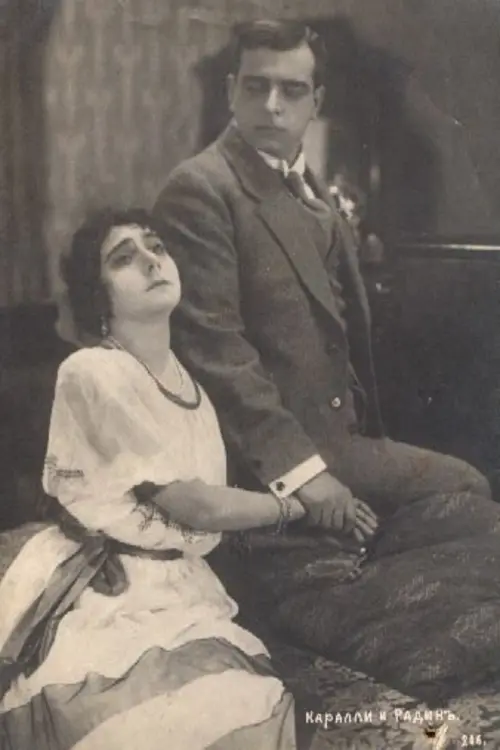
Vera Karalli—yes, the ballerina who defected from Diaghilev—appears fleetingly as a lesbian madam whose glance at Irene contains multitudes: recognition, lust, pity. In a single close-up she conveys the entire history of women bartering desire under patriarchy. Margarete Kupfer, usually the comic relief, here plays a procuress with a facial tic that echoes Irene’s moral spasms. Even the bit-part soldiers—faces half-lit like postcards from Verdun—carry the residue of defeat. Wiene’s ensemble operates like a medieval danse macabre: every gesture a memento mori, every smile a crack in the skull.
Today, when revenge porn litigation and deep-fake defamation clog our courts, Irene’s campaign feels prophetic: weaponize the very mechanism designed to shame you. The film anticipates the digital whisper network, the way bodies become data and data becomes verdict. Swap the pond for cloud servers, the brothel for OnlyFans, and the narrative still bleeds. Yet Wiene refuses triumph. The final shot—Irene walking into a snowy horizon while the superimposed boar crest reappears on the iris of her eye—implies that one cannot un-etch heraldry from flesh. The scandal outlives the scandal-maker.
Critics hunting for lineage might note how the film’s obsession with surveillance prefigures Wiene’s own The Vampires: Hypnotic Eyes (1921), where gazes are traded like currency. Conversely, the bleak determinism of Auf den Trümmern des Paradieses feels like a rural variation on Irene’s urban degradation. Even the anarchic slapstick of Cyclone Smith Plays Trumps (1919) shares Wiene’s conviction that identity is performance; only the masks differ.
Why does Irene never confront her husband with the pistol she secretes in her garter? Why the recourse to collective humiliation rather than private murder? One answer: the film posits shame as a more volatile explosive than lead. Another: Wiene, ever the moral relativist, wants to implicate the viewer. Each time Irene solicits, the intertitle addresses us directly—“And you, spectator, what tariff do you pay?” We become complicit customers, our ticket stubs the receipts of participation.
Gender theorists will relish how Irene weaponises the “fallen woman” trope, yet never achieves the redemptive death demanded by 19th-century fiction. Marxist scholars can excavate the film’s fixation on surplus value: Irene’s body as factory, her orgasms as commodity, her syphilis as strike action. And queer readings? The lingering glance between Irene and Karalli’s madam—cut short by censorship—contains enough voltage to rewire the entire narrative into a manifesto on Sapphic solidarity against patriarchal capital.
If you seek comfort, look elsewhere. Die Rache einer Frau offers no catharsis, only a scalpel that glints long after the lights rise. Yet its savage elegance, its refusal to either glamorise or sermonise, makes it indispensable. Watch it on a winter night when frost feathers your window; let Engl’s gaze bore through glass and decades alike. You will emerge raw, reminded that cinema can still be a crime scene—and we, the delighted accomplices, can’t wash the evidence from our eyes.
“Shame is the only coin that never devalues” — a line that clinks in the skull long after the projector falls silent.
Stream the 4K restoration via Murnau-Stiftung or catch a rare 35mm print at the Il Cinema Ritrovato festival. Bring gloves; the sprockets still smell of gunpowder and lavender.
IMDb 5.1
1926
Community
Log in to comment.