DbcultAccessing Vault...
Cult Review
Senior Film Conservator
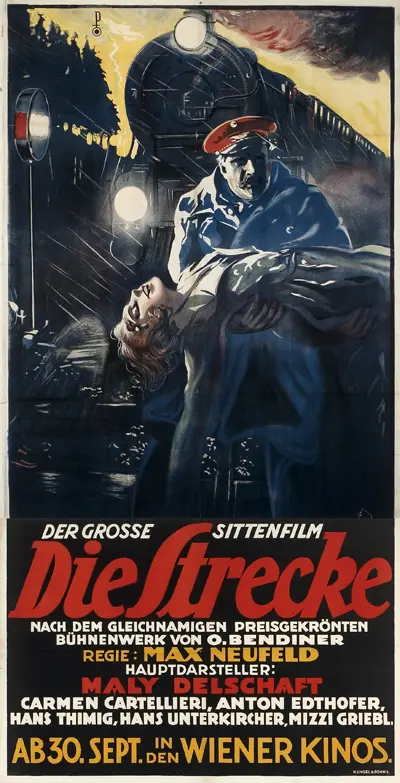
Is Die Strecke a relic worth excavating for the modern cinephile? Short answer: yes, but primarily as a masterclass in industrial atmosphere rather than narrative complexity. This film is for the patient viewer who appreciates the textural beauty of silent-era cinematography and the historical weight of early 20th-century labor dramas; it is absolutely not for those seeking fast-paced thrills or modern narrative beats.
This film works because of its rhythmic, almost hypnotic editing that mirrors the mechanical heartbeat of the railway, creating a sense of inevitable momentum. This film fails because its secondary romantic subplot feels like a mandated concession to the box office, momentarily derailing the stark realism of the industrial setting. You should watch it if you have an appetite for silent-era realism and want to see how early Austrian cinema handled the collision of man and machine.
Yes. While many silent films of the late 1920s were pivoting toward high-concept escapism, Die Strecke remains stubbornly grounded in the dirt and iron of its setting. It offers a rare glimpse into the Austrian cinematic identity before the sound era shifted the landscape. It isn't just a movie; it's a historical document wrapped in a character study. If you can handle the slower cadence of 1927 storytelling, the visual rewards are substantial.
Max Neufeld’s direction in Die Strecke is nothing short of obsessive. He doesn't just show us a train; he shows us the weight of the train. In an era where cinema was often theatrical and static, Neufeld uses the camera to capture the kinetic energy of the tracks. He understands that the railway is a metaphor for life itself—unyielding, moving in one direction, and dangerous if you lose your footing.
Consider the opening sequence. We aren't introduced to the protagonists through dialogue or traditional exposition. Instead, we are given a montage of pistons, steam valves, and the rhythmic clanking of wheels. This isn't just fluff. It sets a tonal baseline. The machine is the protagonist. The humans are merely the components that keep it running. It’s cold. It’s steel. It’s human.
When compared to other works of the era, such as Das törichte Herz, which Neufeld would later explore with a more romanticized lens, Die Strecke feels like a punch to the gut. It lacks the soft edges of his later work. Here, the shadows are deeper, and the stakes feel more permanent. The film captures a specific moment in European history where the excitement of the industrial revolution was being replaced by the realization of its cost.
Anton Edthofer delivers a performance that defines the term 'understated.' In the silent era, actors often leaned into pantomime—wide eyes, clutching chests, and grand gestures. Edthofer goes the other way. His face is a landscape of suppressed emotion. He plays a man who has spent so much time around machines that he has begun to mirror their rigidity.
There is a specific scene mid-way through the film where Edthofer’s character is faced with a catastrophic mechanical failure. Instead of the expected histrionics, he simply stares into the steam. It’s a haunting moment. His eyes convey a profound sense of exhaustion that no title card could ever explain. This is the 'New Objectivity' (Neue Sachlichkeit) movement bleeding into cinema—a focus on the functional, the real, and the unsentimental.
Hans Unterkircher provides the necessary foil. Where Edthofer is the anchor, Unterkircher is the flicker of humanity trying to survive in the dark. Their chemistry is built on shared silence. It’s a testament to the script by Jacques Bachrach and Oskar Bendiener that they allowed these characters to exist without the need for constant, forced conflict. The conflict is the environment.
The visual language of Die Strecke is its greatest asset. The cinematography treats the railway yard like a cathedral. The high-contrast lighting turns the plumes of steam into ghostly apparitions that haunt the characters. In one particularly striking night scene, the only light comes from the glowing furnace of the locomotive, casting long, distorted shadows across the tracks. It’s visual storytelling at its most primal.
The pacing, however, is where some modern viewers might struggle. The film chugs along like a heavy freight train. It takes its time. It builds its world brick by brick, or rather, tie by tie. Unlike the frantic energy of Blind Justice, Die Strecke is content to let the atmosphere do the heavy lifting. This is a bold choice. It forces the audience to inhabit the space of the workers.
I would argue that the film’s biggest flaw is its inability to maintain this grit when the script introduces the romantic interests. The tonal shift is jarring. One moment we are analyzing the structural integrity of a bridge, and the next, we are in a parlor room with soft lighting. It feels like two different movies fighting for dominance. Fortunately, the industrial side usually wins.
One of the most unconventional aspects of Die Strecke is how it uses the visual medium to imply sound. We don't have a synchronized soundtrack, yet the film is loud. You can almost hear the screech of metal on metal. Neufeld uses close-ups of vibrating objects and the frantic movement of workers to create an auditory landscape in the viewer's mind. It’s a sophisticated trick that many silent films failed to pull off.
Contrast this with something like Feenhände, which relies much more on the grace of movement. Die Strecke is about the violence of movement. Everything has weight. Everything has consequences. When a character makes a mistake on the track, the film doesn't look away. It’s brutal in its simplicity.
Pros:
- Exceptional use of shadow and light.
- A restrained, powerful performance by Anton Edthofer.
- Authentic production design that makes the railway feel alive.
- A unique look at Austrian labor history.
Cons:
- The pacing can feel sluggish in the second act.
- Some narrative elements are overly predictable.
- The transition between industrial drama and melodrama is clunky.
Die Strecke is a film that demands your full attention. It doesn't offer easy answers or cheap thrills. Instead, it offers a meditation on the relationship between man and the machines he builds. It is a flawed work, certainly, but its flaws are overshadowed by its visual ambition and the sheer weight of its atmosphere. Max Neufeld managed to capture a world that was rapidly disappearing, and for that alone, it is a essential viewing for anyone serious about the history of the medium. It works. But it’s flawed. And in its flaws, it finds its most human moments.

IMDb 6.7
1934
Community
Log in to comment.