DbcultAccessing Vault...
Cult Review
Senior Film Conservator
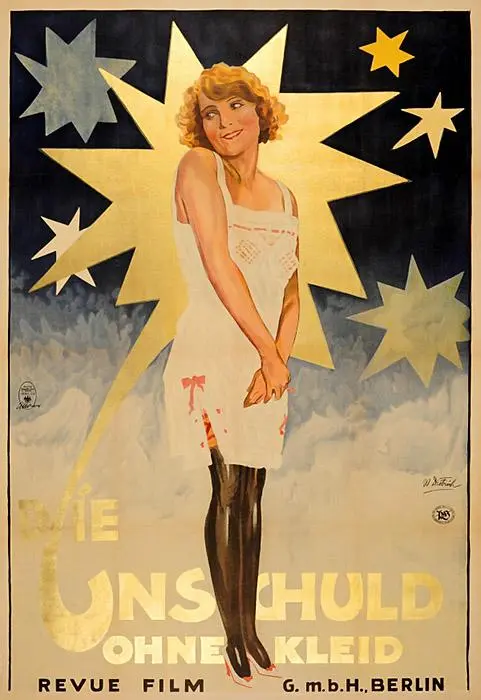
Short answer: yes, but only if you possess an appetite for the nuances of silent-era social satire. This is not a film for those seeking the high-octane thrills of modern cinema or even the expressionist shadows of its contemporaries; it is a film for the patient observer of human folly.
This film is specifically for historians of the Weimar Republic and fans of early European character comedies. It is absolutely NOT for viewers who find the slow pacing of silent cinema tedious or those who require a clear-cut hero-villain dynamic to stay engaged.
To understand why this film matters, one must look past the grainy celluloid and into the cultural anxiety it represents. In 1923, Germany was a place of radical shifts, and Die Unschuld ohne Kleid captures that friction perfectly. It works. But it’s flawed.
This film works because it uses a trivial physical object—a dress—to expose the profound emptiness of social status. When the protagonist is 'without her dress,' she hasn't lost her virtue, yet the world around her reacts as if the moral sky has fallen. This subversion of expectation is where Orthmann finds his best comedic and dramatic beats.
This film fails because the second act drags significantly, relying on repetitive misunderstandings that feel stretched even for a feature-length production. There are moments where the plot circles the drain of its own premise before finally pulling the plug in the finale.
You should watch it if you enjoyed the subtle social maneuvering in The Pretenders or if you are interested in how early cinema handled the concept of 'the fallen woman' with more wit than many of its American counterparts, such as A Petal on the Current.
Maria Mindzenty carries the weight of the film on her shoulders. In a standout scene where she must face a room full of judgmental socialites, her eyes do more work than a thousand lines of dialogue. She manages to convey a sense of 'naked' vulnerability that isn't about the lack of clothing, but the lack of a social shield.
Her performance is a stark contrast to the broader, more theatrical style of Wilhelm Bendow. While Bendow provides the necessary levity, Mindzenty provides the soul. It is a performance that feels surprisingly modern in its restraint. She doesn't resort to the wild gesticulations often associated with the era; instead, she opts for a simmering frustration that resonates across a century.
Compare her work here to the more stylized performances in The Soul of Buddha. While that film leans into the exotic and the extreme, Mindzenty keeps Die Unschuld ohne Kleid grounded in a recognizable, albeit heightened, reality. Her character isn't a victim of fate, but a victim of the gossip mill, a theme that remains painfully relevant in the age of social media.
Helmuth Orthmann’s direction is functional rather than revolutionary. However, his use of interior spaces is noteworthy. The bourgeois apartments are filmed to feel like cages—ornate, expensive, and suffocating. The camera often lingers on heavy drapes and cluttered sideboards, emphasizing the material weight that these characters value over actual human character.
The pacing is where the film struggles most. Orthmann seems enamored with the 'comedy of errors' structure, but he lacks the surgical precision of someone like Lubitsch. There is a sequence involving a hidden suitor that goes on for several minutes too long, losing the rhythm that a shorter edit would have preserved. It lacks the punchy efficiency found in shorts like Tire Trouble.
Despite this, the cinematography manages to elevate the material. The lighting in the evening scenes uses a soft-focus technique that gives the film a dreamlike, almost ethereal quality. This visual softness contrasts sharply with the 'hard' social judgments being made by the characters, creating a subtle layer of irony that many critics at the time missed.
If you are looking for a historical document that mirrors the shifting morals of post-WWI Europe, then yes, this film is essential viewing. It provides a window into a world where the loss of a dress was a metaphor for the loss of a lifestyle. However, if you are looking for a tight, fast-paced narrative, you will likely find yourself checking the clock.
The film is a fascinating bridge between the moralistic dramas of the early 1910s and the more cynical, sharp-edged comedies that would define the late 1920s. It sits in a strange middle ground—not quite daring enough to be revolutionary, but too smart to be dismissed as mere fluff. It is a film of 'almosts' and 'could-have-beens' that still manages to charm.
Wilhelm Bendow is the secret weapon of the production. His comedic timing is impeccable, often saving scenes that are on the verge of becoming too melodramatic. There is a specific moment where he attempts to explain away a scandalous discovery with a series of increasingly absurd lies that is genuinely funny even today.
Bendow’s mustache acts better than half the extras in the background. He uses his entire body to convey a sense of flustered panic that serves as the perfect foil to Mindzenty’s calm. While the film is titled after her character, it is often Bendow who drives the energy of the plot forward, preventing it from sinking into a purely somber meditation on reputation.
His role here is a precursor to the archetypal 'funny best friend' or 'bumbling uncle' that would become a staple of cinema. He brings a level of physical comedy that feels more aligned with the energy of Just Cowboys than the starchy dramas of the period. Without him, the film would be a much drier experience.
The editing of the film is typical for 1923, which is to say, it is somewhat static. We are still in an era where the camera is a spectator in a theater rather than a participant in the action. There are few close-ups, and the medium shots can feel repetitive after an hour. However, the set design by the production team is top-tier for the budget.
The film’s tone is its most interesting technical aspect. It fluctuates between light farce and serious social commentary. This inconsistency is actually its strength. It reflects the confusion of the era. One moment we are laughing at a man hiding under a bed, and the next we are contemplating the social death of a young woman. It’s jarring. It’s messy. It’s human.
When compared to the technical prowess of something like Blue Blazes, this film feels more intimate and less concerned with spectacle. It is a 'small' film in the best sense of the word, focusing on the micro-aggressions of the upper class rather than grand heroic gestures.
Pros:
Cons:
One surprising observation: the film is actually more conservative than its provocative title suggests. While the title Die Unschuld ohne Kleid promises something scandalous, the film is ultimately a defense of traditional virtue. It’s a bait-and-switch that worked well for 1923 audiences but might feel a bit hollow to a modern viewer expecting a more radical statement.
Additionally, the way the film treats its supporting characters—specifically the gossiping neighbors—is almost proto-noir. They are filmed in shadows, their faces often obscured, making them feel like a collective monster rather than individuals. This is a sophisticated touch for what is ostensibly a comedy.
"Reputation is the only currency in a world that has lost its gold, and this film shows just how quickly that currency can devalue."
Die Unschuld ohne Kleid is a fascinating, if slightly bloated, relic of a bygone era. It doesn't have the visual punch of the great German Expressionist films, but it has a wit and a social awareness that makes it worth the sit. It is a film about the clothes we wear to hide our true selves, and the panic that ensues when those clothes are removed.
It isn't a masterpiece. It’s a conversation piece. For those willing to look past the technical limitations of 1923, there is a sharp, funny, and occasionally moving story about the absurdity of being human. If you can handle the slow burn, the reward is a unique glimpse into the soul of the Weimar Republic.
IMDb 4.7
1928
Community
Log in to comment.