DbcultAccessing Vault...
Cult Review
Senior Film Conservator
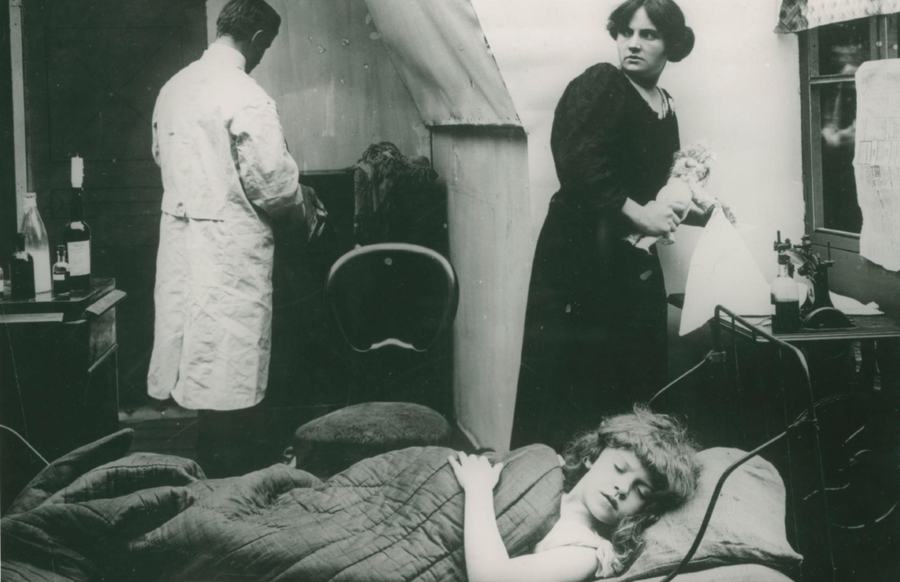
Imagine a kiln so hot it can calcify desire itself—then watch Axel Breidahl sling that very kiln onto the screen in Dockan eller Glödande kärlek. The plot, flimsy as a biscuit shell on paper, becomes alabaster-solid through Breidahl’s cross-lighting scheme: faces modeled by sodium glare, shadows pooled like spilled India ink, every frame a chiaroscuro valentine to emotional combustion.
Cinematographer Arvid Ringheim treats the factory as catacomb and cathedral in one. The camera drifts past rows of bisque dolls—eyes un-painted, mouths agape—mirroring the workers’ silent longings. When Holm (Breidahl) escorts Martha (Ida Nielsen) along the narrow catwalk, the handheld sway feels like a pulse: two ventricles pumping against a metal ribcage. Compare this tactile intimacy to the wide-open tableaux of Glacier National Park; here we’re trapped inside a crucible rather than let loose on a frontier.
Anna’s first close-up arrives with a hard cut that omits every buffer of courtesy. Ringheim’s lens practically skewers her pupils; the ensuing jealousy is not implied but injected. Silent-era antagonists often telegraph scorn through arched brows alone, yet Anna’s micro-twitches—eyelid stutters at 18 fps—feel surgically modern, predating the psychotic stare fest in later Scandinavian noir.
Sweden circa 1910 was a tinderbox of labor unrest, and Breidahl—also the screenwriter—slips that friction into the narrative seams. Holm’s engineering badge grants him authority over machinery but zero leverage inside the bourgeois parlors where Anna preens. Martha, meanwhile, owns nothing except pigment-stained fingertips, yet she commands the film’s moral high ground—a sly inversion of the upstairs-downstairs trope played straight in Oliver Twist the very same year.
Breidahl refuses to romanticize either stratum. The proletarian scenes are grim, but the ballroom waltz is equally suffocating—white gloves fencing off human warmth. This balanced cynicism plants the film closer to the caustic social autopsy of Strike than to the redemptive melodrama found in The Prodigal Son.
Axel Breidahl sidesteps the histrionic semaphore common in 1910. His Holm is all contained urgency—tight jaw muscles, thumbs compulsively rubbing trouser seams—so that when the kiss finally lands it detonates like a slammed mold releasing its cast. Ida Nielsen’s Martha counters with fawn-like reticence; watch how she folds her rag as though staunching an unspoken wound, then lifts her chin to meet Holm’s lips with tragic temerity.
But the film’s live wire is Anna, portrayed by an uncredited actress whose name history has cruelly mislaid. She oscillates between porcelain fragility and kiln-hardened spite, often within a single intertitle. In one devastating iris-out, her eyes flood not with tears but with something colder—liquid glass that will solidify into vendetta.
Triangular love stories customarily pivot on symmetrical beats: introduction, flirtation, rupture, reunion. Breidahl fractures that symmetry by letting the rupture occur at midpoint, leaving a cavernous narrative vacuum. The second half resembles a pottery wheel spinning off-center—scenes wobble, timelines skip, tension warps. Modern viewers may balk at the seeming discontinuity, yet the formal disarray mirrors the psychological dislocation of its characters. Think of it as a silent precedent for the fragmented subjectivity later surfacing in Dante’s Inferno.
Though monochromatic, the surviving print flaunts hand-applied washes: cobalt blues for exterior dusk, rose madder for Anna’s drawing room, sulphur yellows during kiln blasts. These tints aren’t ornamental; they cue emotional thermostats. The cobalt shift when Holm first grasps Martha’s hand bathes the couple in moonlit possibility, whereas the sulphuric flare during Anna’s confrontation feels like breathing molten tin.
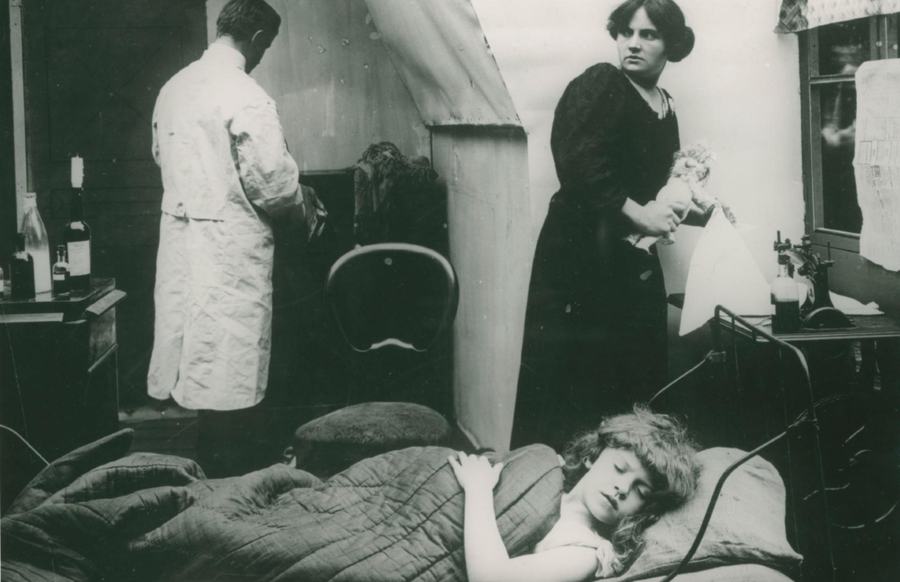
Archival comparisons reveal similar tint strategies in The Life and Passion of Jesus Christ, yet none so systematically tether pigment to pathos. Breidahl’s chromatic schema anticipates the coded color palettes of 1990s digital grading by nearly nine decades.
Most Swedish silents of the era favor perfunctory cue cards. Here, the intertitles read like ruptured love-notes baked into glaze. Example: “Her kiss sealed his fate, but the kiln sealed her future.” The line lands with fatalistic snap yet leaves interpretive fissures—characteristic of crackle glaze where beauty blooms through fracture.
Breidahl’s montage alternates between languid cross-fades and percussive hard cuts, producing a syncopated heartbeat. In the pivotal kiss scene, he fractures the moment into four shots—wide, insert, reaction, silhouette—each running fewer than twenty-two frames. The brevity paradoxically elongates sensation; viewers feel the smack travel through celluloid at the speed of rumor.
No original score survives, so festival programmers habitually bolt on pastoral Nordic folk. A subversive alternative: pair the film with a prepared-piano suite, strings muted by porcelain discs, percussive accents produced by kiln bricks. The ceramic instrumentation would literalize the film’s sonic unconscious while honoring its material fetish.
Early cinema rarely granted women narrative agency without penalizing them. Martha ends the film neither married nor martyred—merely absent, erased by Anna’s machinations. The open-ended loss feels brutally honest, sidestepping the moral recuperation that cripples the finales of Anna Karenina adaptations. Feminist scholars might still bristle at Martha’s vaporization, yet within 1910’s patriarchal scaffolding, her narrative evacuation reads as indictment, not acquiescence.
Despite domestic success, the film slipped into obscurity while Sjöström and Stiller claimed historiographic limelight. Yet traces ripple outward: the factory-as-pressure-cooker metaphor resurfaces in Mauritz Stiller’s Gösta Berlings saga; the color-tint code prefigures Sjöström’s The Phantom Carriage; the triangular cruelty echoes through Bergman’s Sawdust and Tinsel. Cinephiles tracing Nordic noir’s genealogy must rewind past 1940 and kneel at this kiln.
A decomposing 35mm nitrate print surfaced in a Gothenburg basement in 1987, missing some 420ft. The 2018 Svenska Filminstitutet restoration used a French distribution duplicate to fill ruptures, then employed optical blow-up to minimize aspect jumps. The resulting DCP preserves original tinting notes scrawled on the negative’s margins, resurrecting hues unseen since Edwardian audiences first gasped.
Porcelain is fired twice: once to harden, once to glaze. Breidahl’s film undergoes a parallel bisque—its rough narrative clay tempered by historical distance, then glazed by contemporary rediscovery. Watching it today means witnessing cinema learn to handle fragile emotions without safety gloves. You will smell the kiln smoke, feel the chalky dust settle on your lashes, and understand why the most scalding passions often leave the faintest cracks.
Verdict: A crackle-glaze marvel whose fractures only magnify its iridescence—unmissable for devotees of Nordic silent cinema, artisanal melodrama, or anyone who’s ever felt love fired past the boiling point of reason.

IMDb 5.7
1935
Community
Log in to comment.