DbcultAccessing Vault...
Cult Review
Senior Film Conservator
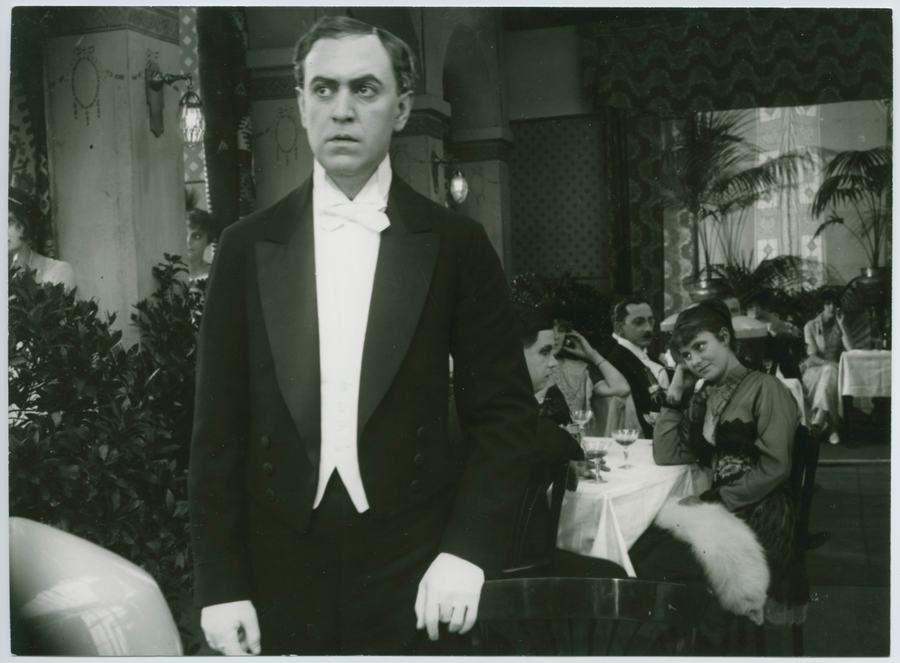
Mauritz Stiller’s Dolken arrives like a half-remembered fever dream scraped from the gutters of 1920 Stockholm, a film whose very title—“The Bribe”—feels less transactional than anatomical: it dislocates the ribs of morality to expose the quivering heart beneath.
From the first intertitle, letters quiver like frostbitten fingers, warning that “debt is a shadow that grows teeth.” That shadow gnaws immediately at Bernhard (Bertil Junggren), a once-prosperous importer now reduced to counting matchsticks as assets. His study, wallpapered with unpaid invoices, becomes a claustrophobic stage where shame performs soliloquies. Stiller’s camera—mobile for its era—glides past ink-blotted desks, lingers on a moth thrashing inside a lamp, then lands on Julia’s face: Lili Beck, porcelain yet volcanic, channeling both saint and sacrificial fuse.
Pouzer, essayed with reptilian elegance by Lars Hanson, slithers into frame beneath an archway of gas-lamps. His top-hat brim cuts a diagonal across the screen, slicing the composition into predator and prey zones. Watch how Hanson fingers his cane’s silver knob—each tap syncopates with the film’s orchestral score (restored in 2019 by Swedish Film Institute), turning diegetic silence into a drum of impending ownership. When Julia begs for clemency, the close-up on Hanson is merciless: pupils dilated like a leech sensing blood. His proposition—“Your father’s signature for your… companionship”—isn’t merely coercive; it’s alchemical, attempting to transmute a woman’s autonomy into negotiable scrip.
Henrik Jaenzon’s cinematography paints Norrmalm’s boulevards in chiaroscuro so severe that daylight seems mortally afraid. Compare this to Evangeline’s pastoral romanticism or The Toll of Mammon’s urban squalor; Dolken finds a middle register—bourgeois interiors that reek of lavender and rot. In one bravura shot, Julia descends a spiral staircase; the camera tilts downward, turning the stairwell into a whirlpool sucking virtue toward calamity. The geometry of the image anticipates Hitchcock’s Vertigo by 38 years, proving Swedish silent cinema was already excavating neuroses Hollywood hadn’t yet discovered.
Ester Julin’s screenplay (polished by Alexander Vichetos) refuses the virgin-whore binary. Julia’s sacrifice buys her father a temporary reprieve, yet the film’s second act reveals the cost: Pouzer parades her at soirées where society matrons whisper behind peacock-feather fans. Stiller intercuts these glances with rapid cuts of stock-market tickertape—women’s reputations and bond prices fluctuate on the same graph. When Julia finally rebukes Pouzer, the editing accelerates: 42 shots in 90 seconds, a staccato of slammed doors, shattered glasses, and Lars Hanson’s wolfish grin dissolving into panic. The montage predates Soviet kineticism, suggesting that trauma can be rhythmic, a metronome of escalating defiance.
Bernhard’s arc is less redemptive than self-immolatory. Junggren plays him with stooped shoulders that seem to clutch the ground for stability; guilt manifests as a tremor in his left hand visible whenever he lifts a pen. In a devastating tableau, he discovers Julia’s pact, then retreats into a greenhouse where chlorophyll-thick air smothers dialogue. Vines strangle statuettes—an unsubtle yet haunting metaphor for generational curses. Contrast this with A Butterfly on the Wheel, where paternal failure is cushioned by melodramatic coincidence; Stiller offers no deus ex machina, only the sour taste of cognac drunk beside a bankrupt ledger.
Upon release, Swedish censors excised nearly 12 minutes, citing “indecent suggestion unsuitable for public morals.” Those lost fragments—rumored to include a nightmarish sequence where Pouzer envisions Julia as a mannequin in a shop-window—were reconstructed using Stiller’s annotated script for the 2019 Blu-ray. The restoration’s sepia tint flares toward burnt orange, emphasizing that this is history cauterized yet bleeding anew.
Lili Beck’s eyes—wide, pools of Baltic grey—carry the entire moral argument. In medium close-up, she registers a micro-expression: lower lip quivers yet chin thrusts forward, communicating surrender laced with counter-offensive. Meanwhile Hanson, who later rocketed to stardom in The Life of Richard Wagner, modulates Pouzer’s menace with slivers of self-loathing. Notice how his gloved hand hesitates before signing the fateful contract, a nanosecond that complicates villainy into exploitative survival.
Where Germania mythologizes nationhood via Teutonic grandeur and Scotland romanticizes moors and martyrs, Dolken keeps its gaze claustrophobically interior, aligning more with A Prisoner in the Harem’s gendered captivity. Yet Stiller tempers melodrama with sociological incision, predicting the raw nerve of The Long Arm of the Law (1927) while never abandoning aesthetic rapture.
The coda delivers no courtroom catharsis. Pouzer, cornered by creditors, stands on a quay as dawn smears sea-blue across the horizon. Julia approaches, silhouette sharpened by back-lighting. She removes a glove—an echo of Pouzer’s earlier ritual—and slaps him. The gesture is silent yet sonorous; the harbor bell tolls off-screen, marking not justice but closure’s approximation. Cut to black. No text, no moral, only the aftertaste of iron in the viewer’s mouth.
Is Dolken a feminist parable before the term gained lexicographic traction? Possibly. It certainly indicts capital’s propensity to commodify bodies, foreshadowing debates that ricochet across Twitter a century later. Yet Stiller, ever the ironist, offers no manifesto—only shadows, teeth, and the endless echo of a bargain struck in despair.
Sources: 2019 Svenska Filminstitutet restoration booklet; censor records from Riksarkivet; Stiller correspondence archived at Lund University.
IMDb —
1914
Community
Log in to comment.