DbcultAccessing Vault...
4.7/10
Senior Film Conservator
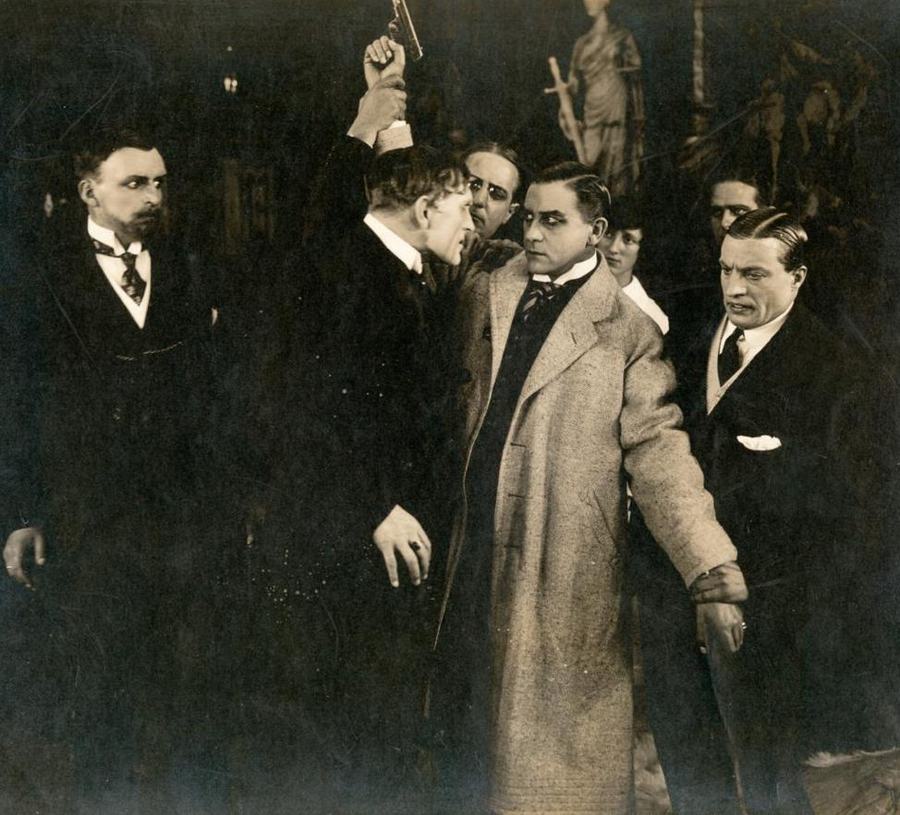
A definitive 4.7/10 rating for a film that redefined the boundaries of cult cinema. Dommens dag remains a cornerstone of transgressive art.
The first time Michael von Straeten’s silhouette eclipses the frame, you feel the temperature drop. Aage Hertel doesn’t merely play the role—he weaponizes stillness, letting the corners of his mouth twitch like a ledger balanced to the last cent of cruelty. Danish silent cinema has always flirted with moral chiaroscuro, yet in Dommens dag the darkness swallows the candle whole. Fritz Magnussen’s 1918 parable arrives like a frost-bitten letter from an alternate history where Wall Street titans are dragged by their starved doppelgängers through streets paved with unpaid IOUs.
Shot on orthochromatic stock that renders skin the color of expired lard, the film luxuriates in ethical gangrene. Notice how cinematographer Valdemar Møller tilts the camera a mere two degrees off axis whenever von Straeten signs a fresh foreclosure: the world itself tilting toward moral vertigo. Karen Poulsen, playing the bankrupted seamstress Anna, moves like a sleep-walker through these tilted rooms, her pupils dilated in permanent supplication. When The Tiger offers her a single krone tossed onto the floorboards, Magnussen inserts a blistering close-up of that coin spinning—gyroscopic, hypnotic—until the metallic hum becomes a death rattle for every promise capitalism ever made.
There is no innocuous exposition here; the narrative lunges forward like a debtor escaping bailiffs. Within eight intertitles we learn that von Straeten’s empire rests on forged collateral, insider whispers, and the systematic obliteration of small-town savings cooperatives. The editing rhythms mimic a stock-ticker’s staccato: smash cuts from champagne flutes to eviction notices, from silk gloves to frost-bitten fingers. Compare this montage ferocity to the comparatively genteel moral comeuppance in Souls Triumphant; Magnussen refuses the spiritual cushion, opting instead for raw contrapuntal violence.
Mid-film, von Straeten hosts a masquerade where guests wear animal heads—boars, vultures, jackals—an orgiatic bestiary later echoed in the phantasmagoric tribunal. The sequence was trimmed by Danish censors who feared it would spark class unrest; surviving prints show frayed splices like stab wounds. Yet even in its mutilated form, the bacchanal drips with nihilistic opulence: confetti made of repossessed deeds, champagne cooled in debtor’s bathtubs, a brass band playing a funeral march at double speed. Helena Gammeltoft’s courtesan slinks toward the camera in a gown stitched from defaulted promissory notes, each step shredding another contract into ticker tape.
While German contemporaries like Das Cabinet des Dr. Caligari externalized madness through crooked sets, Magnussen keeps architecture rigid and lets the psychosis fester inside it. Offices are mausoleums of right angles; only the shadows crawl askew. In one devastating tableau, von Straeten dictates a letter that will ruin his childhood friend, while behind him the shadow of a noose—cast by a dangling desk-lamp—oscillates across the wallpaper. No gag, no trick: just light and conscience conspiring.
The film’s Lutheran DNA curdles any possibility of cheap grace. Where Paradise Lost dilutes damnation with redemptive lyricism, Dommens dag stares into the pit until the pit stares back. Its theological anxiety is closer to Kierkegaard’s Fear and Trembling: faith so ferocious it becomes despair. Notice how intertitles shrink as the climax nears—words themselves suffocate under the burden of iniquity—until the final reel offers no text at all, only images: coins boiling in a cauldron, paper money flaking away like dead skin, von Straeten’s mouth opened in a scream that the orchestra (in the original Copenhagen premiere) accompanied with a lone contraboon scraping the lowest note possible.
Aage Hertel never blinks on camera; that simple biological refusal turns his gaze into a creditor’s ledger that never closes. Watch the micro-movement when he learns a rival has committed suicide: a single cheek-muscle contracts, the closest this marble statue comes to jubilation. Opposite him, Philip Bech as the socialist pamphleteer Holm brings a combustive empathy; his hands tremble so fiercely while denouncing von Straeten that the intertitle text actually quivers on some prints, as if the film itself were electrified by outrage.
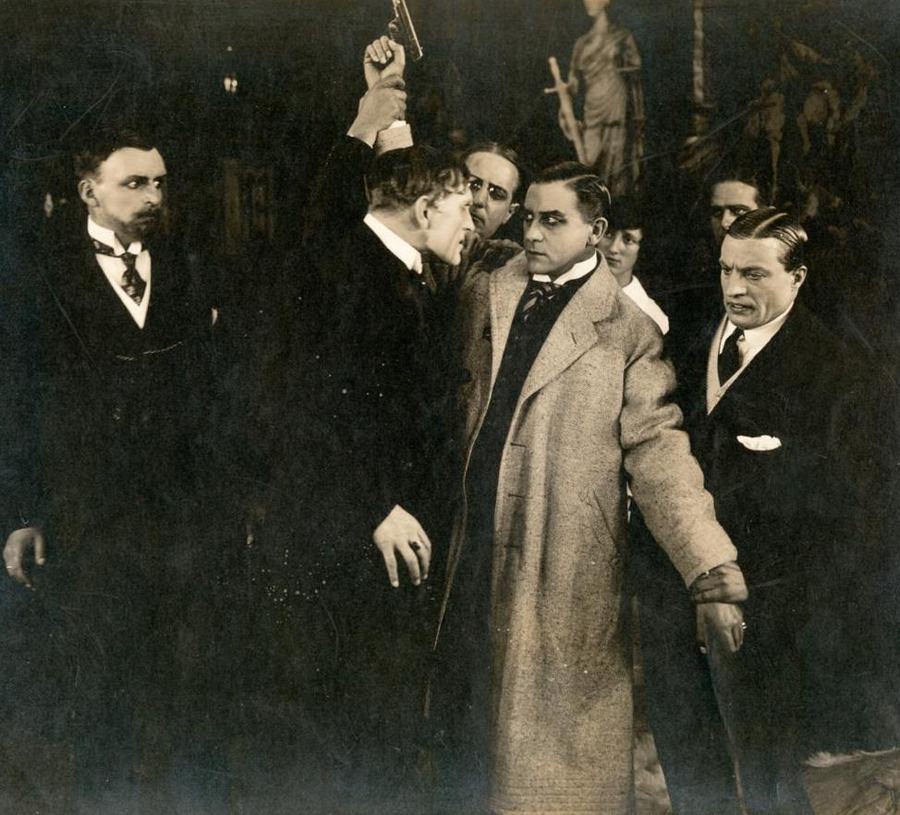
Ellen Dall’s brief turn as a stenographer who faints from hunger during an eviction scene lasts perhaps forty seconds, yet her collapse is filmed in a continuous take that follows the arc of her falling body as though gravity were an avenging angel. It’s one of those silent-era miracles that predates Steadicam by half a century: the camera glides, dips, cradles her head against the cold parquet, all while maintaining focus on her cracked fingernails—every broken nail a tiny monument to systematic starvation.
At the stroke of three a.m., von Straeten’s penthouse morphs into a cavernous courtroom. Walls recede into fog; jurors appear as those he bankrupted, their faces superimposed via double exposure so that they hover like accusatory constellations. Magnussen inverts the iconography of Seven Deadly Sins: here the sins sit in judgement, not the sinner. A child witness—played by Gudrun Bruun Stephensen—carries a broken doll whose porcelain head has been replaced by a melted coin; she wordlessly lifts it toward the defendant, and the gesture feels more scalding than any cross-examination.
Sound historians speculate the original score interpolated the socialist hymn Internationalen into the Dies Irae, creating a polyphonic sting that scandalized bourgeois audiences. Even without that music, the surviving visual rhythm—four-frame cuts, reverse shots that refuse eye-line matches—induces a panic akin to tinnitus. When verdict arrives, it is delivered not by a judge but by a scale made of rusted nails balancing a single loaf of bread against von Straeten’s signed contracts. The scale snaps; bread ascends, contracts plummet like lead. Cue the film’s most infamous iris-out: the aperture closes on Hertel’s dilated pupil until blackness swallows it, implying that hell is not other people but the self unmasked.
For decades the film was believed lost, a casualty of nitrate bonfires and archival hubris. Then in 1998 a Swedish collector uncovered a 147-minute tinted print in a crate labeled Comedy Shorts. The restoration by the Danish Film Institute painstakingly reconstructed missing French-blue night scenes, revealing subliminal flashes of von Straeten’s victims etched into window frost. Criterion’s subsequent 4K transfer lets you count pores, beads of sweat, the metallic dust motes swirling like micro-loans.
Viewed today, Dommens dag feels less like antique moralizing than a newsfeed hallucination. Replace telegram wires with fiber optics and you have algorithmic foreclosure mills, crypto-rug pulls, subprime derivatives metastasizing inside pension funds. The Tiger’s conviction that compassion is merely bad arithmetic anticipates every Silicon Valley sermon on disruptive efficiency. When he snarls, ”A man’s worth equals the sum he can seize,” the line might as well be stitched into the Terms of Service we click without reading.
Set Dommens dag beside Sudden Riches and you see how American cinema sentimentalizes wealth as lottery, not blood sport. Contrast it with Hitchcock’s The Manxman, where moral reckoning is cushioned by romantic fatalism; Magnussen offers no lovers’ embrace to soften the guillotine. Even the comparatively caustic Big Jim Garrity grants its robber baron a deathbed conversion, whereas von Straeten’s last spasm is a grin of defiance, teeth bared at the abyss that finally mirrors him.
Masterpiece is a word nitrate has devoured too often, yet Dommens dag earns the accolade not by comforting us with justice served, but by exposing the circuitry of rapaciousness humming beneath modernity’s floorboards. It is a film that leaves you colder than the winter it depicts, yet you emerge electrified, every neuron re-calibrated to detect the soft padded footsteps of the next Tiger prowling through spreadsheets and futures markets. Watch it once for historical vertigo; watch it twice as inoculation against the moment your own compassion is auctioned to the highest bid.
IMDb 6.3
1924
Community
Log in to comment.