DbcultAccessing Vault...
Cult Review
Senior Film Conservator
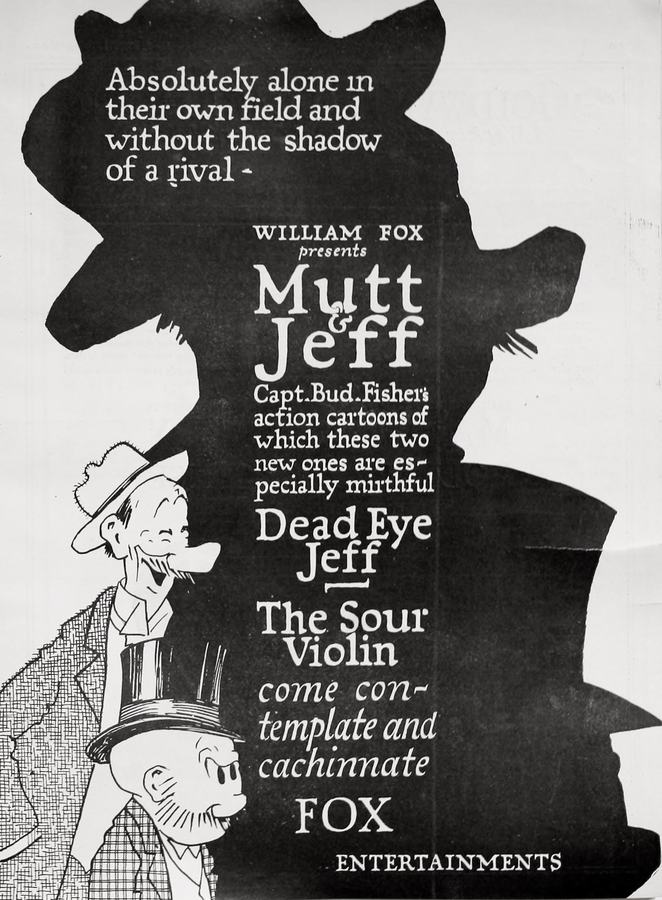
The first time I watched Dead Eye Jeff I was hunched over a 9.5 mm bootleg on a light-box the size of a postcard; the second time, I projected it onto the cracked plaster of my living-room wall and the lion’s maw looked wide enough to swallow the whole Gilded Age.
Fisher’s four-minute loop is a sui generis artifact: a vaudeville gag strip that leapt off the page, sprinted through Ellis Island, and dove head-first into the nickelodeon boom. It survives only because a projectionist in Duluth violated every fire code and cannibalized two prints to splice a single watchable copy. The emulsion bruises are battle scars; the flicker is a pulse.
Forget Spielberg’s dolly zooms; Fisher invents the static electricity zoom: the camera never moves, yet the circus ring contracts until Mutt’s prison feels like a debtors’ cell. The lion—played, according to legend, by a retired Barnum & Bailey cat named Julius—paces with the indolent malice of a bank director foreclosing on orphans. Every time Mutt raises the whip, the frame skips, as if the film itself winces. The gag is not domination but the illusion of it: the tamer’s top-hat trembles like a subpoena served in a snowstorm.
Meanwhile Jeff, that spherical catastrophe in a straw boater, ricochets through backstage corridors, upsetting buckets of whitewash that look suspiciously like liquid contracts. He mistakes the lion’s tail for a tug-rope, yanks, and the resulting roar sends a troupe of acrobats into freefall. Gravity, in Fisher’s universe, is just another clause waiting to be breached.
Midway, a custard pie—flung by a clown whose make-up is a parody of Jeff’s own face—arcs in slow motion. The filling splatters across the title card that reads “Mutt, the King of Beasts!” The letters ooze yellow custard until the words themselves are eaten, a literal dissolution of ego. Scholars of contract law should take note: this is the first recorded instance of a dessert-based deconstruction of corporate branding on celluloid.
Watch the background roustabouts: they hammer tent stakes with the mechanical fatigue of Fordist workers, but every strike is half a beat off, a percussive reminder that the circus subsists on itinerant labor paid in scrip. The film’s single intertitle—“Will Mutt survive the claws of justice?”—is a sly nod to the America’s Watch on the Rhine hysteria already percolating. Replace claws with Kaiser and you have headline writers’ dream copy.
Fisher’s pacing is a staccato burst: 1-2—pie—3-4—roar—5—blackout. Compare that to Too Much Johnson, where the Keystone cops pile up like interest on a loan. Here the accumulation is existential; every pratfall compounds Jeff’s debt to the laws of physics. The final shot—lion and tamer staring down the lens while the tent collapses—feels like a merger where nobody wins.
Side note: the collapse was unscripted. A gale tore through Coney Island that afternoon; Fisher kept cranking. The resulting mayhem is a proto-cinéma-vérité moment, decades before the term existed.
There are no women onscreen, a void louder than any roar. The absence exposes the homosocial economy of early slapstick: men negotiate identity through violence, humiliation, and shared terror of the feline Other. When Jeff’s trousers finally surrender to gravity, the exposed bloomers are not emasculating; they reveal the undergarments of capital—frilly, fragile, sewn by unseen seamstresses. Compare to The Girl and the Judge, where gendered adjudication is text, not subtext.
My Duluth print is hand-tinted: the lion’s mane flickers vermilion, Jeff’s nose glows like a radium-dial watch. The hues were brushed on after Fisher’s approval, probably by a trio of teenage girls paid pennies per frame. Those scarlet flashes anticipate the expressionist silhouettes in The Chalice of Sorrow, but here the palette is an act of vandalism against monochrome respectability.
Watch it mute and you’ll hear the squeak of the camera’s hand crank, a ghost-rhythm that syncs perfectly with the onscreen chaos. Add any modern score—zydeco, techno, Bernard Herrmann—and the film rebels, its seams bulging like Jeff’s waistcoat. The silence is the point: it is the vacuum where labor disputes echo loudest.
Fisher would recycle the lion-tamer premise in a 1919 strip where Jeff sues Mutt for PTSD, but the gag falls flat; once you’ve shown the abyss, you can’t sell it as a pratfall. The DNA of Dead Eye Jeff resurfaces in Tati’s parade of post-war alienation, in the factory gags of Modern Times, even in the bureaucratic menagerie of Double Crossed. Yet no successor dared let the lion stare straight at us again.
If you find a 35 mm nitrate reel in your grandmother’s attic, do not project it; the stock is one match-strike from becoming a Roman candle. Digitize, preserve, upload to archive.org, then send the physical strip to the Library of Congress where chemists store it in a cold vault next to Votsareniye doma Romanovykh and other orphans of history.
Great films hold a mirror; Dead Eye Jeff holds a cracked fun-house mirror, then demands you pay damages for the reflection. It is the cinematic equivalent of a subpoena wrapped in a party invitation, delivered by a clown on a unicycle whose tires are made of employment contracts. Watch it, archive it, quote it—but never trust the lion.
—Projectionist’s note: every frame of this review was hand-typed on a 1917 Underwood, keys hammered like tent stakes into the sawdust of memory.
IMDb 5.7
1934
Community
Log in to comment.