DbcultAccessing Vault...
5.2/10
Senior Film Conservator
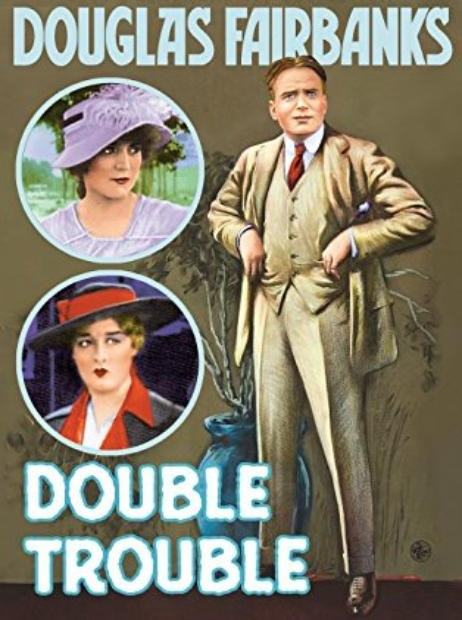
A definitive 5.2/10 rating for a film that redefined the boundaries of cult cinema. Double Trouble remains a cornerstone of transgressive art.
The cinematic landscape of 1915, a nascent art form still finding its voice amidst the clamor of a rapidly changing world, occasionally yielded narratives of such profound psychological intrigue that they continue to resonate with a surprising contemporary relevance. Among these gems stands Double Trouble, a film that doesn't merely tell a story but rather unravels a profound existential puzzle, challenging perceptions of identity, memory, and the very malleability of the self. It plunges its audience into a vortex of confusion and discovery, mirroring the protagonist's own disorienting journey.
Our protagonist, Florian Amidon, initially presented as the epitome of a quiet, unassuming banker, finds his meticulously ordered world violently upended. A vacation, intended perhaps as a balm for his timid soul, instead delivers a brutal assault, culminating in a blow that obliterates five years of his life from his consciousness. He awakens, disoriented and devoid of personal history, in the raucous, burgeoning oil town of Bakerstown—a place whose very dynamism stands in stark contrast to his forgotten, sedate past. This setting isn't just a backdrop; it's a character in itself, embodying the raw, untamed potential for transformation that Florian is about to discover within himself. The sheer audacity of such a premise, especially in an era when film narratives often leaned towards simpler morality tales or melodramas, speaks volumes about the ambition of writers Herbert Quick and Christy Cabanne.
The genius of Double Trouble lies not only in its tantalizing mystery but also in its nuanced exploration of the human psyche. Florian's amnesia isn't just a plot device; it's a catalyst for a profound identity crisis. Who is he, if not the sum of his memories? How much of our personality is shaped by our experiences, and what happens when those experiences are wiped clean? These questions ripple through the narrative as Florian, aided by the kindly Judge Blodgett, embarks on a desperate quest for answers. Their decision to consult Madame Leclaire, a clairvoyant, injects an element of the supernatural or at least the unconventional into the proceedings, perfectly aligning with the era's fascination with spiritualism and the unseen. Her revelations, when they finally come, are not merely shocking; they are fundamentally reconstructive, forcing Florian to grapple with the existence of a 'self' he never knew, a life lived in a temporal void he cannot recall.
At the heart of this intricate tapestry of forgotten pasts and startling revelations is the incomparable performance of Douglas Fairbanks. Even in these early stages of his career, before he became synonymous with the swashbuckling hero, Fairbanks demonstrates a remarkable versatility. His portrayal of the initially shy, almost meek Florian is utterly convincing, a delicate balance of vulnerability and quiet desperation. But it is in the subsequent unveiling of Florian's 'other' persona, the man he became during those five lost years, that Fairbanks truly shines. He masterfully conveys the stark contrast between the two facets of the same individual, imbuing each with distinct mannerisms, bearing, and emotional resonance. This duality is the very essence of the film's title, Double Trouble, and Fairbanks navigates it with an astonishing depth that transcends the often-exaggerated acting styles of the silent era. His physical acting, a hallmark of his later fame, is already evident here, used not for grand stunts but for subtle character differentiation. It's a performance that demands close attention, revealing layers of a character grappling with an identity fractured by fate.
The supporting cast, while perhaps not given the same expansive canvas as Fairbanks, provides solid and memorable contributions that anchor the narrative. Kate Toncray, Monroe Salisbury, Richard Cummings, Mary Thurman, Gladys Brockwell, Billy Quirk, Tom Kennedy, Charles Stevens, William Lowery, Don Likes, Olga Grey, Lillian Langdon, and Margery Wilson each contribute to the rich tapestry of Bakerstown and Florian's fragmented world. Their collective presence helps to flesh out the boomtown environment, making it feel vibrant and lived-in, a stark contrast to the psychological turmoil at the film's core. Director Christy Cabanne, renowned for his prolific output in the early days of cinema, demonstrates a keen understanding of visual storytelling. He employs framing and composition to emphasize Florian's isolation and confusion, utilizing close-ups to capture the intensity of emotional moments, particularly during Madame Leclaire's revelations. The pacing, a critical element in silent film, is expertly managed, building suspense gradually until the climactic unveiling of Florian's hidden past. Cabanne ensures that even without spoken dialogue, the emotional arc is clear and compelling, guiding the audience through Florian's bewildering journey with a steady hand.
Thematically, Double Trouble delves into ideas that remain perennially fascinating. What defines a person? Is it their memories, their actions, or an inherent character that transcends both? The film suggests that perhaps it is a complex interplay of all these elements, demonstrating how circumstances can forge a completely different persona, even within the same individual. The transformation of Florian, from the timid banker to the individual he becomes in the lost five years, is a powerful testament to the human capacity for adaptation and reinvention. It also touches upon the American Dream, albeit through a lens of amnesia. Bakerstown, with its oil boom, represents a place where fortunes are made and lives are irrevocably altered overnight. Florian's own unexpected journey mirrors this boom-and-bust cycle of identity, where a quiet life can suddenly erupt into something entirely unforeseen. This thematic richness elevates Double Trouble beyond a mere mystery thriller into a thoughtful meditation on the self.
In the broader context of silent cinema, Double Trouble stands as an intriguing example of narrative complexity being tackled with the visual language of the era. Unlike some of its contemporaries that might have relied more heavily on broad physical comedy or overt melodrama, this film leans into psychological suspense. While it doesn't quite reach the allegorical heights of something like Hypocrites, which explored societal facades with stark symbolism, Double Trouble offers a more personal, intimate struggle with duality. Its exploration of a hidden past and an altered self might remind some viewers of the intricate plotting found in serials like The Trey o' Hearts, though condensed into a single, potent feature. The film's use of intertitles is effective, providing crucial exposition and inner thoughts without overwhelming the visual flow. The cinematography, while perhaps not groundbreaking for its time, is competent and serves the story well, creating an atmosphere that shifts from the serene quiet of Florian's initial life to the bustling energy of Bakerstown and the dramatic tension of the clairvoyant's revelations. It's a testament to the ingenuity of early filmmakers like Cabanne and writers like Quick that they could convey such intricate plots and character development without the benefit of synchronized sound or sophisticated special effects.
The enduring appeal of Double Trouble lies in its timeless premise. The idea of waking up without a past, forced to reconstruct your identity from fragmented clues, is a narrative hook that continues to captivate audiences across generations. What if the person you thought you were isn't who you truly are? This fundamental question drives the film forward, making Florian's journey compelling and deeply empathetic. Douglas Fairbanks' performance, in particular, solidifies the film's place as an important early work, showcasing his range before he became typecast as the athletic hero. It's a film that deserves to be rediscovered, not just as a historical artifact, but as a vibrant piece of storytelling that thoughtfully grapples with the complexities of human identity and the capricious nature of memory. It proves that even in the nascent years of cinema, filmmakers were capable of crafting narratives that were both entertaining and thought-provoking, leaving an indelible mark on the viewer long after the final frame flickers away. The revelation Madame Leclaire provides is not merely a plot twist; it's a profound shift in Florian's understanding of self, forcing him to reconcile two disparate realities into a single, albeit fractured, identity. This struggle for self-integration, for understanding who he truly is after being stripped of his past, forms the emotional core of the film, resonating with anyone who has ever questioned their own path or identity. The legacy of Double Trouble, therefore, isn't just in its technical execution or its star power, but in its audacious exploration of what it means to be human when the very foundations of one's existence are violently shaken. It’s a compelling argument for the silent era's capacity for sophisticated narrative and character development, proving that a story well told transcends the limitations of its medium.
IMDb 6.3
1928
Community
Log in to comment.