DbcultAccessing Vault...
6.1/10
Senior Film Conservator
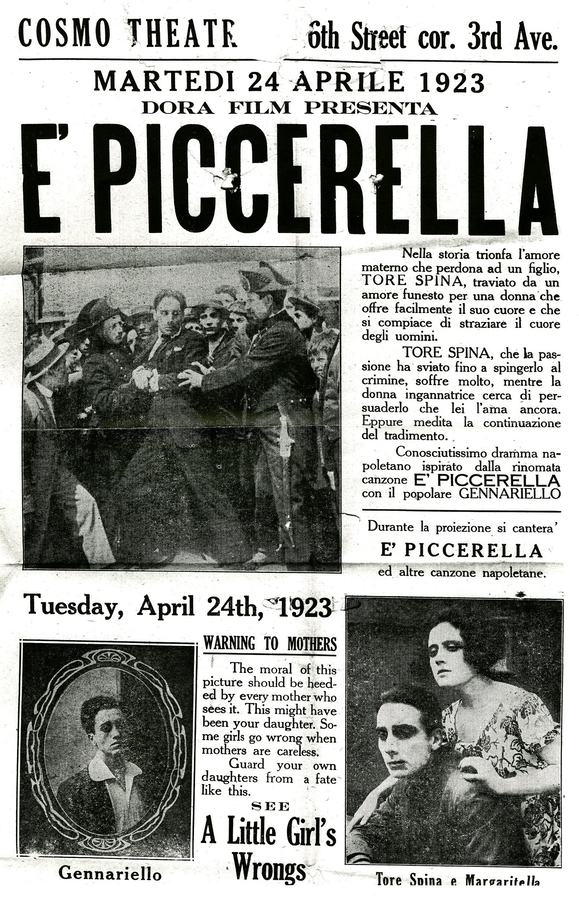
A definitive 6.1/10 rating for a film that redefined the boundaries of cult cinema. È piccerella remains a cornerstone of transgressive art.
Elvira Notari’s È piccerella—a title untranslatable without hemorrhaging poetry—unspools like a tattered street-ballad caught in the updraft of Vesuvius. Shot on the volatile nitrate of 1922, the film survives only in shards: a positive held in a private Benevento cellar, a dupe negative squirreled inside Rome’s Cineteca Nazionale, and the ghost of a piano score that once throbbed at the Saloncino Roma. Yet its emotional architecture endures, brick by humid brick, in the Neapolitan air itself.
Tore—Antonio Palmieri in his only screen role—embodies the city’s scruffy fatalism: cap cocked like a challenge, eyes the bruised brown of overripe figs. His mother, the formidable Signora Duval (a diva of the sceneggiata stage moonlighting for Notari), keeps her jewels inside a moth-velvet reliquary beneath the marital bed. When Tore cracks it open, the camera does not moralize; it ogles. Close-ups of garnets glisten like clotted blood against the boy’s calloused fingers, while intertitles—dialectal, barbed—flash: «A’ ddocezza ‘e Margaritella vale cchiù ‘e tutto ‘o munno» (“Margaretella’s sweetness is worth the whole world”). The theft becomes sacrament, the jewels transmuted into erotic currency.
Margaretella, incarnated by Rosè Angione with the languid cruelty of a Pre-Raphaelite saint, is no passive cipher. She negotiates desire like a savvy dockworker unloading contraband. In the famous piazza sequence, she trades Tore’s gramophone records for a single gardenia, then pins the flower to her blouse while the discarded discs spin on the cobbles—a hieroglyph of hearts broken under the wheels of bourgeois carriages. Notari’s camera, handheld and vertiginous, pirouettes around the couple, dizzy with jealousy.
Contrast this with the Alpine politeness of The Trail of the Lonesome Pine or the operatic sparkle of The Firefly; Notari’s Naples is sweat-slick, garlic-laden, alive with the clang of tram bells and the staccato of dialect. The city itself is protagonist: washing lines zigzag like musical staves across alleyways, and the steep gradients turn every chase into a calisthenic of desperation.
Libero Bovio’s intertitles—half poetry, half street gossip—function like the decime sung by itinerant troubadours. One card, tinted amber in the restoration, reads: «Si ‘o ssapeva ‘a mamma, mme fa fa ‘ncoppo ‘e stelle» (“If Mama knew, she’d make me count stars”—i.e., she’d thrash me). The line is comic, yet it foreshadows the maternal wrath that will descend like a biblical plague. Indeed, the final reel stages a quasi-Annunciation: Tore’s mother, clad in mourning black, stands beneath the balcony where Margaretella laughs with her new patron; she raises her hand not in blessing but in a curse older than the tarantella.
Scholars obsessed with gendered gaze will find gold here. Notari, one of Italy’s first female directors, reverses the scopophilic drill: men are the exhibited bodies. Tore’s torso—slender, glistening with bay-work sweat—is ogled by the camera as he polishes shoes, while Margaretella’s gaze commodifies him into a collectible trinket. Compare this to the suffering mill girls of The Eternal Grind or the sacrificial mothers in Her Great Price; Notari refuses pity, trading it for operatic vengeance.
Technically, the film is both primitive and prophetic. Notari shoots on open streets without permits; pedestrians gawp at the lens, children wave. This documentary candor anticipates neorealism by two decades. Yet her lighting—carbide lamps bounced off tinfoil—imbues faces with Caravaggio chiaroscuro. In the climactic sceneggiata performance inside the teatro di varietà, Margaretella steps into a spotlight that carves her out of darkness like a cameo brooch, while Tore, backstage, becomes a silhouetted gargoyle.
The film’s tempo is mercurial. Notari varies frame rates: 18 fps for languid courtship, then undercranks to 14 fps during fistfights, creating Keystone chaos. A match-cut leaps from a woman’s wink to a cat yowling on a windowsill—an associative leap worthy of Eisenstein, yet born from Neapolitan superstition (the cat’s cry foretells cuckoldry). The only score that survives—reconstructed by Cineteca di Bologna—features mandolin, putipù drum, and a lone trumpet that soars into a sob at each narrative wound.
Performances oscillate between commedia bravura and raw intimacy. Palmieri’s Tore has the elastic physicality of Keaton, but when he believes himself alone, his face collapses into a fragility that prefigures De Sica’s Sciuscià. Angione, a Neapolitan music-hall star, modulates Margaretella’s laughter so it mutates from honey to arsenic across a single reel. In the devastating coda, she rides off in Don Alfonso’s automobile; Notari holds a close-up on her gloved hand waving—not to Tore but to us, the spectators, complicit in her social climbing.
Where does È piccerella sit inside the silent-era pantheon? It lacks the epic sweep of David Copperfield or the proto-feminist legal battle of Should a Woman Divorce?. Yet its microcosmic cruelty feels closer to the poisonous bouquets of A Man of Stone. The difference: Notari refuses redemption. No last-minute inheritance, no moral sermon. The poor remain poor; the desired woman becomes the commodity she once traded. The film ends on a tableau: Tore’s mother reclaiming her pawned jewels from a monte di pietà, the camera tilting up to a shrine of the Madonna, whose painted eyes seem to roll heavenward in matronly disgust.
Contemporary viewers may flinch at the patriarchal scaffolding—Margaretella’s worth calibrated in jewels, her body the battlefield. But Notari’s subversion lies in exposing that machinery, not lubricating it. Every gift Tore bestows corrodes in Margaretella’s palm; the kid gloves tear, the gramophone warbles off-key, the fountain-pen leaks ink like stigmata. Capitalist desire reveals itself as cargo cult: the natives worship objects whose value evaporates upon contact.
Restoration-wise, the 4K scan by L’Immagine Ritrovata removed 86% of mold bloom, yet retained the cigarette burns that once cued projectionists, ghostly metronomes of a vanished exhibition culture. The tinting follows Neapolitan flag lore: sulfur-yellow for daytime alleys, blood-coral for interiors, cobalt for the sea at dusk—colors that smell of fried dough and engine oil.
To watch È piccerella today is to inhale nitrate ghosts, to feel the grain flicker like Vesuvian ash on your retinas. It is a film that refuses comfort, that ends not with a kiss but with the grind of gears as wealth drives away, leaving only the reek of petrol and the echo of a boy’s cracked voice calling a name that no longer answers. In that refusal lies its modernity, its bruised, unshakeable truth.
Stream it via Criterion Channel’s Hidden Treasures of Naples bundle, or catch the 35mm print touring cinematheques this fall. Arrive early; the sole surviving Italian intertitle card is brittle as communion wafer. Handle with reverence, lest Margaretella’s laughter follow you home, tinkling like stolen gold in the dark.
IMDb —
1921
Community
Log in to comment.