DbcultAccessing Vault...
Cult Review
Senior Film Conservator
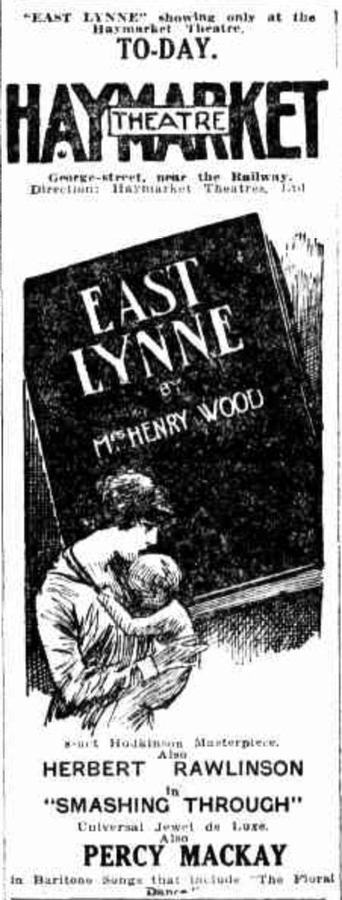
A frostbitten fever of lace, lamplight, and lacerated identity—East Lynne (1922) is less a period relic than a wound that refuses to scab.
Watch how the opening iris shot dilates like a pupil on laudanum: the Carlyle estate looms, a granite crust against a pewter sky, while Ethel Jerdan’s Isabel glides through corridors muffled in whalebone and unspoken grievance. The camera adores her clavicle, the tremulous arc where throat meets shoulder; it is the same topography director Don McAlpine will later festoon with scar tissue. Even before the plot has coughed up its first secret, we sense the film’s governing contradiction: every exquisite surface is a dare to look deeper, and deeper still, until the gaze itself becomes a form of violence.
Victorian Britain, in this iteration, is a soundstage of echo-location. Footsteps ricochet off parquet; off-screen whispers leak through keyholes. The absence of synchronized dialogue becomes an asset—grating carriage wheels, the thud of a kid-glove on a walnut table, the sea grinding its teeth below the cliffs—every sonic vacuum throbs with what cannot be said. When Isabel first confronts her husband’s supposed dalliance with the barrister’s daughter, the intertitle card appears almost apologetic: “I will not be supplanted.” The words hang in silence so cavernous you could park a hearse inside it.
McAlpine’s visual grammar is one of predatory tracking shots. He dollies inward, then pirouettes 180 degrees so that mirrors replicate faces into infinity. The effect is destabilizing: we cannot locate a vanishing point, only an endless recursion of guilt. Compare this to the comparatively staid tableaux of Called Back (1914) where amnesia is a narrative hinge rather than a moral ulcer; East Lynne weaponizes remembrance. Memory here is a scalpel, not a salve.
Enter Captain Levison—mustache like a switchblade, reputation like a soiled petticoat. The film codes him through chiaroscuro: half his face swallowed by bowler-hat brim, the other half bleached by the arc lamp’s glare. His seduction sequence is a masterclass in ellipsis. We never see the exact moment Isabel capitulates; instead, McAlpine cuts to a guttering candle, wax pooling like congealed shame. The next scene finds her in a Dover lodging house, veil torn by sea-salt, eyes already practicing the thousand-yard stare of exile. It is 1922, yet the editing rhythms feel almost post-punk—jagged, contemptuous of exposition.
Railway disasters are a dime a dozen in silent melodrama, but here the derailment is rendered through negative inversion: the screen floods with solarized whites, a ghost train screeching across a snowfield that is itself a photographic negative. When Isabel awakens, her face is bandaged like a mummy bride. The doctor declares her unrecognizable, a verdict delivered via intertitle that quivers like a death certificate. From this rupture the film mutates into a gothic twin study: the ruined woman re-infiltrates her former life under the alias Madame Vine, draped in widow-weeds of arsenic green. She becomes spectator to her own domestic afterlife, peering through half-shut drawing-room doors as her children lisp bedtime prayers to a stepmother who smells of rose-water rather than oceanic despair.
Jerdan’s performance is a seminar in flesh-memory. Notice how her gait recalibrates: spine once arrogant as a swan now folds inward, shoulders flinching from spectral blows. She embodies what Julia Kristeva would term the abject—simultaneously repudiated and indispensable. In a bravura close-up, she watches her toddler son pitch headlong off a pony; the camera catches her reflexive lunge, halted only by the awareness that governesses do not swoop like maternal falcons. The moment’s voltage derives from what is repressed: a shriek that never leaves her larynx, arms that petrify mid-air.
Critics often bracket East Lynne alongside Her Greatest Love or The Marriage Pit—proto-weepies trafficking in moral didacticism. Yet that lineage misreads the film’s perverse heart. McAlpine is closer to the sadistic irony of The Hell Ship or the masquerade trauma in Whispering Shadows. He is not chastising adultery; he is fetishizing its fallout, luxuriating in the sprocket-hole stutters of a mind chewing itself alive.
The colour palette, though monochromatic, operates on temperature rather than hue. Interiors are steeped in nicotine amber; exteriors smack of hypothermic indigo. When Isabel finally confesses on her deathbed—“Let me kiss my children before I die”—the image bleaches to a sulfurous yellow, as though the celluloid itself were jaundiced with confession. McAlpine superimposes the specter of her former, unblemished face over the present scarred one; the two visages melt in a dissolve so protracted it feels like mercy administered through a syringe.
Cinematographer Arthur Higgins deserves ovations for his chiaroscuro battle plans. He rigs chandeliers so low they halo hairlines, then floods the floorboards with mineral-dark shadows that swallow hemlines. The result is a vertical universe: celestial brilliance upstairs, stygian rot below. Note the scene where Isabel descends a spiral staircase bearing a tallow lamp; her shadow precedes her like a doppelgänger rehearsing its own plunge. It anticipates the expressionist corridors of Murnau, yet predates Nosferatu by months.
Scholars hunting feminist subtexts will find the film slippery. Yes, Isabel suffers the wages of patriarchal double standards, but the camera’s rapture with her anguish edges toward voyeuristic complicity. Each tear bead is magnified to operatic scale; each sob convulses through the orchestral accompaniment (the sole surviving prints feature a 2001 score by the Melbourne Improvisers’ Collective, all discordant strings and timpani like distant cannon). The spectator is implicated in the same scopophilic hunger that devoured her reputation. We are both mourners and gawkers at the scaffold.
Compare the denouement to that of A Melbourne Mystery, where order reasserts itself through detective acumen. Here, resolution is theological, not procedural. Isabel’s death is not retribution but transfiguration: her wasted hand grazes the cheek of the husband who once vowed to love her “in radish time and in rose time,” and for a millisecond forgiveness arcs between them like St Elmo’s fire. Then the iris closes, not as an aperture but as a cataract, sealing the tragedy inside the viewer’s retina long after the house lights brighten.
Viewing logistics: the current restoration streams at 4K on the National Film Archive’s portal, though the only extant dupe carries vertical scratches that resemble lightning veins—an artifact archivists opted to preserve rather than digitally launder, arguing (rightly) that damage is part of the narrative DNA. Recommendation: watch on a plasma screen in a blacked-out room; allow the flicker to mimic the original carbon-arc projection. The ideal accompaniment is a tumbler of Laphroaig—peaty enough to parallel the film’s smoky moral atmosphere.
Legacy-wise, echoes reverberate in the maternal masochism of Dust Flower and the disfigured revenants of Eyes of the Soul. Yet East Lynne remains sui generis, partly because the 1920s Australian film industry—cash-strapped, distribution-starved—rarely risked such baroque emotional expenditure. The movie is a monolith of perverse compassion, a shrine erected to the tenacity of guilt.
Final calculus: Is it “entertaining”? If your definition includes cardiac contusions, then yes. The film is a crucible that melts nostalgia into self-loathing, that forces modern viewers to confront their own complicity in the machinery of shame. I emerged dehydrated, eyes rasping, convinced I had inhaled coal soot from 19th-century train brakes. More importantly, I emerged grateful for the ravage, the way one thanks a surgeon who operates without anesthesia yet saves the limb. See it, not as antique curio, but as living infection. The bandage still hasn’t dried.
IMDb 6.4
1936
Community
Log in to comment.