DbcultAccessing Vault...
Cult Review
Senior Film Conservator
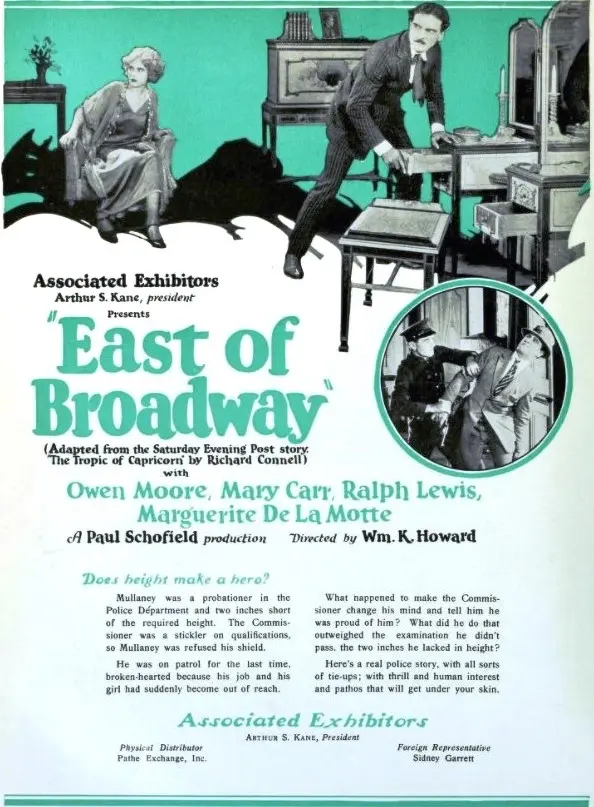
The silent era of Hollywood was often criticized for its penchant for saccharine escapism, yet within the celluloid frames of 1924’s East of Broadway, we find a gritty, albeit romanticized, exploration of urban aspiration. Directed with a keen eye for the rhythmic chaos of New York City, this film stands as a testament to the enduring mythos of the 'American Dream' as viewed through the lens of the Irish diaspora. It is a work that oscillates between the slapstick physicality of the era and a more somber, sociological meditation on what it means to belong to a city that demands everything from its inhabitants.
Owen Moore, often overshadowed by the colossal legacy of his wife Mary Pickford, delivers a performance here that is both nuanced and explosively physical. His Peter Mullaney is not a refined hero; he is a creature of the cobblestones, a man whose eloquence is found in his fists rather than his vocabulary. The early sequences of the film, depicting Peter’s life on the East Side, are infused with a documentary-like texture. Unlike the more stylized melodrama found in The Little Church Around the Corner, which sought a spiritual resolution to class conflict, East of Broadway grounds its stakes in the visceral reality of police recruitment and the desperation of the working class.
The central conflict—Peter’s failure to meet the height requirement—serves as a poignant allegory for the systemic barriers faced by immigrants. He is 'not enough' by the standards of the law, yet he possesses a surplus of the very courage the law claims to uphold. When Peter engages in a brawl to prove his worth, the choreography is frantic and unpolished, reflecting the raw survival instinct of the East Side. This is a stark contrast to the more theatrical, almost balletic violence seen in contemporary adventure films like A Prisoner in the Harem.
One of the film’s most enduringly clever moments is Peter’s failure of the written exam. Asked to locate the Tropic of Capricorn, he confidently places it in the Bronx. While played for laughs, this error highlights a significant thematic thread: the disconnect between formal education and the lived experience of the urban poor. For Peter, the world outside New York is an abstraction. His geography is defined by precincts, alleys, and the distance between his home and Judy McNulty’s doorstep. This lack of 'worldly' knowledge makes him a failure in the eyes of the state, yet his localized loyalty makes him the ideal guardian of the streets.
The writers, Paul Schofield, Tom Miranda, and Richard Connell, craft a narrative that deftly avoids the cynicism often found in later noir, yet it doesn't shy away from the fragility of Peter’s position. The commissioner’s decision to let Peter wear the uniform for one night—a 'mercy masquerade'—is a cruel kindness. It places Peter in a liminal space where he is both a hero and a fraud, a theme that mirrors the existential dread found in Trompe-la-Mort, where identity is a fluid and often dangerous construct.
The film’s final act shifts gears from character comedy to high-octane suspense. The cinematography during the robbery sequence is surprisingly avant-garde for its time, utilizing deep shadows and flickering light to create a sense of claustrophobic danger. As Peter walks the beat with Officer Gaffney, played with a weary gravitas by George Nichols, the audience is made aware of the thin line between the mundane and the lethal. The shooting of Gaffney is a pivotal moment; it strips away the artifice of Peter’s borrowed uniform. In this moment, he is no longer 'playing' cop; he is the law.
The capture of the robbers is not a clean, cinematic victory. It is a messy, painful affair that leaves Peter hospitalized. This physical sacrifice is the currency required for his social mobility. The scene in the hospital, where the commissioner pins the shield on Peter’s gown, is a masterclass in silent pathos. It validates the idea that bravery is the ultimate equalizer, a recurring motif in Richard Connell’s writing. This resolution feels more earned than the somewhat contrived endings of films like The Door Between or the lighthearted resolutions of An Overall Hero.
The ensemble cast provides a rich backdrop to Moore’s central performance. Marguerite De La Motte as Judy McNulty offers more than just a romantic interest; she represents the domestic stability that Peter is fighting to secure. Her presence keeps the film grounded in human emotion, preventing it from becoming a mere procedural. Francis McDonald and Ralph Lewis provide the necessary institutional weight, representing the 'old guard' of the New York establishment. The chemistry between the cast members suggests a community that is tightly knit, a stark contrast to the fractured social circles seen in Youthful Cheaters.
Even the minor roles, such as Mary Carr’s portrayal of the immigrant mother, add layers of authenticity. Carr, who specialized in maternal roles during this period, brings a quiet dignity to the Mullaney household. This focus on the family unit as the primary motivator for success is a common trope in 1920s cinema, yet here it feels less like a cliché and more like a sincere tribute to the generation that built the city.
When comparing East of Broadway to other films of the era, its unique blend of social realism and melodrama becomes apparent. While Taxi Please explored the urban landscape through comedy, and Wanted: A Baby dealt with domestic anxieties, East of Broadway tackles the broader theme of institutional acceptance. It lacks the exoticism of Miyama no otome or the high-society artifice of His House in Order, but it gains far more through its sincerity and its gritty portrayal of the New York streets.
The film also avoids the heavy-handed moralizing found in National Red Cross Pageant. Instead, it allows its moral lessons to emerge naturally from the characters' actions. Peter’s journey is not one of moral correction, but of social ascension through merit. It is a proto-typical 'hero’s journey' that would later be refined in the talkies of the 1930s, but here it retains a certain innocence and visual purity that is lost in the transition to sound.
Visually, the film is a treasure trove for historians of New York. The location shots capture a city in flux—the transition from horse-drawn carriages to the motor car, the looming presence of the elevated trains, and the crowded tenements of the East Side. The lighting, particularly in the night scenes, utilizes the orthochromatic film stock of the day to create deep, inky blacks and brilliant, halo-like whites. This high-contrast aesthetic mirrors the moral clarity of the story: the 'good guys' in blue versus the 'bad guys' in the shadows.
The pacing, managed by the editing of the era, is surprisingly brisk. There is little of the 'stodge' that can sometimes plague silent dramas. Every scene serves to either advance the plot or deepen our understanding of Peter’s internal struggle. Even the comedic interludes, such as Peter’s interactions with the neighborhood children, serve to humanize him and raise the stakes for his eventual success. It is a far more cohesive narrative experience than the episodic nature of Playmates or the somewhat disjointed Miss Peasant.
In the grand tapestry of silent cinema, East of Broadway may not have the epic scale of a Griffith or the technical wizardry of a Murnau, but it possesses a heart and a sense of place that many more famous films lack. It is a quintessential 'New York story,' one that understands that the city is a character in its own right—a demanding, fickle, and ultimately rewarding entity. For Peter Mullaney, the journey from the tenements to the precinct was more than just a career move; it was a reclamation of his dignity.
The film remains a vital watch for anyone interested in the history of the police procedural or the immigrant experience in America. It captures a specific moment in time with clarity and passion, proving that even in the silent era, the loudest voices were often those of the marginalized, fighting for their place in the sun. It is a story of grit, of 'Tropic of Capricorn' blunders, and ultimately, of the bravery that transcends height requirements and written exams. Like The Princess of Patches or Le nabab, it explores the transformative power of status, but it does so with a uniquely American, blue-collar spirit that continues to resonate a century later.
Critique Score: 8.4/10
"A masterful blend of urban grit and immigrant hope, anchored by a career-defining turn from Owen Moore."
IMDb —
1919
Community
Log in to comment.