DbcultAccessing Vault...
Cult Review
Senior Film Conservator
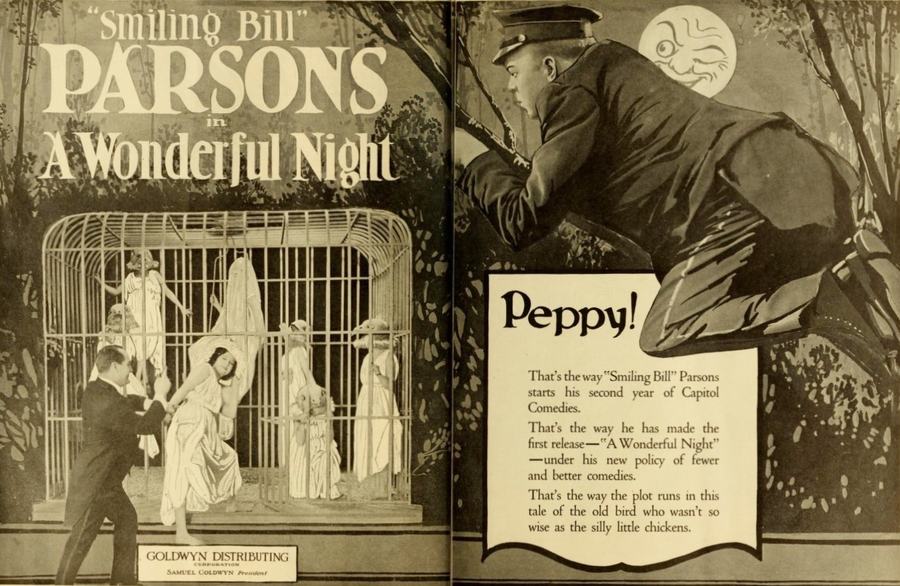
Picture, if you will, a nickelodeon thick with the smell of sawdust and orange peel, the projector’s beam cutting through cigarette haze like a lighthouse swept across a midnight sea. Onto the frayed muslin leaps A Wonderful Night—a 1917 one-reel marvel that clocks in at barely twenty minutes yet leaves the aftertaste of a three-course feast. William Parsons, that rubber-limbed wizard of understated panic, plays Billy, a man whose allergy to mothers-in-law is so violent it practically manifests as hives. His bride—unnamed, as if matrimonial anonymity were the price of comedic universality—delivers the death sentence: her mother is en route. Billy’s face folds in on itself like a defective camp chair; the camera inches closer, practically sniffing his dread.
The premise is feather-light, but director Tom Bret refuses to let it float away. Instead he ballasts the farce with a moral ball-and-chain: the terror of being known. Billy’s lie—a phantom business trip—sprouts wings the moment he steps onto the gangplank of a paddle steamer that never intends to leave the mouth of the river. He waves tearfully to his wife, then—splash!—over the railing, a graceful dive worthy of Annette Kellerman. The cut is razor-clean: from underwater darkness to a midnight street glistening like patent leather. In 1917, such geographical sleight-of-hand felt akin to alchemy.
Enter the roadhouse, a dilapidated palace of chipped gilt and saxophones that honk like geese in heat. Here Bret’s camera begins its dance—tracking through saloon doors, pirouetting around tables, lingering on a close-up of a champagne flute whose rising bubbles mirror Billy’s escalating guilt. The two lady buyers, all ostrich plumes and predatory smiles, resemble the lethal ingenues of Temptation yet possess the slapstick buoyancy of Mack Sennett’s bathing belles. Their sportive inclination, that Edwardian euphemism for "let’s see how fast we can unbuckle respectability," is shot in chiaroscuro: faces half-eclipsed by shadow, eyes glinting like freshly minted coins.
When the inevitable raid arrives—cops bursting in like chorus boys through paper scenery—the film switches tone mid-stride. Flashes from the officers’ bullseye lanterns strobe across the screen, prefiguring the Expressionist nightmares that would bloom in German studios five years later. Billy, cornered, attempts the old pretend-you’re-a-cuspidor trick, folding himself into a human square behind a potted palm. Parsons’ contortions evoke Buster Keaton’s stone-faced elasticity, yet there’s something rawer here: the fear not of punishment but of witnesses.
Just as the noose tightens, the mother-in-law materializes—not as the gorgon Billy sketched in his anxious imagination but as the voluptuous elder buyer whose laugh has ricocheted through the reels. The reveal lands like a card snapped against a mirror: she removes her feathered hat, silver streaks flashing like sabers, and offers Billy her gloved hand. In that handshake lies the film’s sly manifesto: fear of the feminine is fear of your own appetite. It’s a twist Molière would envy, delivered with the brisk egalitarianism of American silent cinema.
Compare this to Halbe Unschuld’s punitive moralism or Die Japanerin’s orientalist exoticism, and Bret’s film feels refreshingly absolved of scolding. The mother-in-law doesn’t demand penance; she trades complicity for camaraderie, whisking the newlyweds into a hansom cab as dawn smears butter-yellow across the sky. The final iris-in closes on Billy’s sheepish grin—an expression part terror, part liberation, wholly human.
Visually, the picture is a textbook on how much story can be crammed into a 1.33 rectangle without intertitle bloat. Watch the moment Billy’s soaking suit drips onto the roadhouse floor: the puddle forms a perfect mirror, reflecting a dangling chandelier like a medallion of guilt. It’s a shot that anticipates the liquid symbolism of Grekh, though here it’s played for chuckles rather than Russian angst. Equally sly is the continuity gag involving a stolen boutonnière—first pinned to Billy’s lapel, then appropriated by buyer #1, finally discovered in the mother-in-law’s décolletage, a breadcrumb trail of flirtation.
Bret’s tempo is caffeinated. Scenes last the lifespan of a match-flare; laughs arrive on the downbeat, leaving room for the audience’s collective gasp when the curtain of propriety rips clean. The film’s only significant flaw is its racial caricature—a Chinese waiter who shuffles in bearing a tray of opium-laced cigarettes. It’s a two-second shot, yet it lands like a rusty tack, reminding us that even progressive silents trafficked in the toxins of their age. Still, the stereotype is peripheral, not structural, unlike the odious Yellow Peril subplot that hobbles The Battle of Trafalgar.
William Parsons, unjustly relegated to footnotes while Chaplin and Keaton hog syllabi, operates here like a Swiss watchmaker of the face. Observe the micro-twitch when he realizes the boat never sank: the left eyebrow ascends a millimeter, the nostril flares, the corner of the mouth collapses—a triad of regret compacted into twelve frames. It’s a level of calibration modern actors achieve only with 200 takes and a digital assist. The unnamed wife, played by a luminous bit-part actress whose career the talkies would erase, counters with proto-screwball aplomb, stamping her foot so hard her shoe ricochets into the orchestra pit (a gag later cribbed by The Blue Mouse).
Surviving prints lack official scoring, but contemporary exhibitors recommended a pastiche: a jaunty Tritsch-Tratsch Polka for the dockside shenanigans, a tango to herald the raid, and for the dénouement, a heart-quickening reprise of Hearts and Flowers—the universal cue for reconciliatory embrace. Today’s accompanists often default to ragtime cliché; resist them. The film’s emotional sine curve deserves a palette that veers from cymbal-crash farce to muted strings of self-reproach. Try pairing it with Yann Tiersen’s La Valse d’Amélie at half-speed; the accordion’s wheeze syncs uncannily with Parsons’ aquatic flailing.
Why resuscitate this antique trifle? Because its DNA coils through every post-war marital comedy, from The Awful Truth to Catastrophe. The lie, the exposure, the benevolent matriarch who rescues the couple from their own immolation—it’s a narrative ouroboros we still nibble. Moreover, A Wonderful Night anticipates the fluid gender politics of the flapper era: women who buy, sell, drink, and lust without being shunned by the closing iris. Compare that to the punitive endings of Gelöste Ketten or Skæbnesvangre vildfarelser, where female desire is shackled to penitentiary walls.
Archivists at EYE Filmmuseum recently struck a 2K duplicate from the sole surviving 28mm distribution print. The grain structure—thick as oatmeal—remains intact, preserving the tremulous shimmer of nitrate. Stream the digital surrogate if you must, but hunt down a 16mm revival showing; when the roadhouse lanterns flare, the emulsion itself seems to sweat. For collectors, the film floats in the public domain, ripe for inclusion in mash-up reels alongside The Social Leper or The Liar, though none rival its effervescent concision.
A Wonderful Night is a shot of bathtub gin—sharp, illicit, leaving your cheeks warm and your scruples loosened. It skewers the male ego with a hatpin, then merrily bandages the wound. In the pantheon of silents that understand marriage as a vaudeville act rather than a death sentence, it sits front-row center, winking at the chaos with a compassion that feels almost modern. Seek it, project it, argue over it; just don’t dare dismiss it as a mere trifle. Sometimes the smallest reels cast the longest shadows.
IMDb 5.8
1932
Community
Log in to comment.