DbcultAccessing Vault...
Cult Review
Senior Film Conservator
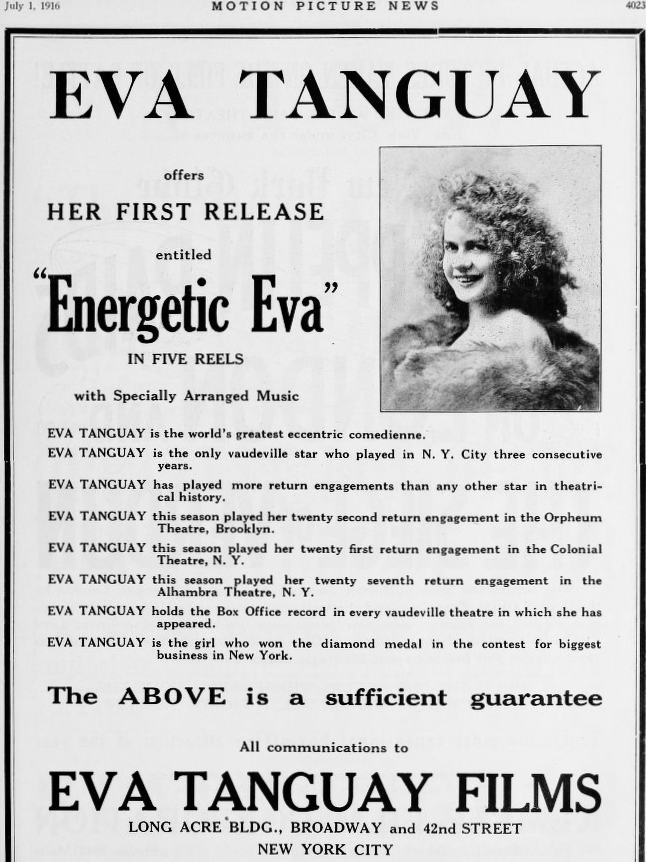
To witness Energetic Eva is to witness a temporal anomaly. In the year 1916, cinema was still grappling with its identity, oscillating between the theatricality of the stage and the burgeoning possibilities of montage. Yet, amidst this evolution, stepped Eva Tanguay—a woman whose reputation for being 'cyclonic' was no mere marketing hyperbole. She was the highest-paid vaudevillian of her era, a dervish of lace and lace-tearing energy who brought a proto-punk sensibility to the silent screen. This film, though ostensibly a comedy, functions as a vital ethnographic document of a lost performance style that prioritized raw, unadulterated vibration over the subtle nuance favored by her contemporaries.
Unlike the meticulously choreographed slapstick found in Shoe Palace Pinkus, where Ernst Lubitsch utilized geometry and timing to elicit laughter, Tanguay relies on a chaotic interiority. She does not move across the frame so much as she colonizes it. Her presence is a physical manifesto of the 'I Don't Care' philosophy that made her a household name. In Energetic Eva, we see the camera struggling to keep pace with a woman who refuses to be framed. It is an exercise in cinematic tension: the static medium of the 1910s versus the kinetic impossibility of the female form in revolt.
When we place this film alongside the broader output of the mid-1910s, its eccentricity becomes even more pronounced. Consider the stoic, almost architectural gravity of a historical biopic like Bismarck. Where that film seeks to solidify a legacy through gravitas and scale, Energetic Eva seeks to dissolve it through motion. Tanguay is the antithesis of the 'Great Man' theory of history; she is the 'Unruly Woman' theory of art. Her performance lacks the tragic poise found in Das wandernde Licht, opting instead for a freneticism that feels startlingly modern.
One might look at Susan Rocks the Boat and see the burgeoning 'flapper' archetype—a playful, rebellious spirit that is nonetheless contained within a traditional narrative arc. Tanguay, however, transcends the flapper. She is something more primordial, something that feels closer to the gothic intensity of Vampire, albeit channeled through the lens of a manic comedy. There is a predatory quality to her joy; she consumes the attention of the audience, leaving little room for the supporting cast to breathe. In this sense, the film is a masterclass in ego-driven cinema, a precursor to the modern 'star vehicle' where the plot is merely a nuisance to be navigated between moments of virtuosity.
The technical aspects of Energetic Eva are, by necessity, rudimentary. The lighting is functional, the sets are utilitarian, and the direction is largely observational. However, this lack of artifice serves to highlight Tanguay's physical language. Every shake of her shoulders, every wide-eyed stare, and every frantic leap is a rejection of the 'polite' cinema seen in works like The Honorable Algy. While Algy navigates the social mores of the British upper class with a wink and a nod, Eva dismantles the very concept of class through her vulgar, glorious vitality.
There is an inherent mystery to the film's structure, reminiscent of the enigmatic plotting in A London Flat Mystery, but whereas that film relies on narrative obfuscation, Energetic Eva relies on visual distraction. You are so mesmerized by Tanguay’s costume—a bizarre concoction of sequins and fringe that seems to have a life of its own—that you forget to look for a coherent storyline. It is a phantasmagoria of personality. It shares a certain spiritual DNA with East Is East, exploring the friction between different worlds, but here the conflict is between the world of the stage and the world of the screen.
To understand the impact of this film, one must understand the socio-political climate of 1916. The world was in the throes of a global conflict, and the suffragette movement was reaching a fever pitch. In this context, Tanguay’s performance is a radical act of self-sovereignty. She is not the demure heroine of Suzanne, nor is she the victimized figure of Saint, Devil and Woman. She is an agent of her own chaos. The film captures a moment where female agency was being redefined not through quiet dignity, but through loud, unashamed eccentricity.
We see echoes of this in Dan or A Boy and the Law, where youthful rebellion is framed within the context of moral growth. Tanguay, however, offers no such moral arc. She does not learn a lesson. She does not 'grow' in the traditional sense. She simply *is*. This lack of narrative resolution was likely jarring to audiences accustomed to the didacticism of films like He Fell in Love with His Wife or the moralizing weight of The Almighty Dollar. Tanguay represents a pure, unmonetized (though ironically highly profitable) form of human spirit that resists the domesticating influence of the marriage plot.
As a critic, one must acknowledge the fragility of this work. So much of the silent era has been lost to the ravages of nitrate decay and historical indifference. Energetic Eva survives as a flickering ghost, a grain-heavy reminder of a time when the cinema was a wild frontier. Looking at the grand scale of Votsareniye doma Romanovykh, one is struck by the formality of the Russian court; looking at Tanguay, one is struck by the informal, democratic power of the American stage. It is the difference between a monument and a lightning strike.
Ultimately, the film is a triumph of personality over production. While the writers remain largely anonymous in the shadow of Tanguay's brilliance, their contribution was providing a space wide enough for her to inhabit. The film doesn't ask for your approval—it demands your attention. It is a work of pure, unadulterated id. In the pantheon of 1916, where many films were content to be mere illustrations of stories, Energetic Eva was an experience. It remains a vital touchstone for anyone interested in the roots of performance art, the evolution of the female star, and the sheer, unbridled joy of a woman who truly, deeply, did not care.
IMDb 7.4
1924
Community
Log in to comment.