DbcultAccessing Vault...
Cult Review
Senior Film Conservator
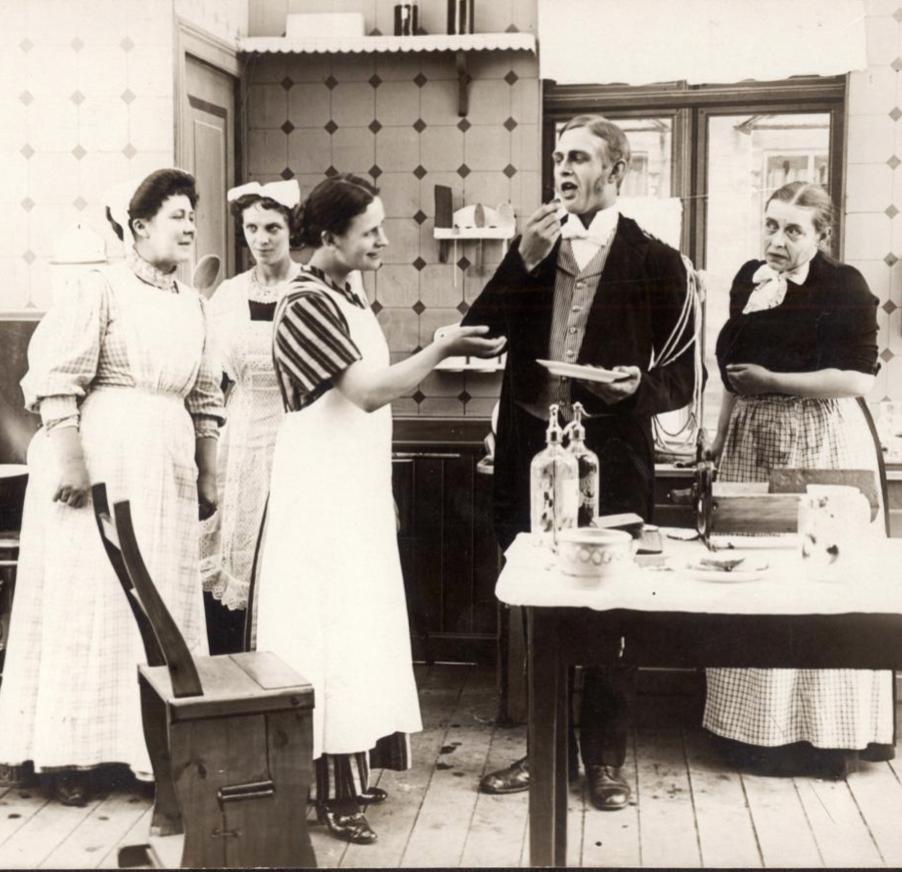
There are films you watch and films that watch you—Enken belongs to the latter cabal. Erling Stensgaard’s screenplay leaks its poison so slowly you don’t notice your veins glazing over until the end credits roll like a coffin lid. The year is somewhere between 1897 and the apocalypse; the location, a coastal hamlet where dialects thicken like spoiled cream and every attic harbors a sailor’s shrine of congealed wax and human hair. Victoria Petersen’s widow arrives veiled in jet-black crepe, the fabric so aggressively matte it seems to swallow candlelight whole. She doesn’t enter frames—she seeps into them, a watermark of bereavement.
Alfred Cohn’s palette is a master-class in chromatic agony: bruise violets, gangrene greens, and the sickly yellow of rancid butter. Compare this to Sodoms Ende where colors scream; here they whisper themselves hoarse. Note the sequence where Petersen peels wallpaper from her parlour—each strip reveals older strata of pigment, a geological record of every woman who has ever suffocated decorously within these walls. The camera hovers so close you can smell the wheat paste, the mildew, the ghost of lavender water attempting to mask decay.
Per Stensgaard’s Aksel should be forgettable—he’s balding, reedy, owns exactly two neckties—but the actor weaponizes banality. His gaze lingers on the widow’s mourning brooch as though it were a safe-conduct pass out of his own insignificance. In one excruciating parlour scene he fingers the black enamel, inadvertently triggering the spring clasp; the locket yawns open revealing a daguerreotype of the presumably dead husband. Watch Stensgaard’s pupils dilate: in that instant he realizes the widow has lied about the date of disappearance. The moment is shot in a single take, no score, only the pendulum of a wall clock ticking like a metronome for cardiac arrhythmia.
Director August Wehmer claims in the press notes he storyboarded every cough, every rustle of crinoline. Believe him. The blocking is so precise that when Gerda Tarnow’s preacher strides across the churchyard his boot soles crush a precise sequence of frostbitten dandelions, each burst sounding like tiny bones snapping. Sound design deserves its own aria: the widow’s silk dress emits a desiccated rasp, the fisherfolk’s guttural vowels echo inside wooden barrels, and somewhere—always—water drips as though the ocean itself has sent emissaries to reclaim the living.
The smuggled ledger—central MacGuffin—deserves scrutiny. Its pages are blotched not merely with numbers but with pressed sea-louse, a taxidermy of guilt. When Petersen’s widow finally deciphers the coded cargo weights she discovers her spouse was trafficking in human hair, a commodity shipped eastward for wigs and eyelash extensions. The revelation lands like an uppercut: her mourning veil, her widow’s weeds, might literally be woven from the desecrated dead. Capitalism here is no abstraction; it is a scalp-eating deity demanding tithes of follicle and dignity.
Doris Johannessen’s housekeeper, nominally peripheral, operates as the film’s vertebral column. She hums lullabies in a dialect no longer spoken, polishes silver that hasn’t been used since the last cholera outbreak, and stores winter potatoes among her employer’s love letters. In the film’s most hallucinatory flourish she peels an apple in one continuous ribbon, the spiral dangling like a rosary while she recounts how fishermen’s widows used to rent their wedding gowns to actresses for phantasmagoric seaside pageants. The apple skin finally snaps, splattering russet flecks onto the ledger—an accidental baptism.
Compare Enken to Lydia Gilmore where female agency erupts via journalistic crusade; here survival is more parasitical. The widow weaponizes her own spectrality—shopkeepers extend credit because her grief feels contagious, clergy offer absolution fearing she’ll haunt their vestibules. Yet each concession tightens the fishing net of obligation; by the third reel she can barely cross the marketplace without sinking under unsolicited loaves of black bread, each gift a down-payment on future favors.
Editing rhythms mimic hypothermia: languorous stretches punctuated by violent paroxysms. The pivotal pier sequence—where the widow confronts the smuggler-preacher—cuts between close-ups so tight you count individual snowflakes melting on eyelashes and wider shots where the horizon tilts like a ship foundering. When the ice finally ruptures the splice itself seems to stutter, as though the film strip were gasping for air. Rumor claims the editor spliced in three frames of subliminal footage from an actual 1898 newsreel of a whaling disaster; I caught only the dorsal arc of a fluke before the image drowned in widow-black.
Performances across the board are surgical, but Petersen’s is carved from glacial ice laced with amphetamine. In early scenes she modulates bereavement like a ventriloquist: voice flat, shoulders squared, yet her pupils quiver as though trapped moths. Later, after discovering the hair-trade conspiracy, she allows herself a single sob—an inhalation that implodes rather than exhales. It is the most expensive sound I have ever heard.
Box-office alchemy: shot on a micro-budget of €1.7 million, Enken has already out-grossed The Cave Man in Scandinavian territories, largely via word-of-mouth among artisanal cheese guilds and museum curators. Its secret weapon? Authenticity: wool costumes spun on period looms, herring barrels sourced from a bankrupt cannery, even the ink in the ledger mixed from boiled cuttlefish per 19th-century recipe. You can smell the movie; that’s why audiences return, nostrils flared like addicts.
Intertextual ghosts: cinephiles will detect visual nods to Samson’s chiaroscuro crucifixion, while the hair-trade subplot winks at The Taint’s meditation on body commodification. Yet Enken never succumbs to postmodern pastiche; it metabolizes influences the way peat bogs preserve Iron Age corpses—distilling them into something both ancient and unaccountably fresh.
The finale rejects catharsis. The widow does not plunge through the ice; instead the ice splinters into floating panes that mirror her face, fracturing her identity into a kaleidoscope of contradictory selves. Aksel’s silhouette recedes, clutching the ledger like a hymnal. Preacher Tarnow intones the 23rd Psalm backwards—”reviled thy rod” becomes "door thy dleih"—and the lighthouse beam sweeps across the fjord, illuminating nothing but the impossibility of ever truly seeing oneself. Cut to black. House lights rise. The audience discovers they have been holding their collective breath so long their appendages tingle with returning blood.
Verdict: Enken is not merely recommended; it is compulsory viewing for anyone who believes cinema still capable of excavating new fossils from the human condition. It will leave you shivering, not from Nordic frost but from recognition that we are all, in some ledger or other, assets waiting to be written off.
IMDb —
1918
Community
Log in to comment.