DbcultAccessing Vault...
Cult Review
Senior Film Conservator
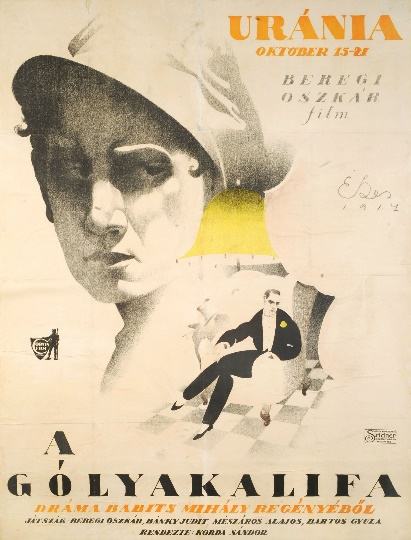
In the annals of Central European cinema, few works possess the haunting, labyrinthine complexity of Gólyakalifa (The Stork Caliph). Released in 1917, during a period of tectonic shifts in both global politics and the nascent art of the moving image, this Hungarian masterpiece serves as a bridge between Victorian melodrama and the burgeoning psychological depth of the 20th century. Directed by the visionary Sándor Korda (later Sir Alexander Korda) and adapted from the seminal novel by Mihály Babits, the film is a stark, chiaroscuro-laden descent into the human psyche that predates the more famous explorations of duality found in German Expressionism.
The narrative architecture of Gólyakalifa is built upon a terrifying premise: the total bifurcations of a man's soul. Oscar Beregi Sr., delivering a performance of staggering nuance, portrays Elemér Tábory, a man of high standing, wealth, and intellectual promise. However, Tábory’s nights are besieged by a recurring, hyper-realistic dream in which he is a destitute carpenter’s apprentice, subjected to the cruel whims of a harsh master and the grinding poverty of the working class. Unlike the whimsical escapism of Alice in Wonderland, where the dream world is a realm of nonsense and wonder, Tábory’s nocturnal existence is a visceral, tactile nightmare that threatens to overwrite his waking life.
As the film progresses, the hierarchy of reality begins to crumble. We are forced to ask: which is the dream? Is the aristocrat dreaming of the pauper, or is the pauper dreaming of the aristocrat? This existential dread is handled with a sophistication that rivals the later works of Bergman or Lynch. The screenplay, refined by the wit of Frigyes Karinthy, avoids the simplistic moralizing often found in contemporary films like Environment, choosing instead to focus on the inescapable trap of the self. The script treats the subconscious not as a repository for repressed desires, but as a predatory entity that eventually devours the host.
Visually, Korda utilizes the limitations of 1917 technology to create an atmosphere of oppressive intimacy. The contrast between the opulent salons of the Hungarian elite and the cramped, sawdust-filled workshop of the apprentice is rendered with a painterly eye. While it lacks the high-budget spectacle of The Life and Works of Verdi, Gólyakalifa finds its power in the shadows. The cinematography emphasizes the isolation of the protagonist, often framing Beregi against stark, empty backgrounds or through the distorting glass of windows and mirrors, symbolizing the fractured nature of his perception.
The supporting cast, including Mari K. Demjén and Judit Bánky, provides a necessary grounding to the surrealist flourishes. Their performances represent the external world—the family, the fiancee, the social obligations—that Tábory finds increasingly alien. In many ways, the film mirrors the social anxieties of its time. Much like The Apaches of Paris explored the gritty underbelly of urban life, Gólyakalifa uses its protagonist's dream life to critique the rigid class structures of early 20th-century Hungary. The apprentice’s suffering is not just a psychological quirk; it is a manifestation of a collective social guilt that the aristocracy could no longer ignore.
When comparing Gólyakalifa to other films of the era, its singular focus on internal conflict becomes even more apparent. For instance, The Man Who Came Back deals with redemption and the recovery of lost status, but it does so through an external journey. Tábory’s journey is entirely internal, a spiral into a void where no redemption is possible. Even the more somber Judge Not; or the Woman of Mona Diggings relies on moral judgment and societal reaction, whereas Gólyakalifa is a purely subjective experience, trapping the viewer inside the protagonist's disintegrating mind.
The film’s pacing is deliberate, almost agonizingly slow at times, to allow the weight of the two realities to settle. This isn't the lighthearted fantasy of The Patchwork Girl of Oz or the sentimental melodrama of Little Pal. It is a grueling psychological marathon. The use of intertitles is sparse, allowing the visual storytelling and Beregi’s expressive face to carry the emotional burden. This technique ensures that the film remains remarkably modern, avoiding the over-the-articulateness that often plagues silent cinema.
One cannot discuss Gólyakalifa without acknowledging its literary pedigree. Mihály Babits was a titan of Hungarian literature, and his exploration of the Freudian "uncanny" was revolutionary. Frigyes Karinthy, a master of both satire and science fiction, was the perfect choice to translate this to the screen. Together with Korda, they created a work that feels like a precursor to the existentialist cinema of the 1940s and 50s. While films like The Secret of the Storm Country were perfecting the tropes of American gothic romance, Gólyakalifa was dismantling the very concept of the romantic hero.
The film also stands as a testament to the lost era of Hungarian silent film. Much of the output from this period has been lost to time, war, and neglect. To see Gólyakalifa is to glimpse a sophisticated cinematic culture that was on par with anything being produced in Hollywood or Berlin. It lacks the sentimentality of Polly Redhead or the straightforward morality of David Harum. Instead, it offers a cold, intellectual, and deeply moving portrait of a man being torn apart by his own consciousness.
In the final act, the convergence of the two lives reaches a fever pitch. The apprentice’s world becomes so vivid that the aristocrat can no longer distinguish between the cold steel of the workshop and the soft silks of his bedroom. This blurring of boundaries is handled with a terrifying precision. Unlike the tragic coincidences of Il fiacre n. 13 or the social disgrace in Fatal orgullo, the tragedy in Gólyakalifa is inevitable and internal. It is a biological and psychological fate from which there is no escape.
Oscar Beregi Sr. deserves further praise for his ability to maintain the distinct identities of his characters while allowing the audience to see the connective tissue of suffering between them. His physical transformation—not through heavy makeup, but through posture and expression—is a masterclass in silent acting. He captures the exhaustion of the apprentice and the mounting hysteria of the aristocrat with equal fervor. In scenes where the two worlds seem to overlap, his confusion is palpable, making the viewer question their own sense of reality.
The direction by Korda is surprisingly restrained. He avoids the flashy camera tricks that would become common in the mid-1920s, opting instead for a steady, almost clinical observation of Tábory’s decline. This restraint makes the moments of surrealism—such as the transition between the dream and waking states—all the more impactful. It is a far cry from the industrial efficiency of The Angel Factory, showing a director who was more interested in the soul than the machine.
Even the score (where preserved or reconstructed) and the rhythmic editing suggest a pulse—a heartbeat that quickens as the two lives collide. The film’s climax is a masterpiece of tension, leading to a conclusion that is both shocking and poetically just. It leaves the audience in a state of contemplative silence, much like the ending of a Volunteer Organist, but without the religious comfort often found in such narratives. There is no divine intervention here, only the cold reality of a fractured mind.
Ultimately, Gólyakalifa remains a towering achievement of early cinema. It is a film that demands to be seen not just as a historical curiosity, but as a living, breathing work of art that continues to challenge our understanding of identity, class, and the subconscious. It is a dark jewel of the Hungarian golden age, a somber reflection on the duality of man that remains as potent today as it was in 1917. For those seeking a cinematic experience that goes beyond mere entertainment, Korda’s exploration of Babits’ nightmare is essential viewing—a haunting reminder that the most dangerous monsters are the ones we carry within ourselves.
IMDb —
1920
Community
Log in to comment.