DbcultAccessing Vault...
6/10
Senior Film Conservator
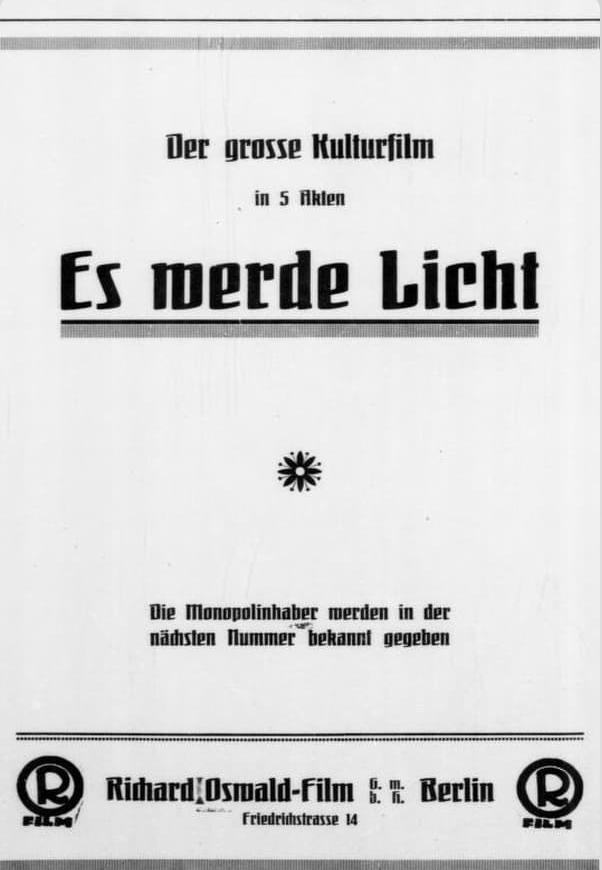
A definitive 6/10 rating for a film that redefined the boundaries of cult cinema. Es werde Licht! 1. Teil remains a cornerstone of transgressive art.
Gaslight, mercury vapor, and the sickly glow of projector carbon arcs: three illuminations collide in “Es werde Licht! 1. Teil,” a 1919 German melodrama that dared to speak the unspeakable—syphilis—at a moment when Europe’s veins still seethed with wartime septicemia. Richard Oswald, cinema’s resident physician-provocateur, teams with Ewald André Dupont and Lupu Pick to dissect a painter whose palette is as contaminated as his blood. The result is a phantasmagoria of lace, laudanum, and lesions that feels less like entertainment than like a biopsy of a continent.
The film opens on Paul Mauthner’s studio, an Aladdin’s cave of stained glass and velvet where models recline like half-finished saints. Cinematographer Max Fassbender lenses the space through amber gels so that every shadow resembles dried blood. Paul—played by Bernd Aldor with the languid cruelty of a poet who has read too much Baudelaire—learns that his recurring fevers are not romantic melancholy but the secondary stage of lues. Oswald refuses a clinical close-up; instead the quack’s diagnosis arrives via shadow-play: the doctor’s silhouette, projected onto a wall hanging of Europa and the bull, grows devil horns while Paul’s reflection liquefies in a convex mirror. Syphilis here is not a disease but a mythological reckoning.
What follows is a seduction scene so clinical it could be instructional. Paul visits the suburban villa of his brother—a Prussian functionary who believes in fresh air and duty—where sister-in-law Elsa (Nelly Lagarst) is arranging white narcissi. The camera adopts her POV as Paul’s gloved finger brushes a petal, then her wrist, then the inside of her elbow. Each touch is a hypodermic plunge. Oswald cuts to a microscopic fantasy: wriggling spirochetes superimposed over lace doilies. The intertitle, translated from the florid German, reads: “Love is merely the perfume that hides the stench of death.” When Elsa’s inevitable chancre appears, the film does not show it; we see only her mirror-framed scream while the narcissi wilt in time-lapse—a visual echo of “The Love Liar” but stripped of that film’s cheeky irony.
Once infection is assured, Paul boards a night train that cuts through the Black Forest like a scalpel. Dupont’s editing here is proto-noir: canted shots of iron bridges, coal smoke back-lit so that it resembles bruised flesh. A fellow passenger—an army nurse with a scar where an eye once sat—offers Paul a swig of schnapps and a cautionary tale about a friend who lost his nose to lues. The scene plays like a macabre inversion of the train flirtations in “Der Zug des Herzens,” replacing heterosexual courtship with venereal memento mori.
Back in Berlin, Elsa dies in a lying-in hospital whose corridors echo with the wails of Kindbettfieber victims. The camera glides past rows of copper tubs where newborns float like tragic Ophelias. Her child—delivered by forceps that resemble a painter’s mahlstick—enters the world already marked by copper-colored lesions. Yet Oswald pivots toward hope: the infant is spirited away to a Rhineland clinic run by Dr. Zweig (Ernst Ludwig), a proto-Freudian who believes in sun-lamps, sea-baths, and the talking cure. The final reel bathes the frame in heliotherapy gold: children play on dunes while nurses in starched habits chart spirochete counts that dwindle like the war’s casualty lists. It is the inverse of “The Valley of Decision,” where redemption arrives through sacrifice; here salvation is bureaucratic, scientific, and funded by a fragile republic.
Bernd Aldor, better known for swashbuckling aristocrats, gives Paul a reptilian charm. Watch the way he fingers a cigarette holder as if it were a brush loaded with carmine poison. When the tertiary stage arrives—tabes dorsalis shaking his gait—Aldor’s shoulders twitch in rhythms that anticipate “The Mark of Cain” but without expressionist hysteria. His final scene, a Marseille flophouse where he scrawls self-portraits that melt under absinthe drips, is silent cinema’s answer to De Quincey: a man painting his own collapse.
Restoration prints reveal a chromatic strategy as deliberate as any Kandinsky. Berlin sequences are tinted sepia, the color of old medical ledgers; syphilitic hallucinations flare cyan; the clinic radiates amber. Compare this to the monochrome moralism of “Judith of Bethulia,” where virtue equals luminosity. Oswald’s palette argues that sickness and cure occupy the same spectrum, merely shifting wavelengths.
Released months after the Weimar Republic’s birth, the film faced instant censorship boards who feared it would deter demobilized soldiers from matrimony. Leipzig’s moral league demanded the excision of the microscopic spirochete shot, claiming it “inflames prurient curiosity.” Oswald counter-screened the film for physicians at Charité Hospital; their petition saved the print, though regional cuts persisted. Today only the Austrian Film Museum holds a 92-minute 35 mm element, its nitrate reek neutralized by cold-storage, its intertitles reconstructed from censor cards discovered in a Potsdam attic.
At this year’s Pordenone Silent Film Festival, composer Maud Nelissen unveiled a new score: clarinet, musical saw, and glass harmonica. During the clinic sunrise she introduces a distant, looped lullaby—an echo of the children’s ward—over which a single trumpet line ascends, suggesting that health itself is a fragile improvisation. The effect is more haunting than any orchestral bombast.
Where “The Girl of the Golden West” sanitizes desire into horseback flirtations, Oswald insists that bodies remember every trespass. Conversely, “Anfisa” treats illness as metaphor; here illness is material, countable under a microscope. Only “Tangled Lives” rivals its frankness, yet that American potboiler blames moral laxity while Oswald indicts a whole society that sends men to brothels and women to early graves.
One hundred and four years on, “Es werde Licht! 1. Teil” still feels radioactive because it refuses the comfort of closure. Paul disappears into colonial exile; Elsa’s ashes are interred beneath a marble angel whose wing has already cracked; the cured child waves at a future she may yet contaminate. The film’s parting shot—an iris that closes on the sun like a cataracted eye—hints that every generation will rewrite this pathology under new names: AIDS, HPV, antibiotic-resistant gonorrhea. To watch it is to confront cinema’s original sin: the knowledge that spectatorship itself can be a vector. Leave the auditorium and you carry invisible spirochetes of empathy, fear, and the dim awareness that art, like love, is merely the perfume that hides the stench of death.
Stream or Screening: Currently unavailable on major platforms; 35 mm prints circulate through cinematheques. Blu-ray crowdfunding campaign slated for 2025 by Deutsche Kinemathek. Bookmark their newsletter for updates.
IMDb —
1915
Community
Log in to comment.