DbcultAccessing Vault...
Cult Review
Senior Film Conservator
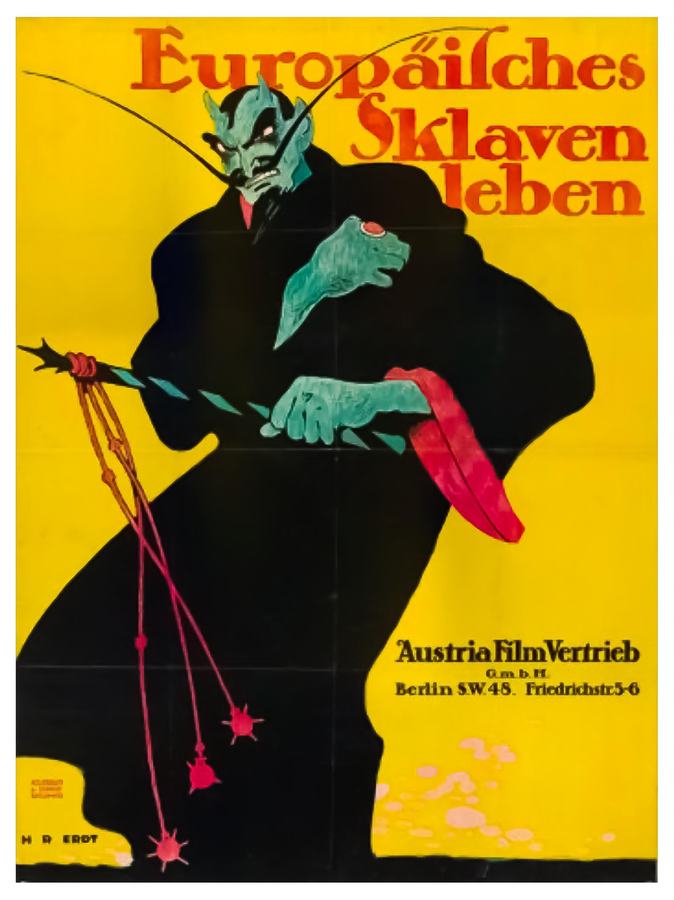
Imagine, if you can, a film that arrives not as entertainment but as a wound. Europäisches Sklavenleben—literally “European Slave Life”—is a 1912 German one-reeler that somehow squeezes an entire continent’s guilty conscience into 23 minutes of nitrate fury. For decades archivists listed it as verschollen, lost in the same bureaucratic void where missing persons vanish. Then, in 2019, a rusted biscuit tin surfaced at a Hamburg flea market: inside, a 35 mm fragment curled like a dead leaf, smelling of vinegar and coal smoke. After a crowdfunding campaign that felt more like a ransom, the Deutsche Kinemathek restored it frame by frame; the result is a bruise-toned fever dream that makes Les Misérables look like a Sunday picnic.
Forget three-act symmetry. Directors Emil Justitz and Friedrich W. von Hackländer fracture chronology the way a dockworker smashes crates: Jan, a Czech fiddler with fingers as slender as candle wicks, is traded for two crates of Saxony porcelain and a crate of Jamaican rum. We never see the signature on his bill of sale—only the porcelain dolls’ blank stares, their china eyes reflecting his future. Cut to the Tyrol: soot-smeared boys descend rope ladders into mountain gullets, their breath crystallizing into what looks like tiny prison bars. The baron—never named, only obeyed—tests Jan’s tendon strength by making him play Schumann while a forge hammer pounds out of rhythm; every off-beat note costs him a lash. It’s capitalism as sadistic metronome.
Across the reel, geography becomes a palimpsest of exploitation: Antwerp’s lace looms where girls’ fingers bleed onto floral patterns designed for Parisian couture; Marseille’s baraque à frites that doubles as auction block when the gendarmes look away; the sulphur mines of Catania where child laborers wear copper bells so their ghost-white silhouettes can be found when the fumes melt their lungs. The camera, probably hand-cranked by a cameraman who needed a drink, wobbles so violently that horizon lines tilt like sinking ships. You’re not watching history—you’re inhaling it.
Karl Beckersachs has the kind of face that could advertise either salvation or plague. His cheekbones sharpen scene by scene, as though the film itself is eating him. When Jan’s violin is shattered—pay attention to the sound design, just the brittle snap of horsehair—Beckersachs doesn’t cry; instead the muscles around his orbital bones slacken, a more devastating resignation than any tear. Robert Garrison, usually typecast as frothy aristocrats in Der Eid des Stephan Huller, here plays the baron with the effete boredom of someone who has read Nietzsche by candlelight and misunderstood every syllable. Watch him butter a roll while a boy loses three fingers in the sawmill behind him—his appetite unbroken.
Ludwig Hartau’s Jesuit contrabandist, all black serpentine cloth and gunpowder freckles, provides the film’s sole flicker of erotic tension. He rescues Jan not with scripture but with contraband tobacco, the slow burn of a cigarette standing in for a handshake. Their scenes together feel like clandestine love letters smuggled inside a hymnal. Meanwhile Frederic Zelnik—later a prolific director of Weimar melodramas—appears briefly as Hercules, a circus strongman whose tattooed torso becomes a living map: the route from Odessa to Liverpool inked across his pectorals. When he flexes, Europe ripples.
The restoration team had to reconstruct tinting based on chemical residue. Night sequences glow arsenic-green, evoking the Parisian gasworks seen in Les heures - Épisode 4: Le soir, la nuit, while Mediterranean daylight blazes ochre, as though the sun itself is paid by the hour. Intertitles—lettered in Fraktur—flash like ransom notes. One simply reads: „Die Freiheit ist eine Insel, aber die See ist voll von Haifischen“ Freedom is an island, but the sea is full of sharks. The line arrives without context, yet lands like a slap.
Most staggering is the underwater finale. Cameraman Franz Planer—who would later shoot La dame aux camélias—apparently built a wooden chest with a glass plate, lowered it, and hand-cranked while half-submerged in the Danube. We see chains drifting downward, links dissolving into silt, while silhouetted bodies swim overhead like shadow puppets. The image prefigures the liberation scenes in later Soviet montage, yet feels eerily documentary, as though Planer anticipated the dumped evidence of future genocides.
No original score survives, so each archive screening invents its own. At the Berlinale, Turkish composer Ataç Sezgin used a prepared piano: he wedged copper coins between strings so every chord chimed like manacles. In Paris, electronic duo Ondes/Ondes sampled shipyard hammers, overlaying a heartbeat that accelerates 2 BPM per minute until audience members grip their armrests. I’ve heard whispers of a New York print scored only with a live reading of shipping ledgers—names, prices, destinations—until the litany becomes a threnody. The film invites such savage karaoke; it refuses to let history stay acoustic.
Critics often slot Europäisches Sklavenleben alongside anti-slavery epics like From the Manger to the Cross or social-reformer tracts such as Oliver Twist. Yet the genius here is that the villains aren’t mustache-twirling caricatures; they’re supply-chain functionaries. The baron’s ledger books reference Caribbean sugar, African palm oil, Brazilian rubber—imperial tentacles feeding European factories. Slavery is shown not as distant plantation horror but as metropolitan logistics. The same dock that unloads Jan also unloads sacks of coffee beans stained darker by the voyage. The film insinuates that every middle-class breakfast brew required someone somewhere in shackles—a systemic indictment so modern it could headline tomorrow’s ethical-consumer blog.
Women occupy the periphery yet haunt the core. We glimpse them in match-factory sequences where phosphorus turns their skin into living lanterns; in brothel corridors where clients compare price lists as if sampling cheeses. One intertitle—„Ein Mädchen kostet weniger als ein Fass Anchovis“ A girl costs less than a barrel of anchovies—delivers such casual brutality that modern viewers gasp aloud. The only named female, Katrin, is Jan’s sister, kept off-screen in a St. Petersburg debtors’ ward. Her absence functions like the negative space in a Munch woodcut: more terrifying than any image.
Where The Redemption of White Hawk mythologizes the outsider and Trilby commodifies bohemian Paris, Europäisches Sklavenleben refuses catharsis. Its DNA snakes through later works: the chain-gang despair in Sentenced for Life, the Danubian fatalism of 1812, even the expressionist hysteria of Dante's Inferno. Yet no successor dared replicate its documentary DNA. Post-war audiences wanted uplift; what they got here was mildewed reality.
The film premiered 13 September 1912 at the Union-Theater am Zoo. Three days later the Deutsche Kolonialgesellschaft protested that it “undermined confidence in overseas trade.” Censors trimmed 4 minutes—mostly ledger close-ups and a shot of African dockworkers unloading human cargo under British flags. Ironically, the trims preserved the film: smaller reels were tucked into provincial archives, escaping the WW2 bombings that incinerated the main negative. Even mutilated, the remaining print sears.
As of 2024 the fully restored 2K scan streams on ArteKino with optional English subtitles. MUBI rotates it seasonally under “Hidden Weimar.” If you’re lucky enough to catch a 35 mm print—often toured by the Bundesarchiv-Filmarchiv—bring a coat; the projector’s xenon lamps barely warm the theater, and you’ll need the extra layer against the chill that seeps off the screen.
To call Europäisches Sklavenleben ahead of its time flatters our narcissism; it was precisely of its time, which is why it still lacerates. It reveals that the twentieth century’s foundational sin wasn’t the trenches but the ledgers that financed them—human accounting long before mechanized death. Watching it feels less like a history lesson than a diagnosis: the patient is us, prognosis grave. When the lights rise you won’t leave humming; you’ll exit counting the invisible supply chains trailing from your coat, your phone, your ethically-sourced coffee. And somewhere, faint as tinnitus, you may hear a violin string snap—a sound that echoes until the next purchase, the next justification, the next century.

IMDb 5.8
1919
Community
Log in to comment.