DbcultAccessing Vault...
Cult Review
Senior Film Conservator
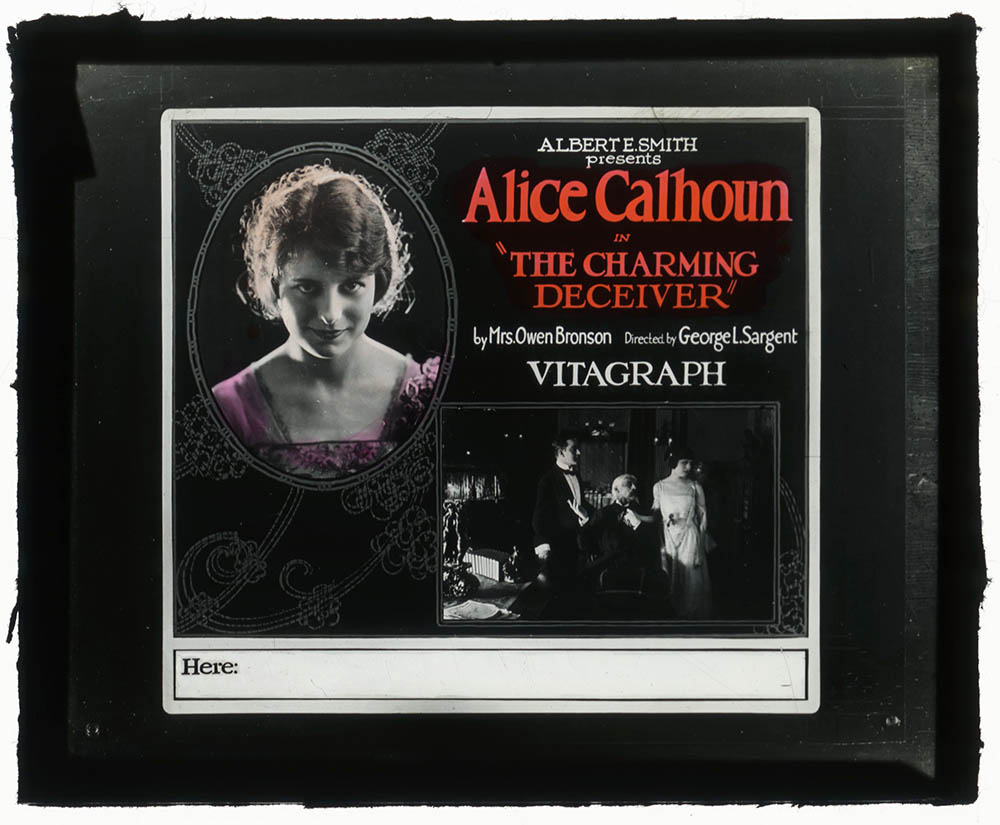
The camera, a taciturn confessor, glides past Corinthian pilasters and settles on Edith Marsden’s gloved fingers as they graze a bronzed bust of Minerva—an instant metaphor for a girl who must become both ornament and armament inside a household that trades in appearances. Roland Bottomley’s Stanford, beard clipped like hedge fund dividends, exudes the chilly magnetism of a man who has never asked permission; his baritone intertitles boom with patriarchal arithmetic: one granddaughter = one immaculate rebrand.
Yet this is no simple Pygmalion parable. Writers Fred Schaefer and Mrs. Owen Bronson lace the lineage with rot: the Stanford bloodline is already tainted by the very daughter excommunicated for marrying a forger. That contradiction—pristine façade, fermenting root—gives The Charming Deceiver its vinegar sting, distinguishing it from contemporaries like On the Fighting Line where morality lines up in trench formation.
Alice Calhoun’s Edith is lit like a porcelain cameo yet moves with the nervous quiver of a child forced to curtsy atop a fault line. Watch her pupils in the medium close-up when Stanford gifts her a rope of pearls: the iris flash is half gratitude, half terror that the necklace might metamorphose into a hangman’s noose once her father’s sins slither out. Calhoun, underappreciated even by cinephile coteries, practices an expository minimalism—eyelid flickers instead of theatrical arm-flings—anticipating the modernist restraint audiences would later celebrate in Scandinavian fare like Storstadsfaror.
Enter Robert Gaillard as Walling: shoulders set in that polite, pre-WWI equilateral triangle, moustache trimmed to suggest trustworthiness sold by the yard. Gaillard’s gift is reaction chemistry; when he overhears Marsden’s slurred confession in the tavern, the actor lets his jaw slacken a single millimeter—less a double-take than a moral hairline fracture. In that infinitesimal gesture the film tips from drawing-room pageant to primal tragedy, the same pivot Vengeance achieves when its protagonist confronts the mirrored abyss of reprisal.
Charles Kent, directing for Vitagraph with the efficiency of a watchmaker, alternates between chiaroscuro interiors—where shadows pool like spilt burgundy—and the sun-scalded exteriors of the quarry, whose limestone cliffs loom like the ridged spine of some antediluvian beast. Note the vertical wipe-transition that replaces a champagne flute with a precipice: an early special-effect coup that sutures luxury and peril more elegantly than many a CGI splice today.
Eugene Acker’s imprisoned Marsden appears first as epistolary boogeyman, then as flesh riddled with DTs, a Study in Brownian motion. His self-exposure scene—shot in a single, unforgiving take—channels the raw nerve endings found in German street films like Irrende Seelen. The performance, all tics and whiskey tremors, is silent-era code for addict, a lexicon 1921 viewers could decipher without the later semantic crutch of spoken dialogue.
The quarry climax, often clipped in repertory montages, deserves its own aria. Kent intercuts three spatial planes: police lanterns flickering like faulty constellations; Walling’s pursuit, boots grinding shale into acoustically imagined crunch; Marsden’s vertiginous POV as moonlight razors across jagged stone. When the fugitive slips, the fall is not undercranked for slapstick but protracted via double-exposure, so gravity itself seems to decelerate, allowing the audience to taste each heartbeat of inevitability. Impact is implied, not displayed—an austerity that makes modern gore-horror look like toddler tantrums.
Critics who dismiss early melodrama as corseted histrionics overlook how cunningly these films weaponize omission. The screenplay never shows Stanford reconciling with his dead daughter; instead we get a final tableau of Edith and Walling framed beneath a rose arbor, petals drifting like unsigned peace treaties. The absence of generational absolution stings sweeter than any speech, proving that what’s withheld can perforate the psyche deeper than what’s paraded.
Comparative litmus: where The Price moralizes that every transgression demands symmetrical restitution, Deceiver posits survival as its own exoneration. The ledger is never balanced; the survivors merely inherit the next blank page. That proto-existential tilt nudges the movie toward the moral nebula later charted by Manon Lescaut, albeit without operatic flourish.
Film preservationists take note: the 35mm print housed at MoMA retains the original amber tinting for interiors and cobalt for exteriors, chromatic cues that guide emotional thermostats even when projector bulbs flicker. Home-video iterations often flatten these hues to graphite; seek archival screenings or the 2022 Kino-helmed 2-K restoration if you crave authentic chromatic rhetoric.
Bottomley’s Stanford, armored in starched collar and cufflinks that glint like subpoenas, embodies capitalism’s patriarchal iteration: love as asset class, bloodline as portfolio. His late-film capitulation—signing over dowager control to Edith—reads less as sentimental thaw than as strategic rebranding, a maneuver any Silicon Valley titan would applaud. No tearful pardon, just a transfer of voting shares.
Alice Calhoun’s post-Vitagraph career slipped into Poverty Row quicksand, yet her micro-gestures here—catching breath when pearls clasp, or the stroboscopic blink as quarry dust settles—forecast the emotional granularity later demanded by method apostles. If you squint, you can spot DNA strands leading from Calhoun to Bergman’s nuanced breakdowns in A Lady in Love.
The film’s Achilles heel, if one must probe scars, is the abbreviated coda: a sixty-second montage of Edith embroidering bridal veils while Walling peers over a newspaper headline exclaiming FORGER DEAD, FAMILY FREED. The tonal pivot from gothic precipice to nuptial fluff feels airlifted from a different reel, perhaps a producer’s appeasement to exhibitors allergic to downbeat finales. One yearns for an Eisensteinian dialectic epilogue, but studio commerce rarely genuflects to poetics.
Still, the movie haunts because its moral geometry is scalene: no vertex of absolute guilt, no pristine victim. Marsden’s forgery stems from wartime penury; Stanford’s tyranny from bereavement; Edith’s complicity from self-preservation. Each character navigates a fog where headlamps barely kiss the bumper ahead—an ethos truer to lived experience than the karmic arithmetic beloved by contemporaries such as The Outcast.
For the cine-curious, streamers rarely stock Deceiver; boutique Blu outfits shun it in favor of crowd-pleasing slapstick. Your best bet is repertory houses during silent-film fests or university archives hosting 16mm parlors. Arrive early, secure aisle seat; Calhoun’s subtle eye-work dissolves when viewed from extreme rake.
Ultimately, the picture survives as a cracked family heirloom: flawed, tarnished, yet glowing with an irreplaceable patina. It reminds us that deception, charming or otherwise, is merely capitalism in evening dress, asking for one last dance before the quarry claims its due.
IMDb —
1918
Community
Log in to comment.