DbcultAccessing Vault...
Cult Review
Senior Film Conservator
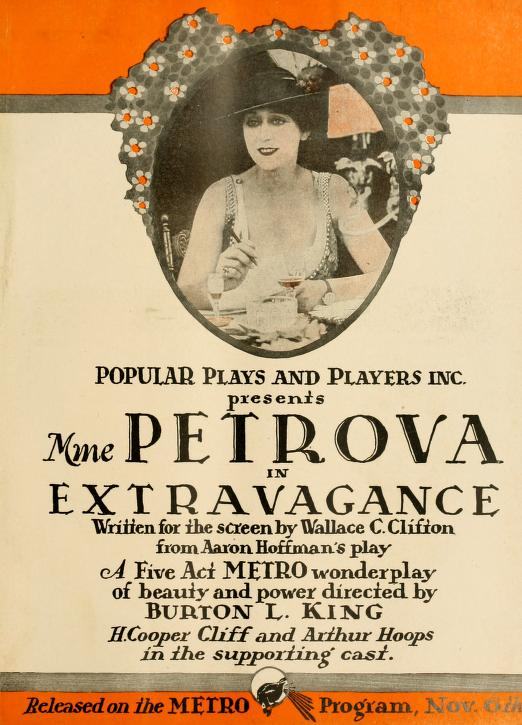
A chandelier crashes in slow motion for ninety minutes and nobody hears the sound because the orchestra is too busy sawing at violins—welcome to Extravagance, a 1925 silent that treats insolvency like grand opera and makes debtor’s prison look almost chic.
There is a moment—blink and you’ll miss it—when Norma Russell, swanning down a mahogany staircase in a gown stitched from the equivalent of a year’s wages, pauses to sniff a wilting gardenia. The flower is already browning at the edges, a whispered augury that everything we see is compost for the next reel. Director Phil Rosen (never lauded enough for his chiaroscuro eye) lets the camera linger until the petals resemble burned paper currency. It’s the entire film in microcosm: beauty aware of its own expiration date.
Olga Petrova—slavic eyes sharp enough to slice the nitrate—plays Norma as a woman who has mistaken credit for immortality. She spends the first act fluttering through a Versailles-of-the-mind, signing restaurant tabs with the same flourish Marie Antoinette must have used to endorse her death warrant. Petrova’s silent-era contemporaries often relied on wide-eyed martyrdom; she instead gifts Norma a narcotic self-belief, a conviction that every bounced cheque is merely an eclipse. Watch her fingers when father Courtland admits the note is due: they flutter to the pearl choker as though reassuring themselves the noose is still fashionable.
Enter Edward Martindel’s Dundore, a banker carved from Carrara marble and liquid nitrogen. He doesn’t walk; he arrives, like bad weather. The film’s smartest deviation from pot-boiler cliché is that Dundore never twirls a moustache—his villainy is bespoke, tailored to the insecurities of the age. In the scene where he refuses the extension, Rosen frames him behind a ledger the size of a tombstone, the columns of numbers superimposed over Norma’s anxious profile. The message is unspoken: in the new century, account books make better shackles than iron.
Which brings us to forgery, that most cinematic of sins. When Courtland duplicates Mackay’s signature, the close-up of the quill resembles a scalpel entering flesh; the ink bleeds like a vein. Rosen double-exposes the stroke over Norma’s future wedding veil—a flourish so overt it should feel heavy-handed, yet it lands like a shiver. The film understands that every forged name births a doppelgänger self, a spectral debtor who will one day demand the real debtor’s life.
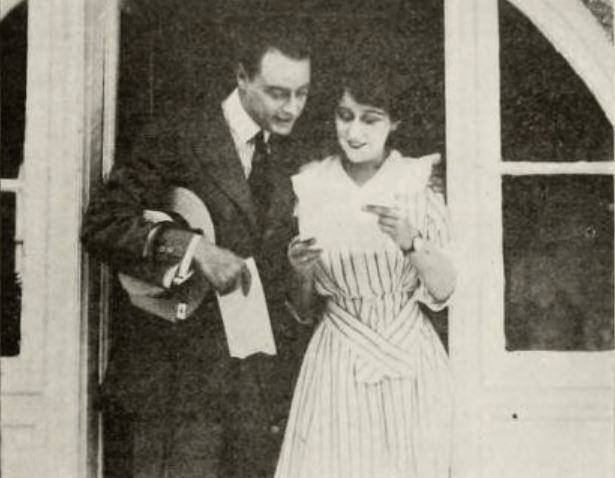
Franklin Hall—Mahlon Hamilton doing his best Great Gatsby impression—returns from South America tanned, broke, and improbably honourable. His willingness to liquidate every rubber share to buy back Norma’s future plays less like romance than like a man paying ransom to his own better nature. Hamilton has the thankless task of radiating nobility while the script boxes him into ever-tighter corners; he compensates by letting fatigue pool in the hollows of his eyes, as though virtue itself is an overdrawn account.
The mid-film arrest arrives with German-expressionist shadows slashed across the courthouse steps. Rosen tilts the camera fifteen degrees—just enough to make justice look seasick. The trial sequence is a masterclass in visual shorthand: jurors’ faces dissolve into currency portraits, the judge’s gavel becomes a stock-ticker mallet. By the time the five-year sentence falls, the audience feels it has watched capital punishment performed on a soul rather than a body.
Imprisonment should be the curtain, but Extravagance mutates into something stranger: a parable of female adaptation. Norma’s descent from drawing-room diva to studio scenarist is charted in montage worthy of Intolerance’s rhythmic editors. Typewriter keys become machine-gun staccato; her fingers, once adept at piano concertos, now hammer out three-reel redemption plots for cash. Petrova lets pride leak out of her posture frame by frame—watch her shoulders round, her chin lower—until the woman who once ordered champagne by the case is thrilled by a ten-dollar advance and a streetcar transfer.
Meanwhile father Courtland, expelled from clubs that once toasted his bloodline, finds work as a motion-picture heavy—an irony the film declines to underline. In a delicious meta-wink, he is often cast as the very banker he defrauded, reliving his sins for a daily pittance. Rosen stages these studio scenes like carnivals of second chances: klieg lights bleach age from faces, painted flats stand in for vanished estates. Yet behind every cardboard mansion lurks the smell of turpentine and desperation.
The amnesiac Horace Scott—played by Tom Cameron with the hollow gaze of a man whose mind is a locked vault—enters as a deus ex machina wrapped in bandages. Norma’s decision to film the truth and screen it for Dundore is the kind of meta-narrative stunt we now label “postmodern,” but in 1925 it must have felt like witchcraft. The nested film-within-film, titled The Banker, restages every sleight-of-hand with actors who look just off enough to jog a damaged memory. When Scott’s recognition detonates mid-screening, the audience inside the auditorium mirrors us, the real spectators, in a hall-of-mirrors epiphany that makes cinephiles of us all.
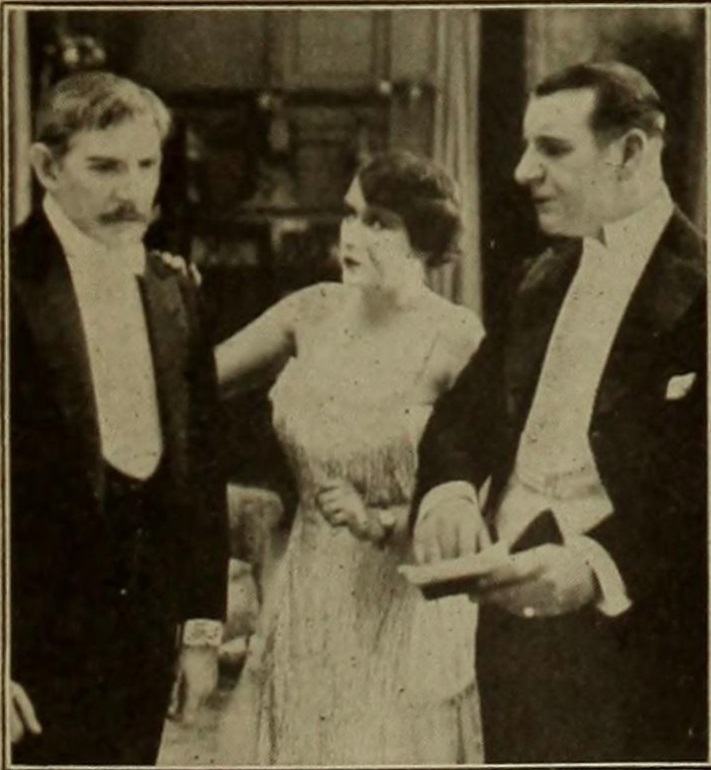
Rosen refuses to hand the audience a clean catharsis. Dundore’s escape is shot like a newsreel: hurried feet on wet platform planks, the cough of a locomotive, then the sickening crunch of steel meeting abandoned boxcars. The fatal crash is intercut with the projectionist’s booth—film reels spinning wildly, as though the medium itself were avenging its betrayed characters. It’s as close as a silent movie comes to saying: money burns, celluloid burns faster, but at least celluloid can rewind.
Restoration and release play out in a quiet dusk shot through with sodium lamps. Hall emerges from gates that look taller than grace itself; Norma waits in a simple coat that cost perhaps a week’s typing. Their embrace is awkward—two adults relearning the shape of solvency. Petrova and Hamilton underplay it, letting the hush speak louder than clutching arms. Over the final iris-in, a title card reads: “Extravagance is a guest who pays the bill long after the feast is forgotten.” One expects moralism, yet the line lands like a sigh, not a sermon.
How does Extravagance converse with its era? The same year saw The Gilded Cage mourning marital possessions, and Kindling torching class barriers. Yet Rosen’s film is less sociological tract than fever dream, less concerned with systemic critique than with the perfume of collapse. Its Jazz-Age despair feels closer in spirit to Fitzgerald’s later The Crack-Up essays than to studio brethren moralizing over flapper skirts.
Technically, the movie flaunts innovations that deserve footnotes in film-school textbooks. The superimposition of ledger columns over faces predates Poor Schmaltz’s numerical anxiety by three years. The negative-image flashback to the forgery—white ink on black parchment—anticipates noir cinematography by a decade. And the use of a diegetic film screening to trigger testimony? A blueprint for courtroom thrillers from Witness for the Prosecution to modern procedurals.
Performances oscillate between grandeur and granularity. Petrova’s star wattage never eclipses the microscopic shudder when she first smells cheap studio ink. Martindel’s Dundore has a habit of smoothing his waistcoat with the heel of his hand, a tic that becomes terrifying once you realize it’s the same gesture he uses to flatten lives. Even the peripheral cast—Arthur Hoops’s dissolute clubman, H. Cooper Cliffe’s cadaverous bailiff—arrive fully fleshed in a single glance.
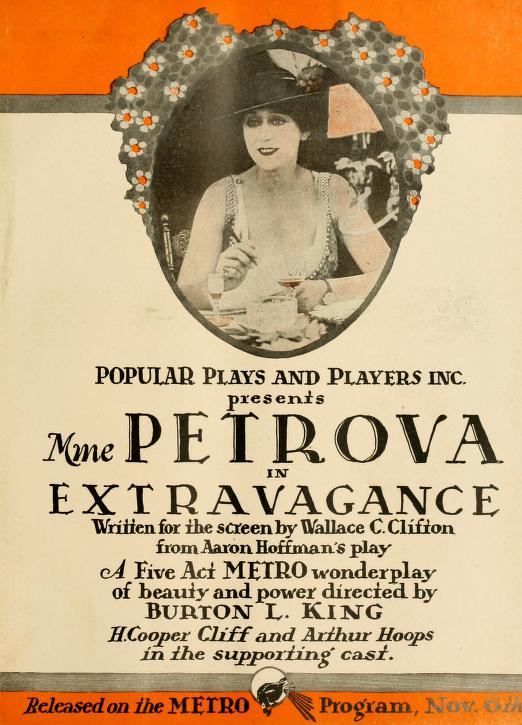
Yet the film’s lingering triumph is sonic silence. Without spoken dialogue, the clink of a crystal glass or the scratch of a pen across foolscap becomes orchestral. Contemporary viewers conditioned by surround-spectacle may need two minutes to recalibrate, but once you attune, every intertitle hits like cymbal crash. Notice how the word “extravagance” itself grows thornier each time it appears—first as invitation, finally as epitaph.
Modern resonance? Swap promissory notes for student loans, banker Dundore for faceless algorithms, and Norma’s scenario gig for influencer hustle—the parable stays immaculate. The movie whispers that living on borrowed shine is a human compulsion, updated each epoch with faster circuitry but identical psychic IOUs. We, too, scroll through curated mansions while rent trembles in the checking account; we, too, forge signatures—digital ones—on forms we barely read.
Is the film flawless? The South-American rubber montage relies on stock footage so scratched it resembles a hive of bees. A subplot involving a rival scenarist evaporates without payoff. And the final locomotive collision, while kinetic, borrows shots from an earlier 1919 newsreel noticeable to hawk-eyed archivists. Yet blemishes feel like frayed lace on a vintage gown—proof of wear, not ruin.
Availability remains spotty; only two 16 mm prints are known to survive—one at MoMA, one in a private Parisian archive that occasionally tours festivals under a pianist’s nimble fingers. If a 4K restoration ever surfaces, pray it keeps the sepia fluctuation; over-polishing would sand away the patina of panic that clings to every frame.
So seek Extravagance the way you’d seek the last unopened bottle of pre-Prohibition champagne: with reverence for bubbles that might burst yet choosing to listen for the pop anyway. Let its glow of dark orange sin and yellow repentance sear your retinas, then cool in the sea blue of recognition. And when the lights rise, clutch your wallet—or your heart—because both, the film assures us, are lighter than we think, and twice as fragile.
IMDb 5.2
1920
Community
Log in to comment.