DbcultAccessing Vault...
Cult Review
Senior Film Conservator
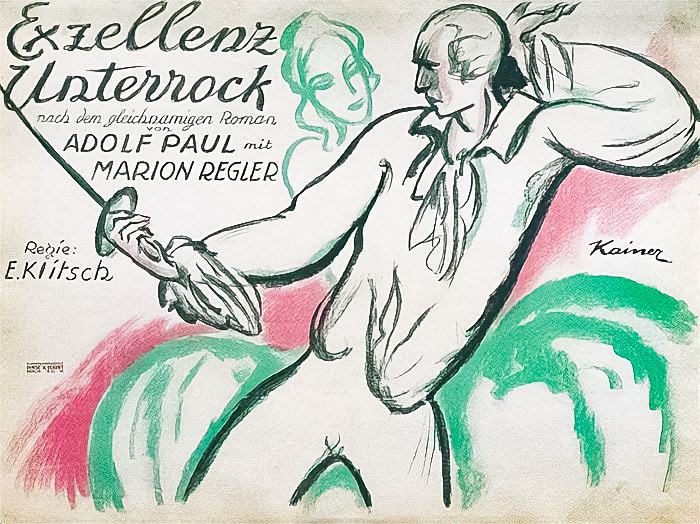
Exzellenz Unterrock is a cinematic artifact that defies temporal boundaries, its Weimar-era origins pulsating with a relevance that transcends the dust of history. Directed with surgical precision by Guido Herzfeld, this 1929 film is not merely a relic of the German silent cinema boom but a provocative interrogation of gender, authority, and the performative nature of power. With its lead actress, Marion Regler, embodying a magistrate in a skirt yet wielding the jurisdiction of a man’s world, the film becomes a palimpsest of contradictions. The very title, translating to 'Her Excellency in Petticoats,' is a sly subversion: it promises a parody of power yet delivers a visceral critique of the systems that sought to marginalize women. Herzfeld’s vision, steeped in the Expressionist aesthetics of The Cabinet of Dr. Caligari yet distinct in its focus on gender, constructs a world where authority is both costume and identity, a theme that resonates with the fragmented selfhood of Weimar cinema.
The narrative unfolds in a bureaucratic nightmare, its corridors echoing with the clatter of typewriters and the muted footsteps of women in high heels. The protagonist, Magistrate Regler, is a figure of quiet intensity, her every movement deliberate, her gaze unwavering. Herzfeld frames her in wide shots that emphasize her isolation within the male-dominated judiciary, the stark lighting casting her in a moral glow while the shadows around her suggest the encroaching darkness of institutional resistance. The film’s most audacious device is its inversion of the 'trouser role'—a trope common in the 1920s where women played male characters—to instead present women in roles of authority while retaining their feminine attire. This choice is not mere theatricality; it becomes a political statement. Regler’s skirts are adorned with pleats that mirror the folds of a judicial robe, a visual metaphor for the hybrid identity she must navigate.
Annemarie Loose’s character, a typist by day and a revolutionary by night, adds a layer of complexity to the film’s gender politics. Her scenes, shot in the dim glow of a typewriter lamp, juxtapose the mundane with the subversive. Loose’s fingers, ink-stained and nimble, are a recurring motif, symbolizing the dual role of women as both scribes of oppression and agents of change. In one particularly striking sequence, she drafts a decree that dismantles a corrupt legal statute, the camera lingering on the paper as it is folded and sealed—a act of bureaucratic defiance. This moment echoes the typist’s role in Les Vampires, yet with a feminist twist: here, the typewriter is not a tool of surveillance but of liberation.
Herzfeld’s direction is marked by a meticulous attention to spatial dynamics. Courtrooms are captured in oppressive wide-angle shots, the walls closing in on the characters as if the very architecture conspires against them. The use of negative space is telling: Magistrate Regler often appears centered in the frame, yet surrounded by empty chairs and echoing corridors, a visual representation of her isolation in power. The film’s score, a haunting blend of cello and typewriter keys, amplifies this tension, the mechanical rhythm of the latter underscoring the bureaucratic grind while the former evokes the weight of history. This auditory duality is reminiscent of the fragmented soundscapes in Perils of Paprika, though here the dissonance serves a thematic purpose rather than a narrative one.
The film’s most enigmatic element is its treatment of time. A recurring motif—a broken pocket watch—appears in several scenes, its frozen hands a symbol of the stasis within the legal system. In one sequence, Magistrate Regler is shown cleaning the watch, her movements precise yet futile, as if attempting to restore order to an irreparably broken system. This motif is mirrored in the editing style: sudden cuts and jarring transitions disrupt the viewer’s sense of continuity, reflecting the instability of a society in flux. The Weimar Republic’s own fragility is thus encoded into the film’s formal structure, a technique that foreshadows the later innovations of the French New Wave.
The cinematography, helmed by Alexander Ekert, is a masterclass in visual storytelling. Ekert employs high-contrast chiaroscuro to create a chiaroscuro of power, where light and shadow become metaphors for authority and resistance. In one of the film’s most iconic scenes, Regler stands in a shaft of light as she delivers a verdict, her silhouette stark against the darkened courtroom. This image, reminiscent of religious iconography, elevates her to a quasi-sacred status, yet the flickering bulb overhead casts doubt on the permanence of her victory. The camera, often positioned at an oblique angle, forces the viewer to adopt an uneasy perspective, mirroring the dissonance between the characters’ realities and their aspirational ideals.
The performances are a testament to the actors’ ability to convey complex emotion in a silent medium. Regler’s face is a canvas of restrained intensity, her eyes conveying volumes in moments of decision. Her colleague, portrayed by Margot Baron, offers a foil—her gestures wider, her expressions more overtly emotional, yet her character’s eventual downfall underscores the precariousness of female ambition in a male-dominated world. The ensemble cast, including the enigmatic Lotte Fliess as a jailer with a hidden ledger of secrets, grounds the film in a sense of ensemble drama. Fliess’s scenes, shot in the stark confines of the prison, are suffused with a quiet menace, her ledger a metaphor for the hidden mechanisms of power.
Thematically, Exzellenz Unterrock is a precursor to the gender-bending narratives of later cinema. Its exploration of identity and authority anticipates the work of directors like Pedro Almodóvar and Wong Kar-wai, who similarly blur the lines between performance and reality. The film’s radicalism lies not in its plot but in its implications: by placing women in positions of institutional power, Herzfeld challenges the viewer to reconsider the arbitrariness of gender roles. This is evident in a sequence where Regler dons a male wig and a judge’s robe for a clandestine meeting, the camera lingering on the transformation with a sense of both fascination and unease. The act of cross-dressing here is not for comedic effect but as a political act of subversion, a theme that resonates with the cross-dressing tropes in Her Boy though with a more overtly political edge.
The film’s historical context is inescapable. The Weimar Republic, a crucible of artistic experimentation and political turmoil, provided fertile ground for such radical narratives. Herzfeld’s work sits alongside other avant-garde films of the era, such as Der Weisse Pfau, yet distinguishes itself through its focus on institutional critique. The collapse of the German Empire had left a vacuum in authority, and films like Exzellenz Unterrock sought to reimagine who could fill that void. The film’s subversive undertones are amplified by the political climate: as the Nazi regime began to consolidate power, such works became increasingly dangerous, their messages of resistance encoded in metaphor and visual allegory.
One cannot ignore the film’s aesthetic debt to the German Expressionist movement. The exaggerated angles, the use of shadows as active participants in the narrative, and the symbolic props all recall the works of Robert Wiene and Fritz Lang. Yet Herzfeld’s approach is more introspective, the focus less on external chaos and more on the internal conflict of the characters. This is evident in the courtroom scenes, where the architecture itself becomes a character, its rigid lines and sharp corners reflecting the moral rigidity the protagonists must navigate. The influence of The Cabinet of Dr. Caligari is palpable, yet Herzfeld’s film lacks the labyrinthine surrealism of that earlier work, opting instead for a more grounded, albeit no less disquieting, portrayal of power.
The legacy of Exzellenz Unterrock is a paradox. Though largely forgotten in mainstream cinema, its themes of gender and authority have found new life in contemporary discourse. The film’s exploration of women in leadership roles prefigures the #MeToo movement and the ongoing fight for gender parity in institutional spaces. Its influence can be discerned in the work of modern filmmakers who use historical settings to critique present-day issues, such as in Nobody Home, which similarly employs period aesthetics to interrogate power structures. Herzfeld’s film, though a product of its time, remains a prescient meditation on the fluidity of identity and the performative nature of authority.
In conclusion, Exzellenz Unterrock is a film that demands to be revisited, not merely for its historical significance but for its enduring questions about power and identity. Herzfeld’s vision, though constrained by the silent film medium, bursts with a vitality that transcends its era. The film’s ability to intertwine personal and political narratives, to use the body as a site of both oppression and resistance, ensures its place as a cornerstone of Weimar cinema. For those willing to engage with its complexities, Exzellenz Unterrock offers a mirror to our own struggles with gender, authority, and the institutions that both sustain and subvert them.
IMDb —
1919
Community
Log in to comment.