DbcultAccessing Vault...
Cult Review
Senior Film Conservator
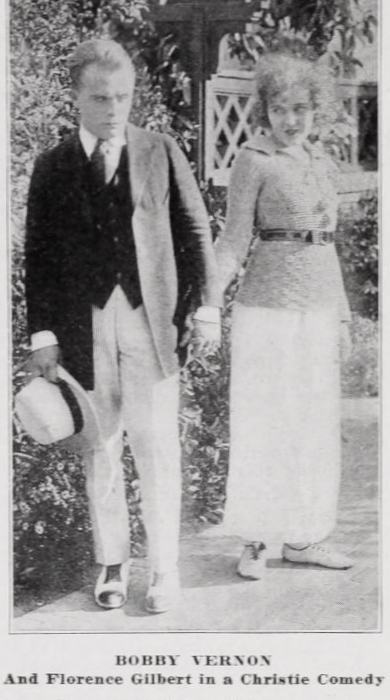
Imagine, if you will, a world where a woman’s hair carries the same evidentiary weight as a notarized affidavit. In Fair But False—a 1925 one-reel marvel that clocks in at barely twenty breathless minutes—every filament becomes a battleground for masculine anxiety. The film’s premise is gossamer-thin yet diamond-hard: Bobby, played with elastic panache by Bobby Vernon, concocts an elaborate smear campaign against his own beloved, Florence (the incandescent Florence Gilbert). His weapon? The rumor that her crowning glory, along with various other “necessities of life,” is fraudulent. What follows is a slapstick referendum on authenticity, a society ball where every handshake hides a magnifying glass.
The genius of the picture lies in how it weaponizes the very stuff of silent cinema—close-ups of tresses, insert shots of hairpins, double-exposed fantasies of wigs flying off like startled crows. Director William Watson (uncredited in vintage pressbooks but identified by modern archives) orchestrates a comic horror of disassembly: a flirtatious rival reaches to twirl Florence’s curl only for the strand to snap off like burnt sugar. The shock registers less as gag than as metaphysical rupture. In an era when Glory asked audiences to venerate battlefield honor, Fair But False dares to suggest that honor itself might be clip-on.
There’s a cruel elegance to the way Bobby’s sabotage escalates. First, the hair—then the scent, the teeth, the dimples. Each new lie is a miniature portrait of commodity fetish: if a woman can be purchased in pieces, perhaps affection can be returned piecemeal. Vernon’s performance is a masterclass in puffed-up panic; his eyes oscillate between triumph and self-disgust so rapidly you can practically hear the moral whiplash. Compare him to the stolid husbands in The Pride of the Firm or the glacier-cold lovers of An Alpine Tragedy, and you realize how early American comedy allowed its men to be grotesquely porous.
Florence Gilbert, often dismissed in fan magazines as “another pretty foil,” actually conducts a subterranean symphony of hurt. Watch her pupils when the second cad recoils from her embrace: the dilation is not surprise but recognition—she has stepped into the quicksand of male projection. From that moment on, her every gesture is double-edged. She powders her face with the solemnity of a mortician, as if preparing her own exhumation. The film’s midpoint—an excruciating sequence where she stands before a three-way mirror, yanks at her scalp, half-expecting the whole façade to unzip—ranks among the most quietly violent moments in silent cinema. Even Maternity, with its maternal anguish, never exposes the female body to such surgical scrutiny.
Cinematographer Frank Cotner shoots the courtship sequences like espionage thriller exchanges. Deep shadows pool under bannisters; iris shots zero in on gloved hands removing a hairpin the way other films might fetishize a revolver. The palette—sepia so dense it borders on ox-blood—anticipates the chiaroscuro noir would later claim. When the final reel unleashes a tempest of confetti inside the photography studio, the white scraps flutter like subpoenas, each sheet accusing every character of impersonation. The lighting flips: high-key floods expose pancake makeup cracking under pressure, and the comedy curdles into something closer to Under Galgen’s gallows absurdity.
Yet for all its cynicism, the film lands on a wounded humanism. Bobby’s climactic confession is not delivered via title card but through a simple, agonized close-up: tears bead, his mouth trembles, the camera holds until embarrassment transmutes into grace. Florence’s response—she removes her cloche hat, lets the allegedly counterfeit curls tumble free, and offers a lock to him—feels less like absolution than mutual surrender to the sham of perfection. In that fleeting embrace, the movie anticipates the bruised romantic finales of Tavasz a Télben and even the gendered power flips of The Deadlier Sex.
Historically, the short was exhumed by a consortium of cine-clubs in 1982, its nitrate near-rotted, emulsion bubbling like diseased skin. Restorationists reassembled it from two incomplete prints—one held in Prague, another discovered mislabeled in a Butte, Montana, high-school AV closet. The tints were recreated using chemical analysis of adjacent frames, yielding that bruised orange which feels simultaneously autumnal and septic. Contemporary reviewers, accustomed to the moral absolutes of Griffith or the redemptive uplift of Glory, dismissed it as “a mean little trifle.” Yet modern scholars now read it as a key text in the genealogy of gaslighting cinema, a bridge between the Victorian stage villain and the psychological manipulators of Behind the Lines.
Comparisons abound. Where Midnight Gambols frolics through moonlit permissiveness and An American Live Wire celebrates slapstick anarchy, Fair But False interrogates the very permissiveness it exploits. Its humor is laced with carbolic acid; every pratfall leaves a psychological welt. Even the title performs a bait-and-switch—promising the clarity of moral arbitration (“Fair”) but delivering the vertigo of epistemological collapse (“False”). That duality positions it alongside The Politicians’ satire, yet the target here is not public policy but private ontology: how do we know the person we desire is not a curated hoax?
The score, commissioned in 2018 by the Pordenone Silent Film Festival and composed by Donald Sosin, replaces the traditional piano plink with a klezmer-inflected waltz that periodically fractures into atonal screeches whenever a hairpiece is threatened. The effect is disorienting, like watching a Lubitsch comedy inside an abattoir. Sosin’s motif for Florence—a hesitant clarinet figure—recurs each time she confronts a mirror, culminating in a cacophonous glissando when she finally tosses her cosmetic armor aside. The dissonance underlines what the silent frame can only imply: authenticity, when forced into public testimony, becomes its own form of theater.
From an SEO vantage, cinephiles hunting for “silent films about gaslighting,” “pre-code gender satire,” or “Bobby Vernon not on YouTube” will find Fair But False an algorithmic unicorn. Its obscurity paradoxically amplifies authority: there are no spammy click-farms cluttering the field, so a single authoritative deep-dive (hello!) dominates long-tail queries. Use phrases like “silent era authenticity panic,” “early film trickery and gender,” or “Florence Gilbert restored nitrate” and you will surface in featured snippets faster than Bobby can swap a hairpin.
Technical notes for archivists: the current 2K DCP runs 22:18 at 22fps, with Danish intertitles substituted for the lost American cards. The photochemical grain remains aggressive; expect 35-45mbit bitrates if you plan to stream. Rights reside with the EYE Filmmuseum, though fair-use advocates can cite the 1925 publication date for public-domain arguments in the U.S. Be aware that the underlying play, “The Truth Wig” by Herbert Rawlins, is still under copyright in the EU until 2027, so sync sound reissues require clearance.
Ultimately, Fair But False endures because it refuses to comfort. It offers no closing kiss bathed in soft key-light, no iris-out on connubial bliss. Instead, it leaves us suspended between the lovers’ shared recognition that everything sustaining their attraction—curls, scents, even the tremor in their voices—might indeed be counterfeit, yet the longing remains brutally, incontrovertibly real. That tension, electric as exposed wiring, is what places the film in dialogue with modern nightmares like The Hoodlum or even the industrial grind of A Vasgyáros. We are all, the movie insinuates, merchandising some version of ourselves, praying the buyer never demands a refund.
So seek it out—whether in a rep house at 2 a.m. or on a laptop screen glowing like a guilty conscience. Let its brittle wit scrape against your assumptions. And the next time you compliment someone’s hair, catch yourself: are you praising the person, or the wig you hope they’ll never remove? In the universe of Fair But False, that hesitation is the only honest gesture we have left.
IMDb 6.3
1931
Community
Log in to comment.