DbcultAccessing Vault...
Cult Review
Senior Film Conservator
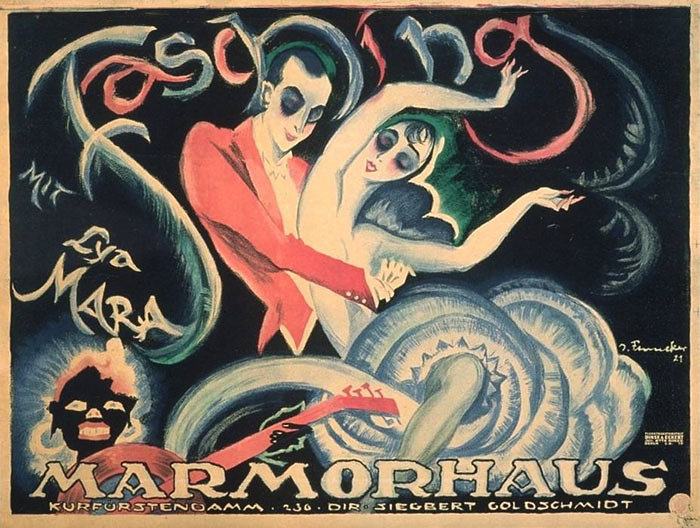
There are films you watch; then there are films that watch you. Fasching belongs to the latter tribe—an unblinking kohl-rimmed eye that follows you long after the final iris-in.
In the detritus of 1919 Berlin, carnival was not mere revelry but a scalpel sliced across the gangrenous body politic. Directors Fanny Carlsen and Paul Oskar Höcker understood this innately: their camera glides through confetti like a coroner’s hand through viscera, cataloguing every sequin of hope pinned to the lapel of despair.
Lya Mara’s face—caught between the luminosity of pre-war innocence and the angular cynicism of the Neue Frau—deserves to be hung beside Otto Dix portraits. Watch the way her pupils flare when Peer offers her a necklace of black pearls: she sees not jewelry but handcuffs polished to a midnight sheen.
Heinrich Peer, usually lampooned as the epitome of wooden Spielfilmatik, here weaponizes his stiffness. His baroque waistcoats cannot hide the fact that he moves like a marionette whose strings are pulled by creditors; every forced smile is a promissory note that will soon bounce.
Meanwhile, Mabel May-Yong pirouettes through the chaos with the feral grace of Josephine Baker before Paris ever tasted her. Her character’s backstory—half Moorish princess, half Andalusian anarchist—may sound like pulp, yet she inhabits it with such kinetic conviction that even the intertitles seem to blush.
Carlsen, primarily known as a scenarist, co-directs with the eye of a montage surgeon. Note how the camera refuses to center any single dancer; instead it fractures the space into cubist shards—an echo of Vendémiaire’s grape-stained swirl but colder, more metallic. The result is a ballroom that feels like a trench recycled into a stage: banners hang like bandages, chandeliers flicker like signal flares.
Compare this to the static bourgeois parlors of The Gilded Youth where morality sits upholstered in damask. Fasching drags that morality into the street, dips it in absinthe, and sets it alight.
Ernst Hofmann’s subplot—an artist obsessively sketching the carnival so he can “stop time from escaping”—is the film’s philosophical spine. His sketchbook becomes a meta-text: charcoal smudges on paper mirror the nitrate scratches on the celluloid itself, reminding us that every archival print is a ghost negotiating its own decay.
Though silent, the film is scored for the imagination: the crunch of sugar almonds beneath patent-leather heels, the hiss of a champagne cork like distant artillery, the wet slap of a kiss that seals a betrayal. When the cabaret emcee (Fritz Schulz) fires off Yiddish-inflected puns, the German audience of 1920 would have heard the antisemitic undertow beneath the laughter—an aural premonition of the oncoming storm.
In one bravura sequence, Carlsen intercuts a can-can with documentary footage of returning POWs. The dancers’ high-kicks match the hobbled gait of men on crutches; the montage lands like a bayonet to the ribs. You realize carnival is not escapism—it is exorcism priced at the cost of a ticket.
Fasching understands that Weimar culture thrived on gender slippage. Mara dons a soldier’s greatcoat to seduce a frightened bride; May-Yong wears a top-hat and monocle, turning the male gaze back on itself until it shrivels. The film’s most erotic moment is not a kiss but a glove removal: Mara slowly unveils her partner’s hand as if peeling a fruit, revealing a wedding-ring tan-line that betrays more than any confession.
Such moments anticipate the sexual frankness of Der Mädchenhirt yet retain an operatic sorrow closer to Sin. Where American films like Powers That Prey punished female desire, Fasching lets it roam until it becomes both weapon and wound.
For decades Fasching was a rumor—a title glimpsed in trade papers, a still misfiled under The Pursuit of the Phantom. Then in 1987 a Portuguese collector unearthed a 35mm nitrate reel in a São Paulo basement, water-stung but legible. The restoration team at Bundesarchiv filled the emulsion gaps with watercolor tinting, creating psychedelic bruises that feel intentional rather than accidental—history hallucinating itself back into being.
The current 4K scan does not erase those scars; rather it spotlights them, reminding us that cinema is a wound that insists on rehealing every time we press “play.”
If The Black Stork dramatized eugenics with Puritan rectitude, Fasching mocks that same hygienic obsession by smearing it in face-paint and forcing it to dance on broken glass. Likewise, where The Heart of a Child sentimentalizes innocence, Fasching knows innocence died in 1914 and what we call childhood is merely scar tissue playing dress-up.
Yet the film is not devoid of tenderness. In a fleeting subplot, a lesbian couple (Else Wasa & Loo Hardy) waltz in a quiet courtyard away from the main revelry. Their embrace is shot in a single long take, the camera circling like a protector rather than a voyeur. It lasts maybe forty seconds, but it radiates more warmth than the entire 140-minute running time of The Greatest Question.
Lya Mara’s greatest asset is her fragility: when her character laughs too loudly you fear her collarbones might crack. She recalls Falconetti’s Joan stripped of spiritual armor, left only with carnal defiance. Opposite her, Heinrich Peer weaponizes his reputation for stiffness; his character’s final breakdown—kneeling amid strewn masks, trying to reassemble a porcelain doll—plays like a tacit admission that postwar masculinity is a jigsaw with half the pieces missing.
Ernst Hofmann, usually relegated to romantic second fiddle, here channels the dissolute charisma of a young Max Linder, all cigarette smoke and self-loathing. His eyes are permanently half-lidded, as though the lids are drapes trying to obscure the matinee within.
And then there is Fritz Schulz: every line of his intertitles crackles with the bitter irony of a man who knows the crowd will laugh tonight and lynch tomorrow. His delivery—via title card timing and pantomimed shrug—turns jokes into shrapnel.
Film historians often cite Snappy Cheese as the proto-noir for its chiaroscuro lighting, but Fasching deserves co-credit. Its carnival setting is the original urban labyrinth: every alleyway a potential trap, every sequin a fragment of broken mirror reflecting moral ambiguity. The femme fatale is not a spider luring men to doom; she is a refugee from matrimony seeking asylum in the arms of whoever can finance the next train ticket.
The film’s final image—a lone balloon drifting past the Brandenburg Gate at sunrise—prefigures the last shot of Rough Seas, yet where the latter evokes existential resignation, Fasching whispers a more treacherous promise: tomorrow there will be another carnival, another chance to swap faces, another waltz to forget the guns.
Approach Fasching the way you would a glass of woodruff schnapps: neon-green, deceptively sweet, liable to leave your throat raw at sunrise. It is not a polite heritage piece to be consumed with museum reverence; it is a spiked punch bowl served in the abyss. Miss it, and you miss one of the most lacerating self-portraits a culture ever committed to nitrate—equal parts masquerade and autopsy.
Watch it on the largest screen you can find, volume off, room lit only by the glow of a string of Christmas bulbs half unplugged. Let the jitter of the restored frames sync with the tremor of your own pulse. When the final balloon vanishes beyond the frame, you will feel a curious aftertaste: the certainty that history itself is a carnival spinning on the axis of somebody else’s debt, and we are all wearing borrowed masks.
The confetti has long since turned to ash, but the music—silent yet deafening—plays on.
IMDb 4.2
1924
Community
Log in to comment.