DbcultAccessing Vault...
Cult Review
Senior Film Conservator
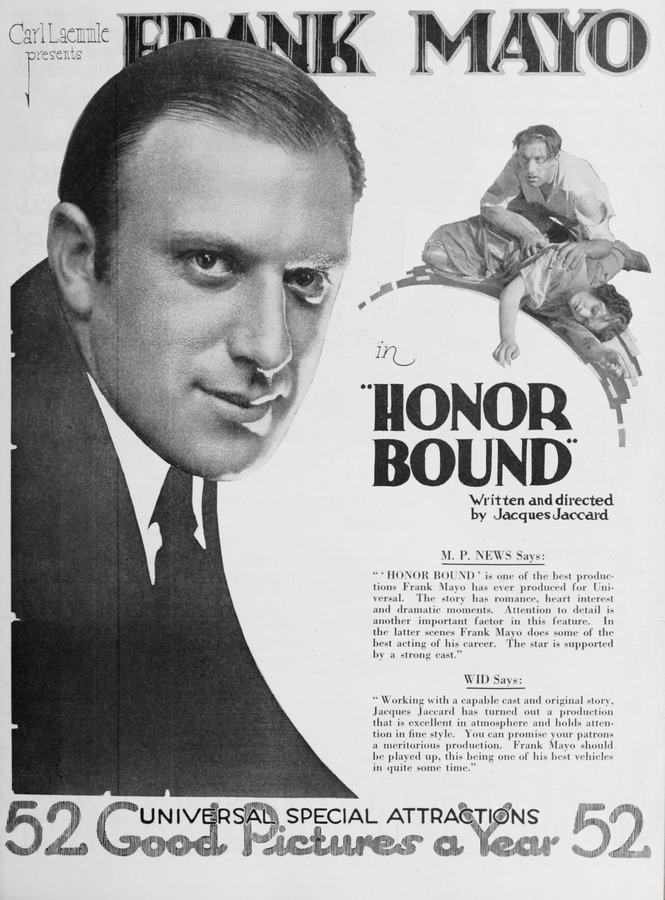
Jacques Jaccard’s Honor Bound is a sun-scorched fever print of 1922, a film that evaporated from public memory faster than river water on galvanized steel yet once flickered with the incandescence of a morality play soaked in rum and jaguar sweat. Imagine The Panther Woman’s erotic tangle relocated to the rubber forests, or Red, White and Blue Blood’s class satire transplanted into a world where the dress code is mosquito netting and the wallpaper is mold.
The print that survives—if you chase it through private hoarders and archivists who guard their 35 mm like crown jewels—runs a terse five reels, yet every frame exhales the humid weight of a Joseph Conrad paragraph. Billy Thorpe, essayed by Edward Coxen with the dimpled insouciance of a man who has never unpopped his own champagne cork, arrives onscreen in a boater hat so blindingly white it feels like an act of colonial aggression. The rubber king George Vincent—Charles Herzinger in a beard sculpted like empire—packs the boy off to “learn the value of a dollar,” a phrase that here translates to “bleed under equatorial sun until the dollar learns to value you.”
What follows is less a linear plot than a spiral of ethical vertigo. Gordon Sackville’s James Ellison strides through the cane wearing the brittle smile of a man who has married the boss’s daughter yet nightly slips into the bush to worship at the altar of Koree, played by Dagmar Godowsky with the liquid eyes of someone who already knows how the story ends. The film’s racial politics are, predictably, of their era—Koree is coded as “native” through jewelry and waist-length hair—but Godowsky infuses the role with a watchfulness that undercuts exotic cliché. She studies the white interlopers the way a chess prodigy studies toddlers with toy swords.
Jaccard’s camera, handheld in a fashion that anticipates Italian neorealism by two decades, drinks in the plantation like a voyeur who refuses to blink. Note the sequence where the Vincent yacht, all polished brass and imperial confidence, noses against the rickety pier: the continuity cuts between teak ballroom and mangrove swamp feel like someone opened a gilt locket to find a rotting orchid inside. The clash of spaces is so jarring it becomes a moral indictment—every gleam of caviar fork lands as a lash on the back of the unnamed laborers we glimpse in background vignettes.
When Ellison allows the party to suspect Koree is Billy’s “sweetheart,” the film ignites into a crucible of reputational napalm. Billy’s silence—played by Coxen with a tremor that oscillates between gallantry and cowardice—protects Mary, yet condemns Koree to the racist condescension of the yacht’s salon. Irene Blackwell’s Mary, a study in porcelain repression, watches the accusation land with the stunned despair of someone who realizes her marriage certificate is written on rice paper. The mise-en-scène traps her behind a ship-deck railing shaped suspiciously like a birdcage; the metaphor is silent but deafening.
Violence erupts not as fisticuff spectacle but as aquatic opera. Santos Cordero—Nick De Ruiz in eyeliner that could slice plantains—lunges at Billy under a moon swollen like an overripe guava. Their brawl spills off the deck into black water; the river receives their thrashing bodies with the indifference of geology. Cinematographer Max Willink (pulling double duty as a supporting actor) positions the camera half-submerged, so half the frame is liquid chaos, half is silver moonlit air. The wound Billy sustains—an artful slash across the clavicle—becomes the stigmata through which privilege finally leaks.
The subsequent convalescence inside Koree’s stilted hut is the film’s ethical nucleus. She peels away Billy’s soaked tuxedo shirt, the costume of ballroom innocence, and presses heated leaves against the gash; smoke curls from a brazier, licking the rafters like ancestral tongues. For once the intertitle card is spare—perhaps the producers feared that any spoken rhetoric would profane the sacrament of shared breath. Here the film approaches the tactile spirituality you’d sooner expect in Spiritismo or in Victor Sjöström’s later wilderness psalms.
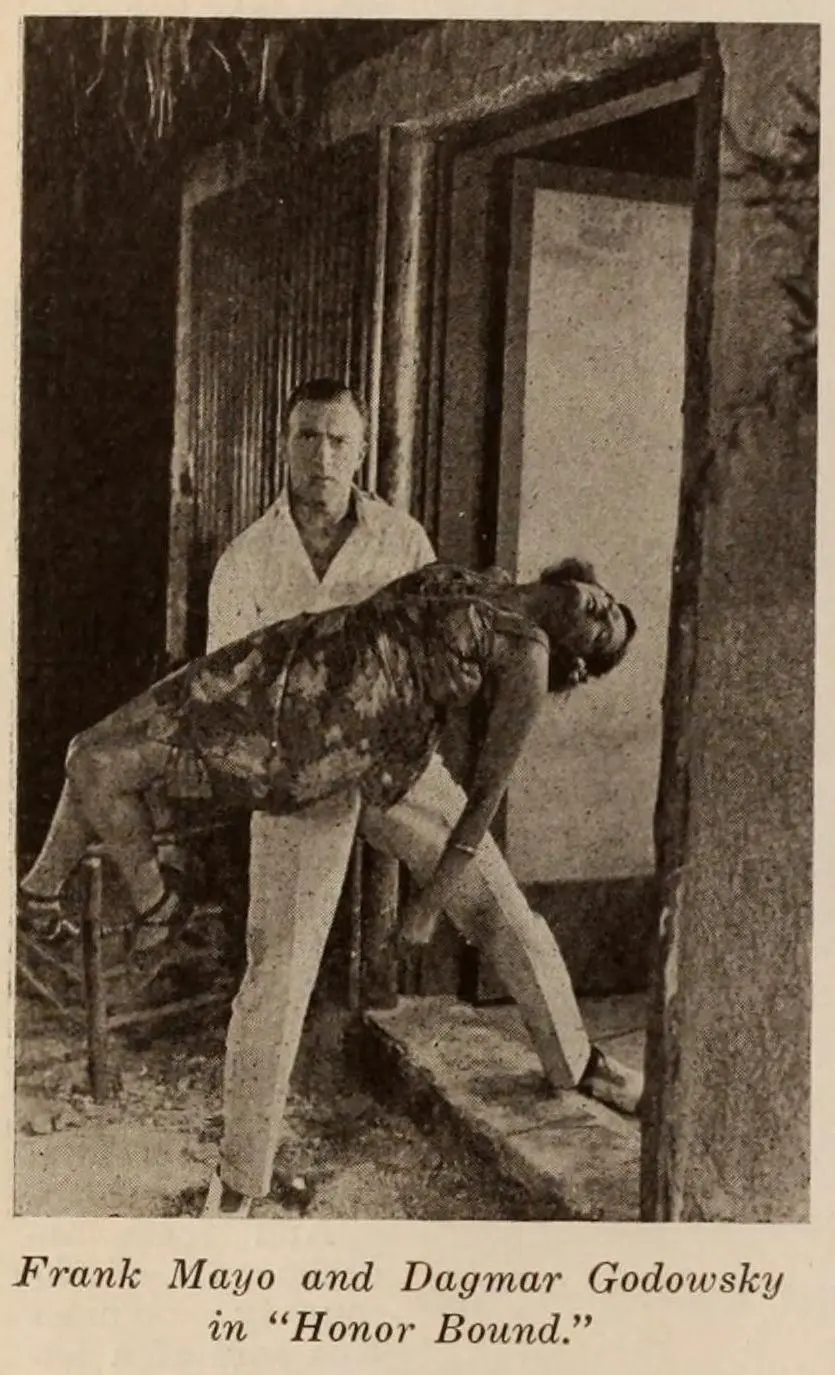
Claire’s arrival—Helen Lynch in linens that seem to wilt in real time—could have devolved into catfight cliché. Instead, Jaccard stages a triangular confession: two women, one man, zero illusions. Koree speaks first, her intertitle rendered in uneven typeface that mimics accent; Claire listens, tears diluting the dust on her cheeks. The moment Claire extends her hand toward Koree, palm upturned like a penitent, the film achieves a proto-feminist détente rare in early twenties cinema, a fleeting sisterhood that sidesteps both the Madonna/whore binary and the savior complex.
Ellison’s comeuppance is swift yet unsatisfying—he is “sent home to rehabilitate,” a phrase that smells of boardroom whitewash. One longs for the cosmic retribution D. W. Griffith might have inflicted: quicksand, anaconda, moral epiphany in the face of extinction. Jaccard denies us that catharsis, perhaps because he knows empire’s sons rarely drown; they merely sail to another latitude. Yet the film’s final tableau refuses easy absolution: Billy and Claire stand ankle-deep in river silt, yacht vanishing around a bend, while Koree watches from the bank flanked by palms that claw the sky like accusatory fingers. The lovers’ embrace is backlit by a sun the color of molten brass, but the camera lingers on Koree’s silhouette until she becomes the moral anchor of the composition, the still point around which the Caucasian narrative dissolves.
Technically, the film is a grab-bag of contradictions. Day-for-night shots render the moon cobalt, giving the illusion the jungle has been dipped in indigo ink; some critics deride it as amateur, yet the effect divorces the action from terrestrial time, suspending characters in a limbo where every decision feels cosmic. The score, reconstructed by a Brazilian quartet in 2018, layers berimbau against ragtime piano, producing a dissonant lullaby that underscores the film’s thesis: cultures colliding without merging, wounds stitched but never healed.
Performances oscillate between the stagy and the startling. Coxen’s Billy matures in micro-movements: notice how his left hand, once gesticulating in flapper-era loops, gradually stills against his thigh as responsibility calcifies. Sackville’s Ellison is all teeth and cufflinks, a hollow man whose grin seems to echo the exploitation he embodies. Godowsky, though saddled with exotica signifiers, conjures interior monologue through the simple act of breathing—her ribcage rises and falls as if the entire forest inhaled with her.
Culturally, Honor Bound sits at the crossroads between Pay Dirt’s capitalist critique and The Test of Honor’s chivalric guilt. Its Amazon is not the verdant Eden of later travelogues but a ledger of unpaid debts: to indigenous labor, to female agency, to narrative complexity. The film’s partial disappearance—only two incomplete prints known—feels like a cultural repression, as though the medium itself recoiled from the mirror it was asked to hold.
Comparative viewing reveals DNA strands in unexpected descendants. The yacht-as-purgatory anticipates Renoir’s The River, while the aquatic knife fight prefigures the baptism-by-blood in On the Waterfront. Most striking is the film’s prescient environmental unease: rubber, the very commodity underwriting Vincent’s fortune, oozes from slashed trees in background shots, a visceral reminder that every empire is built on bleeding bark.
For the modern cinephile, accessing Honor Bound demands the zeal of a pulp detective: whispered passwords at Bologna’s Il Cinema Ritrovato, furtive USB transfers in university corridors, rumors of a 9.5 mm nestling in a São Paulo attic. Yet the chase rewards. The film offers not nostalgia but a bruise, a reminder that moral reckoning is perennially postponed, that honor—bound, gagged, and exported—still bleeds in foreign waters.
Watch it, should the reels ever converge, with the lights off and the windows open. Let urban humidity seep in until wallpaper peels; imagine each crack as Amazonian tendrils reclaiming living-room empire. When the final intertitle fades and Koree’s eyes meet yours across a century, you will sense the film’s true imperative: not to resolve guilt but to enroll you in its unfinished ledger. We are, it whispers, all bound—by rubber, by river, by the stories we let sink—until we choose to surface, gasping and guilty, into the dawn of our own reckoning.

IMDb 5.2
1923
Community
Log in to comment.