DbcultAccessing Vault...
Cult Review
Senior Film Conservator
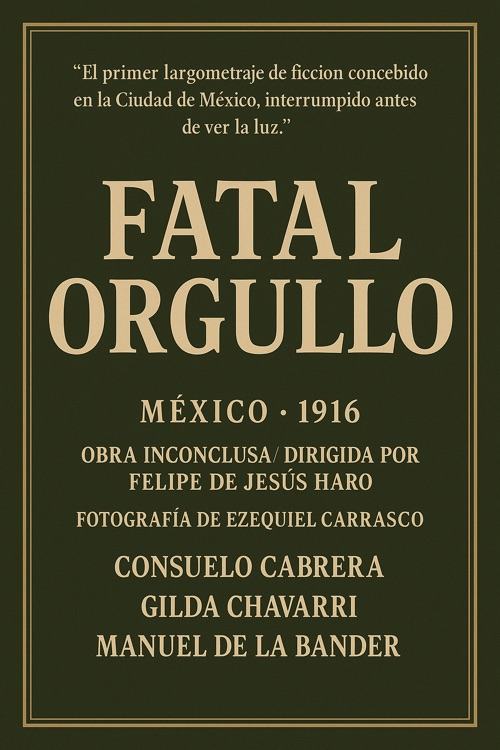
In the flickering, sepia-toned annals of early Latin American cinema, few artifacts possess the ethereal, almost ghostly resonance of Fatal orgullo. This 1916 production is not merely a film; it is a cultural monolith that stands as a testament to the ambitious spirit of Peruvian pioneers. To watch it—or rather, to reconstruct its impact through the fragments of history—is to witness the birth of a national visual language. While contemporary audiences might be more accustomed to the grandiosity of epics like Quo Vadis?, there is an intimacy in this production that bypasses the spectacle for something far more visceral and psychologically taxing.
The luminosity of Consuelo Cabrera cannot be overstated. In an era where silent film acting often devolved into the pantomime of the grotesque, Cabrera maintains a stoic, almost terrifyingly internal composure. Her face serves as the primary landscape of the film, a terrain where pride and despair engage in a silent, brutal skirmish. Unlike the more comedic, light-hearted energy found in Judy Forgot, Cabrera’s presence is heavy with the weight of ancestral expectation. Every micro-expression is a calculated move in a high-stakes game of social survival.
Complementing her is Manuel de la Bandera, whose portrayal of the masculine archetype of the era is both fascinating and repulsive. He embodies the 'orgullo' (pride) of the title with a rigid physicality that suggests a man trapped within his own suit of armor. Their chemistry is not one of romantic longing but of mutual entrapment. They are two celestial bodies locked in a decaying orbit, destined to collide because neither possesses the humility to alter their course. This dynamic reminds one of the intensity found in Othello, though stripped of the Elizabethan verse and replaced with the stark, haunting silence of the Andean shadows.
The direction—though the specific directorial credit often remains a subject of historical debate—utilizes the architectural grandeur of Lima to symbolize the protagonist's psychological confinement. The high ceilings and ornate facades of the aristocratic mansions are not merely backdrops; they are the bars of a gilded cage. There is a specific shot, midway through the film, where a character stands alone in a cavernous hallway, the shadows stretching out like long, grasping fingers. It evokes a sense of dread that rivals the atmospheric tension of After Sundown.
The cinematography relies on the natural light of the Peruvian coast, creating a high-contrast aesthetic that underscores the binary nature of the film’s themes: light versus dark, honor versus shame, the individual versus the collective. While it lacks the sheer technical budget of Potop, it compensates through a clever use of framing. Characters are often positioned behind physical barriers—balustrades, windows, or heavy furniture—emphasizing their isolation even when they share the frame with others. It is a masterclass in the 'cinema of entrapment.'
To understand Fatal orgullo, one must acknowledge the volatile social climate of 1916. Peru was navigating the complex transition from a colonial-influenced past into an uncertain modern future. The film captures this friction perfectly. The 'pride' depicted is not just a personal failing; it is a systemic one. It is the pride of a class that feels its grip on power slipping away. In this sense, the film shares a thematic DNA with The Sentimental Lady, though it trades sentimentality for a much sharper, more cynical edge.
The inclusion of Gilda Chavarri adds a layer of nuanced supporting conflict. Her character represents the collateral damage of this pervasive pride. Through her, we see the ripple effects of the protagonist's decisions. It is a reminder that in the pursuit of maintaining one's 'honor,' it is often the innocent bystanders who are crushed first. This exploration of moral ambiguity is far more sophisticated than the binary heroics of Notorious Gallagher; or, His Great Triumph.
One cannot discuss Fatal orgullo without addressing its status as a partially lost or obscure work. This 'ghost' status adds a layer of romanticism to the viewing experience. We are not just watching a movie; we are excavating a tomb. The scratches on the celluloid, the occasional missing frames, and the jittery movement of the actors all contribute to a sense of profound nostalgia. It makes the film feel fragile, much like the characters it depicts. It stands in stark contrast to the polished, almost commercial sheen of Peggy or the stylized artifice of Die Tangokönigin.
The narrative structure, while linear, feels fragmented in a way that mirrors the human memory. We see the highlights of a life descending into ruin, the 'greatest hits' of a tragedy. This pacing creates a relentless momentum. Once the first domino of pride is pushed, the rest fall with a terrifying, mechanical precision. There is no room for the whimsical detours one might find in The Ringtailed Rhinoceros. Every scene, every intertitle, is focused on the central thesis: that pride, when left unchecked, is a terminal condition.
While American and European cinema in the mid-1910s was beginning to experiment with more complex editing techniques, Fatal orgullo remains somewhat traditional in its 'tableau' style. However, what it lacks in rapid-fire editing, it makes up for in depth of field and mise-en-scène. Consider the way characters move within the frame; they don't just walk, they inhabit the space with a theatricality that suggests they are aware of the 'stage' of history they are standing on. This is a far cry from the more dynamic, almost frantic movement in The Honorable Algy.
Furthermore, the film avoids the easy moralizing of many its contemporaries. In On Dangerous Paths, the moral lesson is often telegraphed with a heavy hand. In Fatal orgullo, the tragedy is presented as an inevitability of character rather than a punishment from a higher power. It is a secular tragedy, which makes it feel surprisingly modern. The 'wrong door' taken by the characters in this film is not one of accidental choice, as in The Wrong Door, but one of deliberate, stubborn conviction.
The final act of the film is a grueling exercise in emotional endurance. As the consequences of the characters' actions finally catch up to them, the visual language shifts from the grand and architectural to the tight and claustrophobic. We are forced to look directly into the eyes of the defeated. It is a harrowing experience that lingers long after the final title card fades. The film doesn't offer a catharsis in the traditional sense; it offers a reflection. It asks the audience to examine their own 'prides' and the walls they build around themselves.
In the broader context of film history, Fatal orgullo deserves a seat at the table alongside works like In the Palace of the King for its exploration of the intersection between personal desire and institutional duty. It is a film that demands to be studied, not just for its place in Peruvian history, but for its universal understanding of the human ego. The 'millions' at stake here are not monetary, unlike in The Lure of Millions, but are instead the priceless pieces of one's soul and dignity.
Ultimately, this is a work of profound melancholy and artistic bravery. It took the burgeoning medium of film and used it to hold a mirror up to a society that was perhaps not yet ready to see its own reflection so clearly. The performances of Cabrera, Chavarri, and de la Bandera remain etched in the mind, ghosts of a cinema that continues to haunt and inspire. It is a reminder that while film stock may decay and names may fade from the marquee, the raw power of a well-told tragedy is eternal.
Reviewer's Note: As we continue to rediscover and restore the treasures of early world cinema, Fatal orgullo stands as a beacon of what can be achieved when national identity is forged in the fire of dramatic excellence. It is a must-see for any serious student of the silent era.
IMDb 5.9
1924
Community
Log in to comment.