DbcultAccessing Vault...
Cult Review
Senior Film Conservator
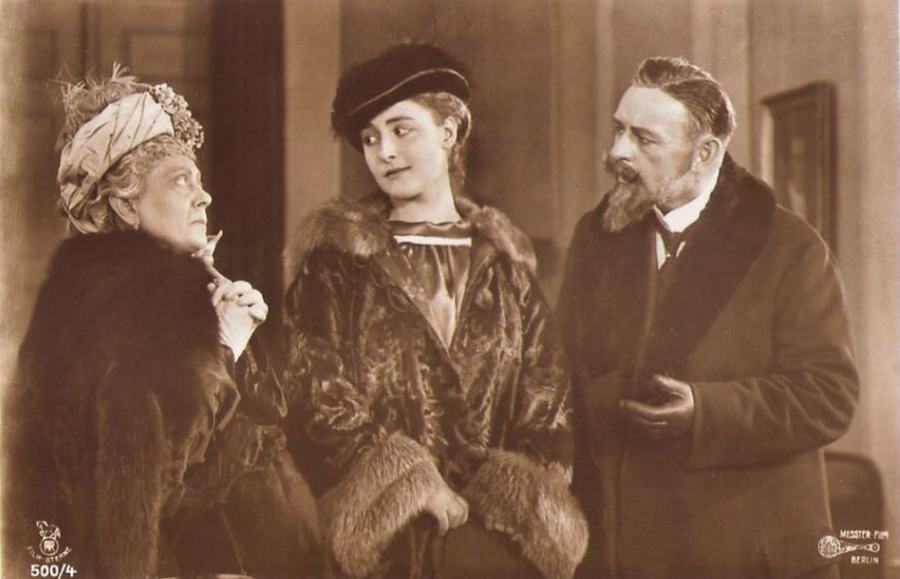
There are films you watch, and films that watch you—Feenhände belongs to the latter caste, a celluloid poltergeist that peers back from 1919 with kaleidoscope eyes still wet with mustard-gas dew.
Robert Wiene, forever shackled to the expressionist curve of Caligari, here trades angular dementia for the liquidity of smoke; he stages horror not on crooked rooftops but inside the pleated silk of a conjurer’s glove. The result is a poem of absence, a funambulist’s elegy for a generation turned to bullet casings.
Silent cinema, at its summit, is less missing sound than distilled dream; Wiene and co-writer Eugène Scribe distill even further, fermenting the very concept of disappearance. Dialogue is replaced by the rustle of canvas, the clink of brass buttons, the hush of ash settling on snow. The intertitles—hand-lettered on what looks like bandage cloth—appear sparingly, like stitches closing a wound that should stay open.
Rudolf Biebrach’s Feenhände never twirls mustache nor exposes fangs; his villainy is the soft-spoken assurance of the bureaucrat who tells you your son “fell with honor.” Watch the way he counts coins off a child’s palm: the thumb lingers, not lecherous but ledger-like, appraising what each finger might fetch in the after-market of grief.
Arnold Korff’s burgomaster swells with self-importance until his sideburns seem to annex neighboring countries; yet in the private theater of his study, where he replays war footage on a hand-cranked zoetrope, the mask slips—his eyes reflect not maps but mud. Claire Reigbert morphs from coquette to Cassandra in a single close-up: pupils blown wide, reflecting a burning big top, she becomes every war-wife who learned to translate telegram euphemisms into anatomy.
Henny Porten, the era’s reigning tragedienne, cameos as a blindfolded tightrope walker who never once steps on the rope—she floats, thanks to under-cranking and a black velvet sky, epitomizing Wiene’s credo: reality is merely a slower miracle. Paul Hartmann’s Caspar, face powdered like porcelain cracked by cannon thud, conveys entire operas of doubt with the twitch of a lip muscle.
The surviving tinted print—sea-blue for night interiors, amber for memory, vermilion for the magician’s den—renders color as moral verdict. When Therese’s lost love is temporarily “resurrected,” the tint oscillates between rose and bile-green: hope and putrefaction share a heartbeat. Wiene’s cinematographer, Willy Hameister, paints with shadows the way other men daub pigment; he chiaroscuros cheekbones until they resemble mountain ranges over which refugees trek toward an unseen border.
Cutting rhythms accelerate like a dying soldier’s pulse: from languid long takes of Therese stitching flags that will never fly, to staccato inserts—button, eye, coin, flame—each splice another nail in the coffin of linear time. The film’s bravura sequence cross-cuts between a village children’s choir singing of resurrection and the magician’s backstage abattoir where wax mannequins are melted into bullet molds; the hymn ascends while lead descends, an audiovisual memento mori.
Though technically mute, Feenhände is scored by absence: the silence after a shell burst, the hush when a mother’s breath catches upon seeing a familiar coat on a stranger. Contemporary screenings accompanied by a live quartet used a composition titled Requiem für die Unsichtbaren—its manuscript lost, but anecdote swears the conductor instructed musicians to not play on every downbeat, letting negative space conduct the audience’s heart arrhythmia.
Where The Sunny South domesticates fate into drawing-room coincidence, Feenhände lets fate run feral, clawing through circus canvas. If Are You a Mason? jokes about secrets, Wiene’s film whispers that the biggest secret is there is no secret—only ledger columns of missing. The Three Musketeers offers camaraderie as antidote to conspiracy; Feenhände offers complicity, inviting viewers to applaud their own vanishing.
Reel four, long presumed lost, ends on a freeze-frame of Caspar’s open mouth mid-scream; the absence of subsequent imagery forces the spectator to provide the after-image—an inverted Palinopsia where trauma is projected onto the screen rather than from it. Film historians still feud whether the reel was destroyed in the 1923 nitrate fire or clandestinely removed by censors unnerved at how the burning tent spells VERLOREN (forfeit) across 40 feet of celluloid.
Women in Feenhände are not mere mourners; they are alchemists of absence. Therese’s sewing needle becomes stylus rewriting the Book of the Dead into domestic linen. Frida Richard’s nurse—listed only as Mutter—delivers a monologue (via intertitle) that indicts war as the ultimate illegitimate son: "I birthed boys for the soil to reclaim; now I unbirth them with thread and ash." The line detonated scandal in Cologne, prompting walkouts by veterans who preferred their widows silent.
Central to the narrative is the macabre bargain: Feenhände can retrieve the dead, but only if another living soul volunteers to forget them. Thus memory becomes currency, a Mephistophelian inflation where recollection is debased until entire families barter grandfathers for grandsons. The moral crater left behind testifies to Wiene’s cynicism: every miracle is a foreclosure, every answered prayer a defaulted mortgage on the past.
Biebrach’s gestural lexicon channels the uncanny valley decades before the term existed: his bow too fluid, his blink too metronomic. In one chilling tableau he removes gloves finger by finger—revealing beneath them not stumps but perfect duplicates of the gloves themselves, recursion without terminus. The moment lasts seven seconds yet feels like sinking through cellar floors.
Production designer Walter Reimann erects a village that seems perpetually in the act of folding into itself; roofs pitch at neurotic angles, chimneys exhale in chorus. The only vertical straight line is the gallows in the market square, politely ignored like an obscene uncle at Christmas. Compare this to the pastoral fatalism of Dimples or the operatic bombast of The Love Tyrant; Wiene opts for claustrophobic intimacy, a snow-globe diorama of purgatory.
Released mere months after the Treaty of Versailles, Feenhände weaponized PTSD as mass entertainment. Audiences who had stifled screams under blackout curtains now paid pfennigs to see their repressed return as vaudeville. Critics of the era labelled it “Schadenfreude mit Dekor”; yet letters survive of soldiers thanking Wiene for externalizing the foxhole hallucination where dead comrades stand mute awaiting orders that will never come.
While Caligari birthed the twist ending, Feenhände birthed the twist absence: what you think is missing is in fact the message. Its DNA can be traced in Tarkovsky’s Mirror, in Resnais’ Night and Fog, even in the final shot of Nolan’s Inception—where the unresolved top is simply a digital grandchild of Caspar’s open mouth. The film survives primarily in description, like a corpse identified by dental records; yet its echo haunts any artwork that dares suggest absence can be a protagonist.
To watch Feenhände today—via the 2018 2K restoration that sutures French, Munich, and MoMA fragments—is to confront a mirror whose silvering has been scraped away where your reflection should be. You exit the cinema seeing outlines of people who aren’t there, hearing applauses that never sounded. And perhaps that is Wiene’s ultimate trick: not to make the dead return, but to make the living understand they have been the ghosts all along.
—a film that ends not with fin but with fehlt: missing.
IMDb 5.2
1926
Community
Log in to comment.