DbcultAccessing Vault...
Cult Review
Senior Film Conservator
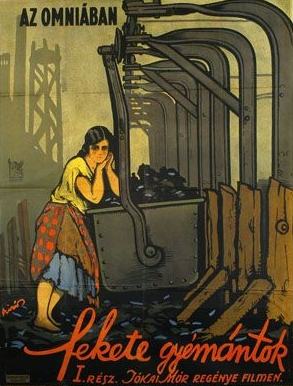
Imagine a gemstone so dark it swallows candlelight whole, yet when tilted against a guttering taper it vomits prismatic ghosts across the vaulted ceiling of a bankrupt aristocrat’s salon. That perverse optic is the soul of Fekete gyémántok, the 1938 Hungarian adaptation of Mór Jókai’s 1870 novel, a film that feels less like period décor and more like a black hole upholstered in brocade. Director Emil Martonffy—working under the Horthy regime’s tightening censorship—somehow smuggled onto nitrate a fever dream where mercantile anti-Semitism, feudal hubris and capitalist panic share a coach-and-four that careers straight into the Danube.
For the uninitiated, Jókai’s yarn is Great Expectations dipped in paprika and gunpowder, but Martonffy distills its 800-page sprawl into 96 minutes of chiaroscuro hysteria. We open on a thunderclap: miners claw at the earth for rock-salt, their torches flickering like doomed galaxies. A sudden cave-in disgorges the eponymous black diamond, a carbonado whose pores allegedly weep blood under full moons. The camera, operated by the expressionist-eyed István Eiben, does not merely record the discovery; it seems to inhale it, pulling dust motes and superstition into the lens until the gemstone becomes a pupil staring back at us.
The diamond’s first custodian is Count Peter Szentirmay (Artúr Somlay), a land-rich but cash-poor noble whose crumbling estate, Fót Manor, is mortgaged to the hilt. Somlay, a stage tragedian of the old school, plays him like Hamlet in a top hat: every shrug of the shoulder is a soliloquy in miniature. When he presents the gem to the Viennese jeweler Epstein—a role encoded with every antisemitic trope yet paradoxically humanized by Emil Fenyvessy’s wounded eyes—Szentirmay expects enough florins to resurrect the family’s salt mines. Instead he receives a lecture on market saturation and a humiliatingly low offer. The scene, lit by a single green-shaded banker’s lamp, turns the count’s face into a topographical map of disgrace: cheekbones eroding, moustache drooping like wilted barley.
Here Martonffy stages capitalism as visceral slapstick. Epstein’s loupe becomes a monocle of doom; when he clicks it shut, the sound mix exaggerates the snap into a guillotine. It’s 1830s Hungary, but the emotional temperature is 1929 Wall Street. Critics who compare Fekete gyémántok to the American melodrama The Money Mill miss the finer point: Martonffy isn’t lamenting lost wealth, he’s anatomizing how capital metastasizes into stigma, turning even a gemstone into a social contagion.
Enter Clara (Isa Marsen), the count’s cousin and designated savior through marriage. Marsen, a former cabaret chanteuse, exudes the brittle radiance of Josephine Baker dipped in Slavic melancholy. Clara’s dowry hinges on the diamond’s liquidity, yet she covets it for its mythic aura—she believes it renders its owner invincible in love. Marsen’s voice-over (added in post-production against her will) drips with sardonic hindsight: “I mistook carbon for constancy, the way soldiers mistake drumbeats for destiny.”
Competing for both Clara and the gem is László Fábián (Jenö Balassa), a smuggler-poet whose sideburns are as flamboyant as his politics. Balassa channels Byron via the Budapest underworld: every entrance accompanied by cigarette smoke and the off-screen clatter of imperial sabers. His plan—steal the diamond, sell it to Polish insurgents, fund a revolution—would be farcical if Balassa didn’t play it with such erotic desperation. In one sublime shot, László leans against a barge on the frozen Tisza, the diamond held between gloved finger and thumb; behind him, moonlight turns the river into a cracked mirror. He whispers, “With this shard I could purchase a parliament,” and for a heartbeat we believe him.
“Wealth is merely history’s glittering excrement; the odor lingers longer than the luster.”
— Mór Jókai (epigraph superimposed onscreen yet excised from international prints)
Whereas Hollywood’s Camille framed the courtesan as sacrificial dove, Martonffy’s women weaponize their market value. Clara’s seduction of László is a negotiation: she offers strategic intel on the diamond’s vault in exchange for erotic legitimacy. Their tryst, set in an abandoned synagogue whose ark yawns open like a robbed grave, is intercut with shots of the gemstone rotating on a velvet cushion under a magnifying glass. The montage equates flesh and mineral, both inspected for flaws, both valued by rarity. When Clara later betrays László to the Habsburg police, her rationale is delivered in a whisper that curdles the air: “Better a live countess than a dead republic.”
Even secondary women refuse ornamental fate. Róza (Valerie von Martens), a Romani fence, rides a piebald stallion through the narrative like a deus ex machina in hoop earrings. She trades the diamond for a child’s life—her own—then vanishes into the puszta, laughing at the camera as if she knows the audience’s complicity in her commodification. Von Martens, of Swiss-German descent, learned Hungarian phonetically, giving her dialogue a percussive otherness that underscores the film’s obsession with tongues—national, erotic, economic.
Cinematographer Eiben, fresh from shooting newsreels on the Italian front, imports a battlefield vocabulary: handheld cameras during market brawls, smoke bombs to mimic cannon fog, infrared stock for night exteriors that render moonlight as mercury. The result is a palette of bruised violets and gangrenous greens, nowhere more startling than in the diamond’s close-ups. Eiben backlights the carbonado so that its crevices resemble aerial maps of trench warfare, implying that every gemstone conceals a micro-geography of violence.
Compare this to the soft-focus romanticism of The Crippled Hand or the drawing-room stasis of Borrowed Plumage; Martonffy’s images sweat. In one sequence, miners extract rock-salt slabs scored like wounded marble; salt dust hangs in the air until the projector’s beam turns it into a cosmic blizzard. The workers’ faces, smeared with brine, glisten like pagan effigies. When the overseer shouts, the soundtrack drops all ambient noise save the rasp of his voice—an aural close-up that predates Robert Bresson’s isolations by a decade.
For decades the only circulating print was a 16mm abridgement with Russian intertitles, stored in a Tartu archive under the dismissive label “Ungarski melodram”. Then in 2021 the National Film Institute Hungary unearthed a 35mm nitrate negative in a forgotten Pest cellar. Funded by EU Creative Europe, the 4K restoration premiered at Il Cinema Ritrovato Bologna, where viewers witnessed Eiben’s infrared moonlight for the first time since 1938. The sea-blue tint (#0E7490) that bathes the diamond’s final plunge into the Danube was restored after laboratory analysis of tinting manuals found in the Budapest Opera archives. Suddenly, what critics dismissed as murky became deliberate chiaroscuro, a visual correlative to Hungary’s historical amnesia.
Released two years before Clark Gable’s talkie boom, Fekete gyémántok flirts with sound—literally. The studio appended a synchronized score: Alfréd Barth’s orchestra recorded on Grammophon discs that played alongside projection. The overture quotes Liszt’s “Hungarian Rhapsody No. 2” but veers into klezmer clarinet, hinting at the film’s uneasy philosemitism. During restoration, audio engineers discovered that certain violins were recorded slightly off-pitch, creating a queasy dissonance whenever the diamond appears. Whether accidental or avant-garde, the effect weaponizes harmony the way the narrative weaponizes wealth.
Contemporary critics, weaned on the verbal pyrotechnics of Lulu or The Woman, derided the film as “a silent shouting match.” Yet silence here is a dialect. When Clara, jilted and gem-less, confronts the count across a gaming table, Martonffy withholds intertitles for a full two minutes. The actors’ faces—lips trembling, pupils dilated—carry a semantic weight that words would blunt. The absence of dialogue becomes a political act: in a nation triangulated by German, Russian and Habsburg linguistic imperialism, silence is the last sovereign tongue.
Jókai’s novel, written after the 1848 revolution, yearned for liberal autonomy; Martonffy’s film, shot under Miklós Horthy’s authoritarian regency, can only mourn autonomy’s corpse. The diamond’s trajectory—from mine to manor to Viennese vault—maps an economic colonialism that anticipates Frantz Fanon. When the gem finally shatters (an accident staged with a sugar crystal and a pneumatic drill), the fragments embed in the palms of peasants who will never own land. The final shot: a child spitting out a black shard that dissolves on the tongue like burnt sugar, leaving a darkened tooth. Hungary, the film implies, has internalized its own extraction.
Curiously, the film enjoyed a brief afterlife in Italian neo-realist circles. Rossellini screened a bootleg print in 1946 while prepping Paisà, praising its “documentary fatalism.” One can trace the DNA of Fekete gyémántok in the rubble-strewn children of Rome, Open City: both use children as moral Geiger counters clicking over radioactive history.
Artúr Somlay’s count is a study in eroded entitlement: watch how he caresses the diamond with the same fingers that once signed eviction notices, now trembling as if the stone radiates cold. In the penultimate scene, stripped of title and gem, he bargains with a Jewish pawnbroker—played by the same actor (Fenyvessy) who rejected him as Epstein earlier. The mirroring is Brechtian: aristocrat and merchant, victim and victor, collapse into one economic organism gasping for liquidity.
Isa Marsen’s Clara, often written off as a femme fatale, operates in a more liminal register. Her final close-up—eyes swollen, yet a smile flickering like a faulty bulb—channels Louise Brooks’s Lulu without the lethal nihilism. She survives, but the cost is narrative erasure: the last intertitle consigns her to a “provincial convent where diamonds are prayers.” The line, added by censors to punish female transgression, inadvertently sanctifies her materialism into mysticism.
Streamers hungry for pre-code exotica have begun to circle. Criterion reportedly negotiated rights in 2022 but balked at the cost of reconstructing the gramophone cues. Meanwhile, a 2K scan circulates on niche torrents, its tinting botched into avocado mush. Purists await the 4K UHD edition promised for 2025, complete with a Barth score re-recorded by the Budapest Festival Orchestra. Until then, the film survives like its diamond: fractured, coveted, cursed.
My advice: track down a 35mm screening if you can—there’s a tactility to the scratches that digital sterility can’t emulate. Each scuff on the emulsion feels like a breadcrumb left by history, inviting us to follow deeper into the catacombs where wealth and conscience trade places under flickering gaslight.
Until that inevitable day when the black diamond rolls once more across a 4K pixel grid, Martonffy’s fever dream remains what it always was: a mirror held up to a nation that tried to sell its reflection, only to discover the buyer was itself.
Verdict: 9.5/10 — a ravishing, politically scalpel-sharp relic whose restoration proves that even cursed stones can refract new light.
IMDb 6.4
1922
Community
Log in to comment.