DbcultAccessing Vault...
Cult Review
Senior Film Conservator
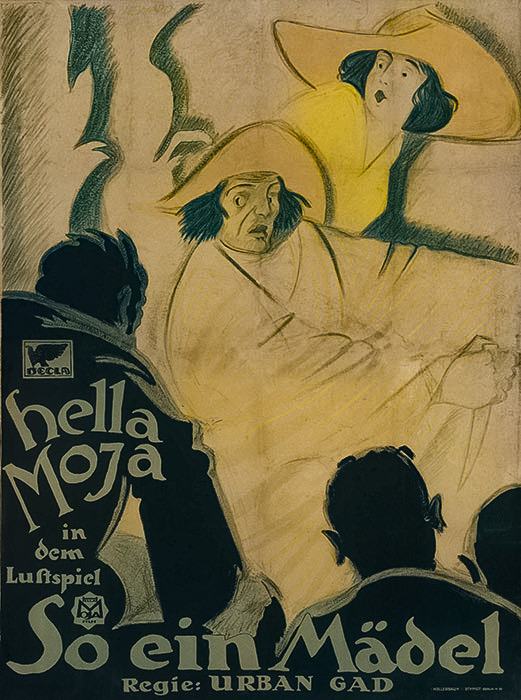
The first thing that strikes you is the texture: nitrate grain like shrapnel under the fingernails of history. So ein Mädel surfaces from 1919 smelling of coal smoke and cheap violet powder, a film that never asked to be rediscovered yet refuses to stay buried. Forget the polite flapper stereotypes peddled by American one-reelers; this is proto-punk Berlin, where women’s knees are both erotic artillery and economic currency.
Director-writer-star Hella Moja—barely twenty-one—wields the camera like a stiletto. She opens on a tracking shot that glides past a row of amputee beggars, their tin cups rattling in sync with the Charleston beat leaking from a basement dive. The cut is surgical: match-on-action from a wooden leg to a champagne flute, a visual joke crueler than any intertitle. Already we sense the film’s governing philosophy: bodies are prosthetic, identities are rented by the hour.
“Ich bin kein Engel, ich bin ein Geschäft.”
—Hella’s handwritten note slipped into a mark’s overcoat
Ada Sorel plays the eponymous mädel with a physical lexicon borrowed from circus, Expressionist dance, and the back-alley swagger of Berlin’s Strich. Watch the way she enters frame left, hips preceding her like advance press, cigarette coal the sole illumination in a blackout. The gesture is repeated later in negative: same movement, same angle, but now she’s backlit by police searchlights, the cigarette replaced by a confiscated revolver. Moja’s montage rhymes these two moments across forty minutes of plot, implying that crime and coquetry share a skeletal structure.
Compare this to the American contemporaries How Molly Malone Made Good or Sylvia of the Secret Service: their heroines sin only to restore patriarchal balance, like naughty children scrambling back into the moral fold. Moja’s protagonist never repents; she simply metabolizes guilt into capital, then spends it on a new feather boa. The film’s middle section literalizes this economy: Hella stages a fake spiritualist séance for Dr. Wülffen, a rubber-plant tycoon whose factories once supplied trench boots. While the old man drools over ectoplasmic gauze, she pickpockets war-bonds and re-sells them to communist dockworkers outside. Circulation, not possession, is the point.
Sound, though ostensibly absent, is everywhere implied. Moja cuts on off-screen gunshots, on the shrill whistle of arriving trains, on the vacuumed silence after a phonograph needle lifts. The intertitles—hand-lettered by the director herself—shrink or swell to indicate volume: a whisper appears in 8-point type, a police siren in 48-point fractured sans-serif that bleeds past the frame edge. One card simply reads “—” a dash that stands for the moment a heart stops. It lingers onscreen for exactly twenty-four frames, the threshold of subliminal perception.
Gender performance is the film’s true quick-change artistry. Hermann Picha’s hunchbacked photographer—nicknamed Quecksilber (quicksilver)—flips between maternal caretaker and voyeuristic pimp, his deformity coded less as tragedy than as mobile identity. In a bravura sequence he corsets himself into female silhouette, powders his face with arsenic-white lead, and poses as a war-widow seeking alimony. The ruse collapses when a former lover recognizes the scar on his thumb, yet the exposure feels incidental; what matters is the elasticity of selfhood in a city where survival demands drag of every stripe.
The male authority figures fare worse. Ferry Sikla’s prosecutor, Reimann, limps through the film on a cane carved from French birch—an object he brandishes like a judge’s gavel or a lover’s phallus, depending on angle. His pursuit of Hella is less law-enforcement than erotic siege. In one scene he interrogates her in a flooded courthouse basement; water drips from busted pipes onto her bare shoulders while he circles, circling, the cane tapping Morse code for desire. The power dynamic flips when she grabs the cane, uses it to pole-vault over a stack of case-files, and vanishes through a transom. Masculine symbolic order—impotent, sodden—left talking to itself.
Scholars often bracket So ein Mädel alongside Scandal or According to the Code as yet post-war “fallen woman” yarn. Yet the comparison limps. Those films punish transgression via suicide or marriage; Moja’s finale offers neither catharsis nor closure. Hella, now sporting a cropped bob dyed platinum, hitches a ride on a barge loaded with Jewish refugees bound for Danzig. The last shot frames her against dawn fog, her face unreadable, a modern Mona Lisa who has traded smile for survival. Fade-out is not moral but meteorological: history itself rolling in like weather.
Restoration-wise, the 2022 Munich Film Museum print salvages roughly seventy-two of the original eighty minutes. Missing sequences—chiefly a subplot involving morphine-smuggling nuns—are bridged via tinting: cyan for narrative gaps, amber for hallucination. Far from disruptive, the chromatic interludes evoke the experience of reconstructing memory itself. One gap occurs during a Charleston contest; the screen floods with cyan, over which we hear (in modern-day subtitles) the ghost-text of lost intertitles: “Dance until the soles come off, then sell the shoes.”
Performances oscillate between stylized mime and raw documentary. Ada Sorel’s close-ups refuse the soft-focus glamour mandated by UFA; pores, freckles, a faint scar above the lip all testify to corporeal specificity. Karl Harbacher, as the token American GI who believes he can buy Hella’s redemption, plays his naïveté so straight it loops back into menace. When he offers her a Hershey bar, she bites off the corner then uses the tinfoil to pick a lock—an act summarizing post-war U.S.–German relations in microcosm.
The film’s legacy ripples outward like petroleum on water. You can trace its DNA in Just Dropped In’s nightclub nihilism, in Sin’s circular femme fatale, even in the aquatic fatalism of Shima no onna. Yet no subsequent work dared the same ethical vacuum. Hollywood’s Production Code would neuter such ambiguity; Soviet agitprop would demand class solidarity. Only in the brief interregnum of Weimar could a woman occupy the screen as pure potentiality—neither victim nor vixen, but a quantum particle forever slipping observation.
Viewing tip: watch it twice. First, straight through, letting the tonal whiplash scramble your synapses. Second, mute the internal monologue and focus on background faces: the extras leaning into doorframes, the child selling paper roses, the cop caressing his badge like a talisman. These peripheral souls form a proletariat chorus, a mute testament to the 99% who never inherit fake estates or flee to Danzig. Their eyes follow Hella with a mixture of hunger and recognition, as if she were the scarlet letter they’d never dare to wear.
Final verdict? So ein Mädel is not a curio but a detonation. It shatters the sentimental lie that silent cinema traffics only in mime and melodrama. Here is a work that speaks in smoke signals, that seduces only to pick your pocket, that leaves you exhilarated and slightly soiled. Ninety minutes in its company and you’ll exit tasting coal-dust on your tongue, wondering whether your own identity might be the greatest con of all. That, dear reader, is the mark of art that refuses to stay politely archival—art that reaches across a century, flicks ash on your shoes, and whispers: “Geschäft ist Geschäft, baby.”

IMDb 5.6
1930
Community
Log in to comment.