DbcultAccessing Vault...
Cult Review
Senior Film Conservator
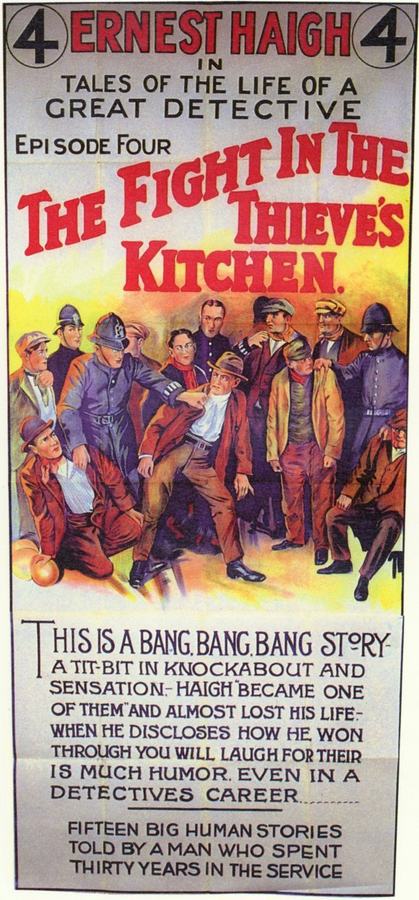
A guttersnipe symphony scored by the hiss of hot fat and the scrape of knives on bone—this is the milieu Frank Miller and Ernest Haigh cook up in Fight in a Thieves' Kitchen, a 1924 British one-reeler that feels like Dickens ladled into a copper pot and left to scorch.
Charles Danvers, equal parts matinee idol and soot-smudged Lucifer, glides through the film with the languid menace of a man who has memorised every rat-run in Limehouse. His coat tails trail cigarillo embers that briefly star the gloom like fireflies caught in a gin-trap. Opposite him Suzanne Morris—petite, perilous—uses stillness as weapon; when she lowers her lashes the whole frame seems to inhale, waiting for a purse to vanish or a throat to be cut.
The plot, deceptively simple, is a Möbius strip of double-crosses. A ledger—its parchment freckled with blood—lists every fence, every bribe, every throat slit for profit. Whoever owns the book owns the gang; whoever loses it buys a shallow grave on the Thames embankment. Benstead’s hulking treasurer believes muscle suffices; Haigh’s weasel-eyed tout thinks information is king. Both learn that in this kitchen the ladle stirs whoever holds the sharpest blade, not the broadest back.
Shot largely in a Clerkenwell cellar reeking of authentic mildew, the cinematographer (uncredited, as was too common in budget Brit-pictures) squeezes chiaroscuro from a single overhead gas-jet. Shadows pool like spilled stout; faces emerge as half-finished death masks, eyes glimmering with the sickly gold of the amber gaslight. There is no glamour here—only the greasy glamour of survival.
Compare this to The Bull's Eye where American opulence buys wide boulevards, or the pastoral fatalism of Op hoop van zegen. The thieves’ kitchen rejects both daylight and destiny; its philosophy is immediate—grab, gulp, vanish.
Danvers delivers lines as though each syllable costs a sovereign—his voice never rises above a murmur yet fills the cramped space like rising tide. Watch the way he fingers a dented sovereign, rolling the coin across knuckles scarred by erstwhile brawls; it is a masterclass in micro-gesture, predating James Cagney’s coin-flipping menace by a full decade.
Morris, given less dialogue, weaponises the pause. In a pivotal close-up she listens to a comrade condemn her to death; the corner of her mouth twitches—half smile, half sneer—before she flicks ash into his teacup. It is the most eloquent f***-you silent cinema has to offer.
Miller and Haigh’s intertitles eschew polite English. We get “nose-painting ken,” “doxy with a fam-lay tongue,” “rum kens where the bub’s too brisk.” The slang arrives in rhythmic bursts, almost iambic, demanding you lean forward as though eavesdropping in an alley. The effect is a linguistic tinnitus—once heard, it rattles around the skull long after the final reel.
Yet beneath the cant beats a universal pulse: the terror of anonymity, the ache for loyalty in a world where loyalty is just another commodity. When Danvers rasps, “A man ain’t worth the price of his boots once his shadow’s sold,” the line echoes across a century of gig-economy precarity.
Being a silent film, Fight in a Thieves' Kitchen relies on ambient suggestion: the creak of a rope, the sizzle of a lamp wick drowning in its own fat. Contemporary exhibitors often enlisted a solitary pianist to hammer out dissonant chords; in today’s vaulted archives the film screens to the rustle of film-stock, the collective held breath of an audience terrified to blink lest they miss a glint of steel.
Curiously, the absence of synchronized dialogue amplifies olfactory hallucination—you swear you smell mutton gone rancid, cheap gin, the copper tang of fear. Such synaesthesia is rare; compare it only to the opium haze evoked by The Opium Runners or the gun-smoke grime of Dead Shot Baker.
Scholarship often pigeonholes silent crime films as boys’-own bloodletting. Morris upends that. Her character, never named beyond “the Duchess,” commands through strategic vulnerability: a lowered veil here, a whispered false confession there. In the film’s bravura set-piece she negotiates her life for the ledger by offering to marry the gang’s most sadistic enforcer—then slips ground glass into his brandy. The marriage that might have been her coffin becomes his.
Such proto-feminist guile predates the more overt rebellion of Elaine in The Romance of Elaine yet feels rawer, less scripted by male saviours.
At a brisk 58 minutes, the narrative hurtles like a stolen cab down Fleet Street. Yet the filmmakers know when to decelerate: a 40-second shot holds on steam rising from a cracked teacup while off-screen a man is garrotted—we hear only the scuff of boots, see only the dissipating vapour. That ellipsis, more savage than any on-screen murder, teaches that violence in suggestion festers longer than gore splashed on lens.
For decades the film was thought lost—one more casualty of nitrate neglect. Then in 2018 a truncated 35 mm print surfaced in a Hobart salvage yard, tucked inside a crate labelled “Pickled Herrings.” The National Film Archive of Australia spearheaded a 4K scan, grafting new English intertitles where Australian censors had snipped. While several minutes remain missing—chiefly a sub-plot involving a corrupt beat cop—what survives is coherent enough to bruise.
Streaming? Sadly, no major platform hosts it. The restored reel tours cinematheques under the auspices of an NFTS curator; check regional listings or badger your local arthouse. A Blu-ray is rumoured for 2025, provided music-rights resolve over the intended Erik Satie adaptation that now scores some prints.
Place Fight in a Thieves' Kitchen between the urban fatalism of The Clue and the swashbuckling derring-do of On the Fighting Line—it inherits the soot of the former, rejects the heroism of the latter. Unlike the redemptive arc in The Virtuous Thief, nobody here seeks salvation; they court coin, carnality, and the ephemeral high of not-yet-being-caught.
Minor imperfections—missing footage, occasionally too-lit close-ups—cannot dull the film’s jagged edge. It is a time-capsule of post-war disillusion, a precursor to the noir cynicism that would bloom once sound allowed cigarettes to sizzle and femme fatales to purr. Most crucially, it reminds that crime cinema need neither glamour nor moral sermon; sometimes the clatter of pots and the whispered promise of a purse suffice to hold us hostage.
Seek it out, if only to witness how Charles Danvers tips his hat before disappearing into fog so thick you could butter it onto bread. You will exit the screening, nose wrinkling at imaginary grease, ears ringing with argot you never learnt yet somehow understood. And, like any good mark, you’ll find your own wallet suddenly weighs less—pilfered not by pickpockets but by the larceny of art that steals certainty and leaves delicious doubt.

IMDb 7
1927
Community
Log in to comment.