DbcultAccessing Vault...
Cult Review
Senior Film Conservator
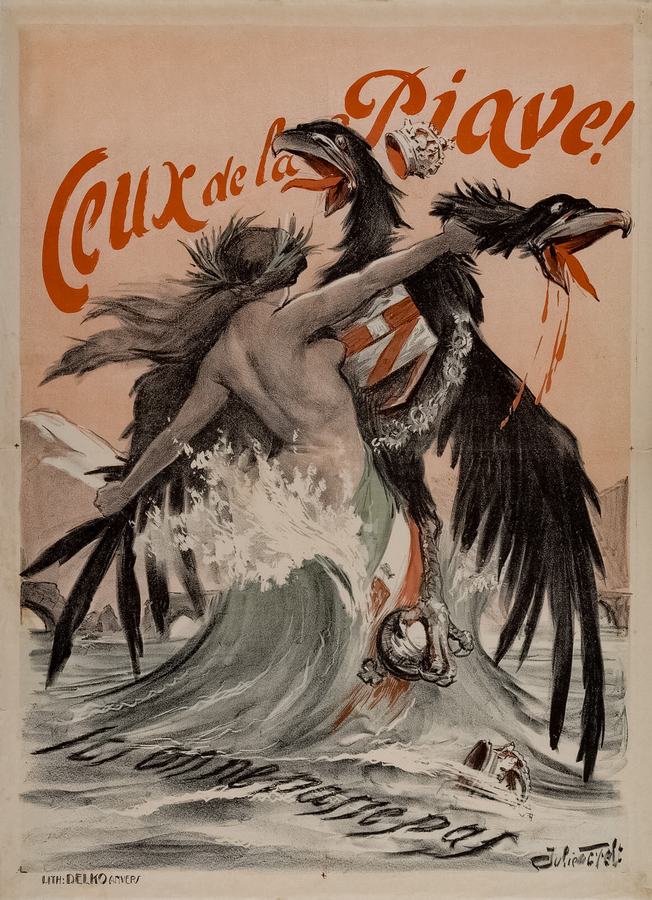
To gaze upon Fighting Along the Piave is to witness the birth of the modern ocular obsession with catastrophe. While the 1910s were largely defined by the burgeoning narrative sophistication of works like Louis Feuillade’s Les Vampires or the escapist intrigue of Ultus 5: The Secret of the Night, the official combat footage emerging from the Italian front operated on a different ontological plane. This isn't merely a film; it is a celluloid scar, a frantic attempt to document the dissolution of empires through the hand-cranked lens of the Italian military's photographic department. The sheer physicality of the footage—the grain, the erratic frame rates, the chemical erosion of the stock—mirrors the erosion of the landscape it seeks to depict.
The documentary’s most striking element is its treatment of the Alpine environment. Unlike the staged drawing rooms of Signori giurati... or the domestic settings of Bab's Burglar, the theater of the Piave is one of sublime, terrifying indifference. The camera captures the gargantuan effort required to winch cannons up sheer rock faces, a labor that feels Sisyphian in its intensity. Here, the Great War is revealed not just as a conflict of ideologies, but as a war against geology. The limestone crags of the Dolomites are not merely backdrops; they are active combatants, splintering under shellfire to create lethal shrapnel long before the steel fragments even reach their targets.
The film captures the peculiar, agonizing stillness of the front lines—a silence that the viewer’s mind fills with the imagined roar of the 149mm guns. There is a sequence involving the crossing of the river that feels remarkably modern in its framing. We see the churning water, the precarious pontoon bridges, and the soldiers—tiny, ant-like figures—contending with the literal and metaphorical flow of history. It lacks the polish of Cy Whittaker's Ward, but it gains a terrifying authenticity that no studio reconstruction could ever hope to replicate.
One must approach Fighting Along the Piave with a critical eye toward its origins. As official footage, it was curated to bolster national morale and demonstrate Italian resilience after the disastrous retreat from Caporetto. However, the camera is a disobedient witness. Even within the framework of state-sanctioned messaging, the reality of the soldiers' exhaustion leaks through the frames. Unlike the polished heroism found in The Honorable Algy or the moralizing narratives of A Man's Prerogative, the faces in this documentary are hollowed out by the 'white war' of the mountains. They are men who have seen the sun rise over peaks that they know will likely become their gravestones.
The editing of the film—likely rudimentary and utilitarian at the time—creates a jarring, modernist collage. We jump from the industrial precision of shell manufacturing to the chaotic, mud-caked reality of the trenches. This juxtaposition highlights the terrifying disconnect between the 'home front' and the 'killing zone.' It reminds me of the psychological fragmentation seen in The Face in the Dark, though here the darkness is not a mystery to be solved but a condition to be survived. There is no detective to unravel the plot; there is only the relentless progression of the barrage.
Technically, the film is a marvel of endurance. Consider the weight of the cameras in 1918—bulky, wooden boxes with heavy glass lenses and metal tripods. Carrying this equipment into active combat zones required a bravery that bordered on the suicidal. The cinematographers of the Piave were pioneers of a visual language that would later be refined by the likes of Vertov and Eisenstein. They understood instinctively that the power of the image lay in its movement. The panning shots across the devastated No Man’s Land offer a panoramic view of destruction that predates the wide-screen epics of later decades.
In comparison to the static, stage-bound compositions of Eva or the theatrical posturing in Lucciola, Fighting Along the Piave feels shockingly alive. The dust and smoke of the explosions aren't the controlled pyrotechnics of a film set; they are the debris of a civilization tearing itself apart. When the camera shakes during a nearby impact, the fourth wall isn't just broken—it is obliterated. We are no longer spectators; we are participants in the panic.
While the film emphasizes the machinery of war—the massive naval guns adapted for land use, the armored trains, the reconnaissance planes—it is the fleeting glimpses of the individual soldier that resonate most deeply. We see them eating in the snow, their hands trembling from cold or shell-shock. We see the camaraderie born of shared proximity to death. These moments are far more poignant than the scripted tragedies of Ashes of Love. There is a raw, unvarnished dignity in their gaze as they look directly into the lens—a gaze that asks the future viewer to acknowledge their existence before they vanish into the maw of the conflict.
The film also captures the surreal beauty that war occasionally produces. The flares lighting up the night sky over the river, the geometric patterns of the trenches seen from an aerial perspective—these are images of a dark, terrible splendor. They evoke the exoticism of Paradisfågeln but transpose it into a nightmare of barbed wire and gas masks. The aestheticization of war is a dangerous game, yet Fighting Along the Piave manages to balance the visual allure of its scale with the grounding reality of its human cost.
As we look back from a century’s distance, the film serves as a vital corrective to the sanitization of history. It reminds us that the WWI Italian front was not a secondary theater, but a brutal, high-altitude struggle that pushed human endurance to its absolute limits. The footage of the Piave flood, which famously aided the Italian defense by sweeping away Austrian bridges, is a rare instance where nature itself intervened in the tactical maneuvers of man. This isn't the whimsical fantasy of The Brass Bottle; it is the terrifying unpredictability of the elements.
The documentary also highlights the evolution of surveillance. The inclusion of aerial photography suggests a new way of seeing the world—from a god-like, detached perspective that would eventually lead to the drone warfare of the 21st century. It is a far cry from the grounded, character-driven mysteries of The Dazzling Miss Davison. In the Piave, the individual is subsumed by the mass, and the mass is subsumed by the map.
Ultimately, Fighting Along the Piave is essential viewing for anyone seeking to understand the visual DNA of the 20th century. It lacks the narrative resolution of The Desert Man, but it offers something far more valuable: a direct, unmediated encounter with the past. It is a film that demands we look, even when we wish to turn away. It captures the transition of the world from the Victorian era into the industrial age, a transition mediated by the roar of the Piave and the whistle of incoming shells.
In the silence of the archival footage, one can almost hear the echoes of a generation’s screams. It is a masterpiece of circumstantial art, where the 'director' is chance and the 'set designer' is devastation. To watch it is to participate in a secular ritual of remembrance, stripped of the flag-waving jingoism that often plagues military history. It is a stark, monochromatic reminder that while the river continues to flow, the men who fought along its banks are long since dust, leaving only these flickering shadows as proof of their struggle.
The preservation of such footage is a triumph over the natural entropy of film. Every frame that survives is a victory against oblivion. As we navigate our own era of digital saturation and manipulated truths, the raw, undeniable presence of Fighting Along the Piave stands as a bulwark of reality. It is a testament to the power of the moving image to not just tell a story, but to hold a mirror to the most harrowing chapters of the human experience. It remains, over a hundred years later, an indispensable artifact of our collective memory.
IMDb 4.7
1935
Community
Log in to comment.